The Ottomans after conquering Bulgaria had excluded…
1636 CE to 1647 CE
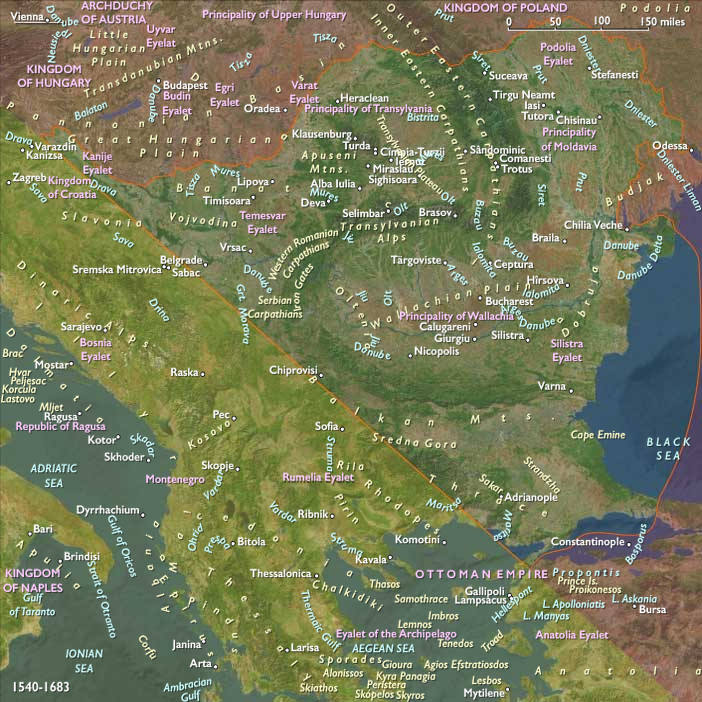
The Ottomans after conquering Bulgaria had excluded a number of key regions, towns and villages from the Ottoman administrative system, leaving these to be governed by the Old Bulgarian administration for practical reasons.
Some of these towns guard the Balkan passes, others are important ore extraction areas, like the village of Chiprovtsi, where the Christian Bulgarian aristocracy seems to have retained most of its authority.
Chiprovtsi during the sixteenth century had become a has (a permanent possession) of the sultan's family and later a valide hanım (estate of the sultan's mother).
Christian Bulgarians had possibly inherited the rights of self-government from the Second Bulgarian Empire and adapted these to the Ottoman military feudal system, but the Sublime Porte has curtailed these rights significantly in the previous and current centuries.
Concurrent with the mid-century Counter-Reformation in Western Europe, the circle of the pro-Western Chiprovtsi nobility develop the idea of using Catholicism as a way to restore the Bulgarian state with the aid of the Catholic West.
To this end, Petar Parchevich, a highly educated Bulgarian Catholic cleric and diplomat, has undertaken a large-scale diplomatic campaign among the Christian rulers of Central Europe between 1630 and 1645.
Together with Petar Bogdan and Franchesko Soymirovich, Parchevich has visited Austrian monarch Ferdinand II, the king of the Polish-Lithuanian Commonwealth Sigismund III Vasa, and his heir, Wladyslaw IV Vasa, as well as the Wallachian voivode, Matei Basarab.
The Ottomans around 1647 withdraw almost entirely from northwestern Bulgaria in relation to their war with Venice for Crete.
Locations
Groups
Commodities
Subjects
Regions
Southeast Europe
View →Subregions