Construction of the Pont Notre-Dame in Paris…
1500 CE
Construction of the Pont Notre-Dame in Paris (c. 1500)
Around 1500, construction of the Pont Notre-Dame, a significant masonry arch bridge spanning the Seine River in Paris, was completed under the guidance of renowned Italian architect and Franciscan scholar, Fra Giovanni Giocondo. Situated at the historical crossing point once occupied by Paris's earliest known bridge, the Grand-Pont, the new bridge symbolized both continuity with the city’s ancient foundations and the arrival of Renaissance architectural sensibilities into the heart of Paris.
The original bridge at this site, known as the Grand-Pont, had stood since medieval times, subsequently replaced by a wooden bridge named "Notre-Dame" by order of King Charles VI in 1412. Completed over seven years, the earlier wooden structure had famously supported a bustling row of sixty houses. However, structural neglect and subsequent deterioration led to its dramatic collapse due to instability in 1499, prompting the immediate need for a sturdier replacement.
The new Pont Notre-Dame, built of durable stone rather than wood, represented a strategic shift toward long-term infrastructural stability and durability. Its solid stone foundations and elegant arches reflect the increasingly sophisticated integration of Renaissance engineering principles into French urban planning, illustrating the gradual adoption of Italian techniques north of the Alps. Fra Giovanni Giocondo’s design notably emphasized strength, stability, and permanence, a significant departure from the fragile wooden predecessors.
Cultural and Economic Significance:
This new Pont Notre-Dame maintained the tradition of supporting residential and commercial spaces atop its structure, with houses and shops once again lining its length. As a central artery connecting the Île de la Cité with Rue Saint-Martin, the bridge rapidly reestablished itself as a vibrant commercial and social hub, significantly enhancing Paris's urban infrastructure and economic vitality during a period of rising prosperity and population growth.
Consequences and Legacy:
The Pont Notre-Dame became an enduring symbol of Parisian resilience, urban development, and architectural innovation during the late medieval period. It underscored the broader transition in French architecture from medieval Gothic towards Renaissance forms and provided a vital model for future civic construction projects. The bridge thus played a lasting role in shaping the architectural heritage and urban landscape of Atlantic West Europe.
Locations
People
Regions
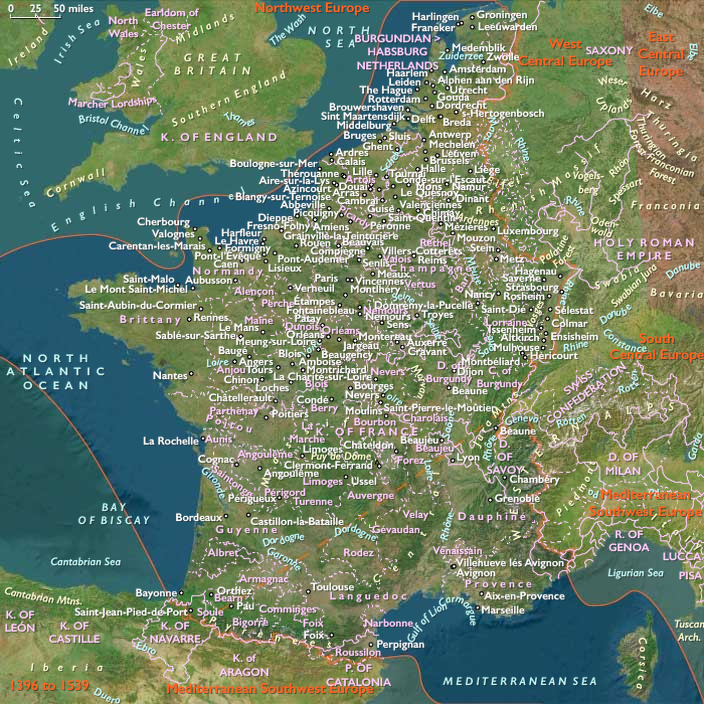
West Europe
View →Subregions