Sixteenth-century Portuguese Catholicism is intolerant, but perhaps …
Years: 1540 - 1683
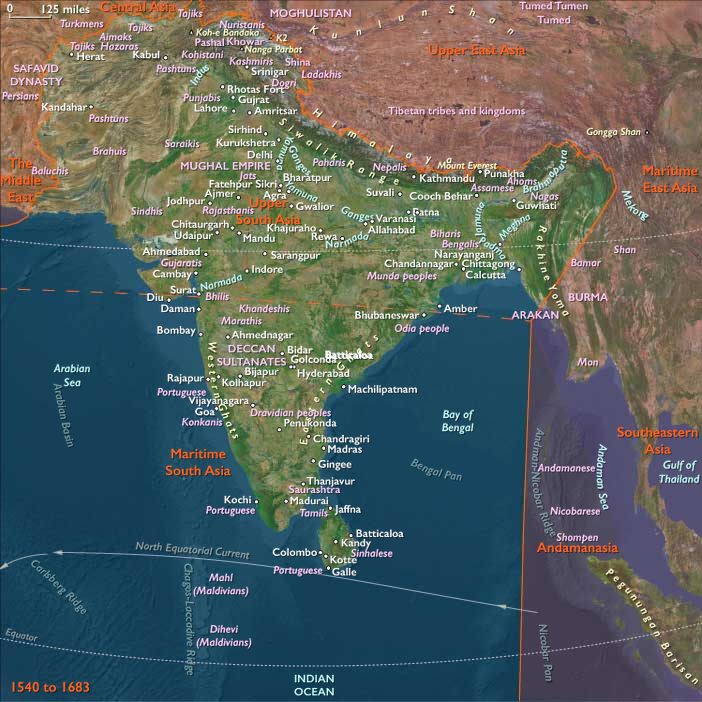
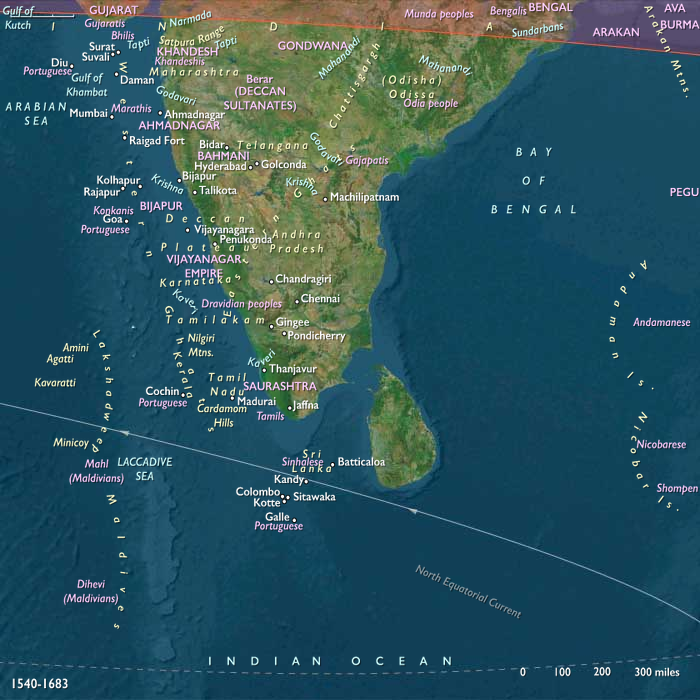
Sixteenth-century Portuguese Catholicism is intolerant, but perhaps because it had caught Buddhism at its nadir, it has nevertheless became rooted firmly enough on the island to survive the subsequent persecutions of the Protestant Dutch Reformists.
The Roman Catholic Church is especially effective in fishing communities—both Sinhalese and Tamil—and contribute to the upward mobility of the castes associated with this occupation.
Portuguese emphasis on proselytization spurs the development and standardization of educational institutions.
In order to convert the masses, mission schools are opened, with instruction in Portuguese and Sinhalese or Tamil.
Many Sinhalese converts assume Portuguese names.
The rise of many families influential in the twentieth century dates from this period.
For a while, Portuguese becomes not only the language of the upper classes of Sri Lanka but also the lingua franca of prominence in the Asian maritime world.
Locations
Groups
- Arab people
- Sinhalese people
- Buddhism
- Christians, Eastern (Diophysite, or “Nestorian”) (Church of the East)
- Islam
- Portuguese people
- Franciscans, or Order of St. Francis
- Jaffna, or Aryacakravarti, Tamil Kingdom of
- Portugal, Avizan (Joannine) Kingdom of
- Kotte, Sinhalese Kingdom of
- Portuguese Empire
- Kandy, Sinhalese Kingdom of
- India, Portuguese State of
- Sitawaka, Sinhalese Kingdom of
Topics
- Colonization of Asia, Portuguese
- Portuguese Conquests in India and the East Indies
- Portuguese Ceylon
- Jaffna kingdom, Portuguese invasion of
Commodoties
Subjects
Regions
Subregions
Related Events
Filter results
Showing 10 events out of 29 total
Northwest Europe (1540–1683 CE): Religious Turmoil, Colonial Expansion, and Political Transformation
Religious Turmoil and Conflicts
Between 1540 and 1683 CE, Northwest Europe was profoundly shaped by religious upheavals stemming from the Reformation. England experienced significant turbulence under Edward VI, Mary I, and Elizabeth I. Mary's Catholic restoration saw persecution of Protestants, earning her the title "Bloody Mary," marked notably by the burning of two hundred and seventy-four Protestants. Elizabeth I's moderate Anglican settlement established relative stability but intensified tensions with Catholic Spain, climaxing in the defeat of the Spanish Armada (1588). Scotland faced similar religious strife, culminating in the establishment of Presbyterianism under the influence of John Knox. Denmark became officially Lutheran around 1550 under King Christian III, solidifying Lutheranism's dominance throughout Scandinavia.
The English Civil War and Revolution
Political and religious tensions erupted in the English Civil War (1642–1651) between Royalists (Cavaliers) and Parliamentarians (Roundheads), ending with the execution of King Charles I and the establishment of a brief republican Commonwealth under Oliver Cromwell. Cromwell's subsequent military campaigns in Ireland (1649–1653) resulted in catastrophic losses, significantly reshaping Irish society. The monarchy was restored under Charles II in 1660, followed by political and religious instability under James II, culminating in the peaceful Glorious Revolution (1688), solidifying parliamentary authority and Protestant ascendancy.
Ireland: Conflict and Colonization
English colonization intensified significantly, notably through the Plantation of Ulster (1609) and the Tudor conquest initiated by Henry VIII's re-creation of the title King of Ireland in 1542. Irish resistance culminated in the Nine Years' War (1593–1603) and the consequential Flight of the Earls (1607). The Wars of the Three Kingdoms, particularly Cromwell’s conquest, inflicted severe demographic losses, including approximately two hundred thousand civilian deaths from famine, disease, and conflict-related displacement, and the forced indenture of fifty thousand to the West Indies.
Scottish Union and Cultural Renaissance
Scotland underwent significant religious and political upheaval leading to the Union of the Crowns (1603) under James VI of Scotland (later James I of England). Cultural and educational achievements flourished during the Scottish Renaissance, significantly enhancing Scottish literary and intellectual contributions.
Economic Expansion and Colonial Ventures
Economic transformations accelerated through colonial expansion, highlighted by English settlements such as Jamestown (1607) in North America, initiating extensive colonial activity. English immigration, particularly indentured servants, became prominent, with approximately seventy percent of arrivals between 1630–1660 as indentured labor. Trading companies, notably the East India Company (1600) and the Dutch East India Company (VOC, 1602), expanded global commerce, with London, Amsterdam, and Bristol emerging as key international trade hubs.
Scientific Revolution and Intellectual Growth
The era witnessed significant scientific breakthroughs and intellectual advancements. Figures like Francis Bacon, Robert Boyle, and Isaac Newton revolutionized natural philosophy, laying foundations for modern science. Institutions such as the Royal Society (1660) systematically promoted scientific inquiry and innovation.
Cultural Flourishing and Artistic Achievements
Cultural developments flourished significantly during this period. England’s literary scene was dominated by figures like William Shakespeare, contributing profoundly to drama and literature during the Elizabethan era, a period often regarded as England's golden age. Artistic accomplishments, notably by Dutch Golden Age painters like Rembrandt van Rijn and Johannes Vermeer, significantly influenced European art.
Norse Territories and Scandinavian Shifts
Iceland, under Danish-Norwegian control, formally adopted Lutheranism by 1550 following the execution of Catholic Bishop Jón Arason. The island continued facing severe economic and climatic challenges, significantly affecting societal structures and stability.
Environmental Challenges and the Little Ice Age
The Little Ice Age continued to exert considerable environmental pressures, severely impacting agricultural productivity across Northwest Europe. Societies adapted by diversifying economies, enhancing trade networks, and developing technological innovations to mitigate these stresses.
Social Unrest and Economic Pressures
Socio-economic disparities intensified, exacerbating rural and urban tensions, leading to frequent local uprisings and unrest. Economic shifts, agricultural crises, and urbanization pressures contributed significantly to social instability, prompting governmental interventions and reforms.
Legacy of the Age
By 1683 CE, Northwest Europe had experienced profound religious conflicts, political transformations, economic expansions, and cultural achievements. These dynamic developments deeply influenced regional identities, governance structures, economic conditions, and cultural traditions, firmly establishing frameworks that shaped modern Europe.

He also hopes to obtain another son in case something should happen to Edward.
Anne proves a dull, unattractive woman and Henry declines to consummate the marriage.
He quickly divorces her, and she remains in England as a kind of adopted sister to him.
So he marries again, to a nineteen-year-old named Catherine Howard, but when it becomes known that she was neither a virgin at the wedding, nor a faithful wife afterwards, she ends up on the scaffold and the marriage declared invalid.
His sixth and last marriage is to Catherine Parr, more a nursemaid to him than anything else, as his health is failing (it had declined ever since the jousting accident in 1536).
The war nets England the city of Boulogne, but nothing else, and the French retake it in 1549.
Scotland also declares war and at Solway Moss is once again totally defeated.
Henry's paranoia and suspicion worsen in his last years.
The total number of executions during his thirty-eight-year reign numbers in the tens of thousands.
He dies in January 1547 at the age of fifty-five and is succeeded by his son, Edward VI.
Northumberland makes plans to place Lady Jane Grey on the throne and marry her to his son, so that he can remain the power behind the throne.
His plot fails in a matter of days, Jane Grey is beheaded, and Mary I (1516–1558) takes the throne amidst popular demonstration in her favor in London, which contemporaries describe as the largest show of affection for a Tudor monarch.
Mary had never been expected to hold the throne, at least not since Edward was born.
She is a devoted Catholic who believes that she can turn the clock back to 1516, before the Reformation began.
Northwest Europe (1540–1551 CE): Reformation Consolidation, Monarchical Power, and Cultural Flourishing
England: Religious Consolidation under Henry VIII and Edward VI
The era was defined by continued religious reform and consolidation under Henry VIII and his successor, Edward VI. Henry VIII reinforced his break with Rome by dissolving the remaining monasteries and redistributing church properties, solidifying the Anglican establishment. Following Henry’s death in 1547, Edward VI ascended as a minor under the regency of the Duke of Somerset and later John Dudley, Duke of Northumberland. Under Edward, Protestantism advanced significantly through measures like the Book of Common Prayer (1549) and the Act of Uniformity, establishing Protestant worship and doctrine throughout England. Henry VIII also patronized the art of gun founding, significantly improving English artillery capabilities, notably through developing hollow shells filled with powder.
Scotland: Conflict and the Rough Wooing
Scotland faced considerable turmoil following the death of James V in 1542, shortly after the catastrophic Scottish defeat at the Battle of Solway Moss. His infant daughter, Mary, Queen of Scots, succeeded him, prompting regencies marked by political instability and intense diplomatic struggles. Henry VIII sought to enforce the marriage of his son Edward to Mary in the Rough Wooing, an aggressive campaign of border raids and invasions, escalating tensions and violence throughout the period.
Ireland: Continued English Expansion and Gaelic Resistance
English influence in Ireland expanded under successive Tudor administrations. In 1541, Henry VIII was declared King of Ireland by the Irish Parliament, transforming the medieval lordship into a full kingdom. This was intended to increase English legitimacy and authority but intensified opposition from Gaelic and Hiberno-Norman lords, who resisted efforts at centralization. The period saw ongoing military campaigns and rebellions, highlighting persistent tensions and the complexity of English rule in Ireland.
Scandinavia: Lutheranism and Royal Centralization
Scandinavian kingdoms further solidified Lutheranism and central royal power. In Denmark, Christian III institutionalized Lutheranism, consolidating royal control over ecclesiastical affairs and greatly diminishing the influence of the Catholic Church.
Iceland: Firm Establishment of Lutheranism
In Iceland, Lutheran reforms were rigorously enforced by Danish authorities, formally suppressing Catholic practices. Bishop Jón Arason, the last significant Catholic figure, strongly opposed the Danish-led reformation but was ultimately executed in 1550 along with two of his sons. His execution symbolized the decisive end of Catholic resistance and marked the firm establishment of Lutheranism in Iceland, profoundly reshaping its religious and cultural landscape.
Cultural and Intellectual Developments
Culturally, this period was marked by continued intellectual vigor. Humanist thought significantly influenced education and literature across the region. English writers, scholars, and reformers benefited from the spread of printed texts, which promoted literacy and the dissemination of Protestant theology. Architecturally, the Tudor style further evolved, prominently featuring symmetrical designs, decorative chimneys, elaborate fireplaces, and richly ornamented interiors.
Maritime Expansion and Exploration
Maritime ambitions continued to grow, particularly in England, where seafaring ventures and exploration became increasingly significant. English explorers sought new routes and commercial opportunities, laying early groundwork for later overseas expansion. Efforts in maritime technology, encouraged by Henry VIII's improvements in artillery, enhanced English naval capabilities.
Legacy of the Era
By 1551 CE, Northwest Europe had firmly entrenched Protestant reforms and centralized royal authority. These developments not only reshaped the region's religious and political landscapes but also fostered lasting cultural transformations. The consolidation of monarchical power, the enforcement of Protestantism, and burgeoning exploration initiatives significantly impacted Northwest Europe, setting a decisive stage for future historical developments.
Scottish reformer George Wishart, who may have graduated M.A., probably at King's College, Aberdeen, and was certainly a student at the University of Leuven, from which he graduated in 1531, had taught the New Testament in Greek as schoolmaster at Montrose, until investigated in 1538 for heresy by the Bishop of Brechin.
He had fled to England, where Thomas Cromwell had brought a similar charge against him at Bristol in the following year.
Under examination by Archbishop Thomas Cranmer, he had recanted some utterances.
He may have visited Germany and Switzerland in 1539 or 1540, but by 1542 he had had entered Corpus Christi College, Cambridge, where he studied and taught.
He returns to Scotland in 1543 in the train of a Scottish embassy that had come to London to consider the treaty of marriage between Prince Edward and the infant Mary, Queen of Scots.
He returns to Montrose, where again he teaches Scripture.
The much married Henry VIII, the red-haired king of England from 1509, has presided over the beginnings of the English Renaissance and the English Reformation, breaking his entire country from adherence to Roman Catholicism.
Greedy and despotic, Henry has squandered much of the nation’s resources on needless foreign wars, but has managed to the country together during a period of rapid change and factional strife.
He has also fostered the development of a sophisticated court in which fine artists and musicians find patronage.
His six wives are, successively, Catherine of Aragon (the mother of the future queen Mary I), Anne Boleyn (the mother of the future queen Elizabeth I), Jane Seymour (the mother of Henry's successor, Edward VI), Anne of Cleves, Catherine Howard, and Catherine Parr.
He had divorced Catherine of Aragon, his deceased elder brother's widow, who later died of natural causes, and executed, for alleged treasonable adultery, Anne Boleyn, who had also failed to produce a viable male heir.
Jane Seymour had died in childbirth, and Anne of Cleves, hated by Henry at first sight, had escaped him through a quick divorce.
Catherine Howard, who had foolishly continued her promiscuous ways despite being made Henry's queen, had ultimately followed Anne Boleyn to the executioner's block.
The calm and obedient Catherine Parr outlives Henry, who dies on January 28, 1547 at fifty-five, possibly from untreated Type II diabetes.
Henry Howard, who had introduced the sonnet form in England, had been beheaded a week earlier on a trumped-up charge of treason.
His father Thomas Howard, third duke of Norfolk, escapes execution because of Henry VIII's death, and is later pardoned.
Surrey leaves his translation of Books 2 and 4 of Vergil's Aeneid as the first example of blank, or unrhymed iambic pentameter, verse in English.
Upon Henry’s death, his nine-year-old son by Jane Seymour succeeds him as King Edward VI.
Henry’s will provides for the succession of his three children in the normal order, despite the fact that both daughters had earlier been excluded from the succession.
The will also provides that England shall be governed by a group of sixteen regents during Edward's minority.
Edward Seymour, earl of Hertford, sets this provision aside and assumes sole authority as his nephew’s protector.
John Dudley, another of the councilors named by Henry to rule during Edward’s minority, acquiesces in the assumption of power by Somerset.
Stephen Gardiner, the doctrinally conservative bishop of Winchester, does not, and is removed from the royal council, imprisoned, and deprived of his bishopric.
Protestant tutors continue the young king’s education.
Edward VI is a precocious child, who had been brought up as a Protestant, but is of little account politically.
His maternal uncle Edward Seymour, made Lord Protector, has been commissioned as virtual regent with near sovereign powers.
Made Duke of Somerset on February 15, he proceeds at first hesitantly, partly because his powers are open to challenge.
When he acts, it is because he sees the political advantage.
He too wishes to forcibly ally Scotland to England by marrying Mary to Edward, and to impose an Anglican Reformation on the Scottish church establishment.
Somerset dispatches ships and troops against Scotland, but meets with little success other than the occupation of Edinburgh.
England's 1547 Injunctions against images are a more tightly drawn version of those of 1538 but they are more fiercely enforced, at first informally, and then by instruction.
All images in churches are to be dismantled.
Stained glass, shrines, statues are defaced or destroyed; roods and often their lofts and screens are cut down, bells are taken down; vestments are prohibited and either burned or sold.
Church plate is to be melted down or sold and the requirement of the clergy to be celibate is lifted.
Processions are banned; ashes and palms are prohibited.
Chantries, means by which the saying of masses for the dead are endowed, are abolished.
How well this is received is disputed; Dickens contends that people had "ceased to believe in intercessory masses for souls in purgatory"; others, such as Duffy, argue that the demolition of chantry chapels and the removal of images coincided with the activity of royal visitors.
The evidence is often ambiguous.
Fifteen-year-old Princess Elizabeth has involved herself in an amorous episode with her stepmother’s widowed husband, Thomas, Baron Seymour of Sudeley.
The forty-year-old Seymour, who exercises considerable influence over the boy king and has used his office to make illegal but profitable deals with the Channel pirates, makes clear his intention to marry Elizabeth.
The Protector, realizing the danger of having his scheming younger brother become an heir to the throne, acquiesces in his arrest and execution (by a bill of attainder rather than a trial).
Seymour is beheaded on March 20, 1549, and the barony ends because of the attainder.
Years: 1540 - 1683
Locations
Groups
- Arab people
- Sinhalese people
- Buddhism
- Christians, Eastern (Diophysite, or “Nestorian”) (Church of the East)
- Islam
- Portuguese people
- Franciscans, or Order of St. Francis
- Jaffna, or Aryacakravarti, Tamil Kingdom of
- Portugal, Avizan (Joannine) Kingdom of
- Kotte, Sinhalese Kingdom of
- Portuguese Empire
- Kandy, Sinhalese Kingdom of
- India, Portuguese State of
- Sitawaka, Sinhalese Kingdom of
Topics
- Colonization of Asia, Portuguese
- Portuguese Conquests in India and the East Indies
- Portuguese Ceylon
- Jaffna kingdom, Portuguese invasion of