
Event
An early form of life insurance dates…
An early form of life insurance dates to Ancient Rome; "burial clubs" covered the cost of members' funeral expenses and assisted survivors financially.
The first company to offer life insurance in modern times was the Amicable Society for a Perpetual Assurance Office, founded in London in 1706 by William Talbot and Sir Thomas Allen.
Each member made an annual payment per share on one to three shares with consideration to age of the members being twelve to fifty-five.
At the end of the year a portion of the "amicable contribution" is divided among the wives and children of deceased members, in proportion to the amount of shares the heirs owned.
The Amicable Society started with two thousand members.
The first life table had been written by Edmund Halley in 1693, but it was only in the 1750s that the necessary mathematical and statistical tools were in place for the development of modern life insurance.
James Dodson, a mathematician, and actuary, had tried to establish a new company aimed at correctly offsetting the risks of long term life assurance policies, after being refused admission to the Amicable Life Assurance Society because of his advanced age.
He was unsuccessful in his attempts at procuring a charter from the government.
His disciple, Edward Rowe Mores, is able to establish the Society for Equitable Assurances on Lives and Survivorship in 1762.
It was the world's first mutual insurer and it pioneers age-based premiums based on mortality rate laying "the framework for scientific insurance practice and development" and "the basis of modern life assurance upon which all life assurance schemes were subsequently based".
Mores also gives the name actuary to the chief official—the earliest known reference to the position as a business concern.
-
{# Image navigates to the detail page; the magnifying-glass chip is the only Fancybox lightbox trigger (kept a separate sibling — anchors can't nest). #}
 The North Atlantic Lands
World
-
{# Image navigates to the detail page; the magnifying-glass chip is the only Fancybox lightbox trigger (kept a separate sibling — anchors can't nest). #}
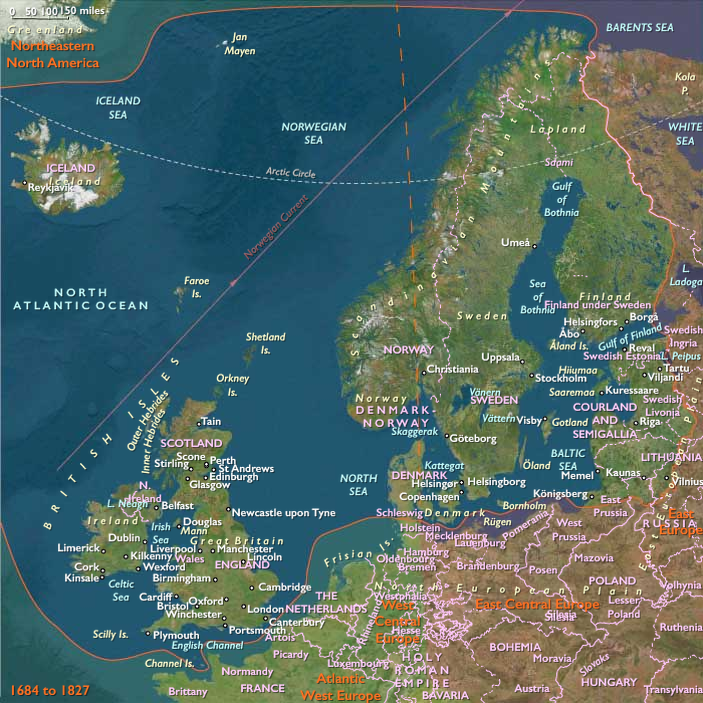 North Europe
Region
-
{# Image navigates to the detail page; the magnifying-glass chip is the only Fancybox lightbox trigger (kept a separate sibling — anchors can't nest). #}
 Northwest Europe
Subregion
