The Council, well aware of the resentment …
Years: 1637 - 1637
September
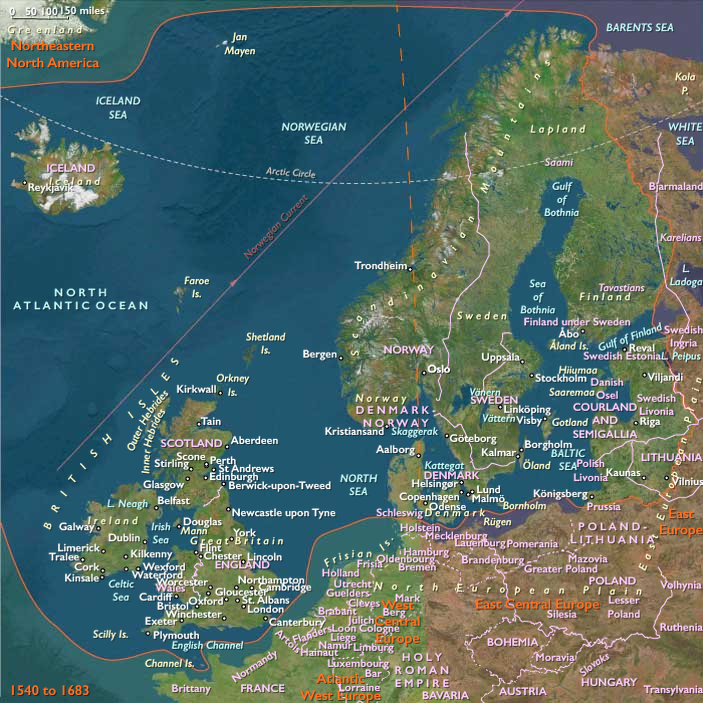
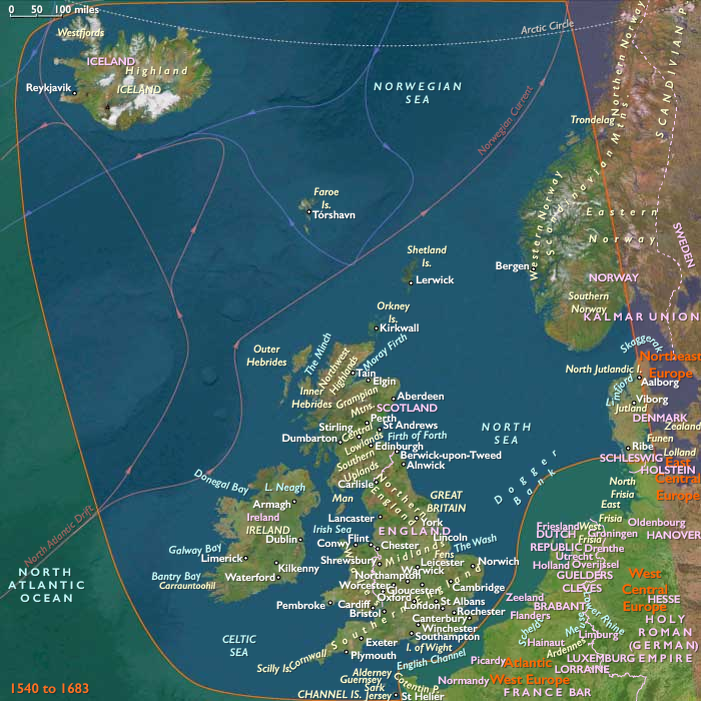
The Council, well aware of the resentment that the reading of the Prayer Book will unleash, are in the weeks that follow placed in an almost impossible position, caught between the anger of the king and the determination of the opposition, for they are now faced with an opposition just as organized as the Lords of the Congregation had been prior to the Reformation.
Locations
People
Groups
- Christians, Roman Catholic
- Scotland, Kingdom of
- Anglicans (Episcopal Church of England)
- Ireland, (English) Kingdom of
- Presbyterians
- England, (Stuart) Kingdom of
Topics
- Protestant Reformation
- Counter-Reformation (also Catholic Reformation or Catholic Revival)
- Personal Rule
Subjects
Regions
Subregions
Related Events
Filter results
Showing 10 events out of 32318 total
Han Chinese had suffered heavy discrimination during Nurhaci's reign, but Huang Taiji has begun to employ officials of Han ethnicity.
He realizes that they will still be the majority and the Manchus always a minority, which means to control the Han people, the two ethnic groups will need to live together or else the Qing Dynasty will repeat the fate of the Yuan Dynasty.
Beginning in the late 1620s, Huang Taiji had begun to incorporate allied and conquered Mongol tribes into the Banner system.
The first Han Chinese additions had been merely sprinkled into existing banners as replacements.
Eventually, the sheer numbers of Han Chinese soldiers had caused Manchu leaders to form them into the "Old Han Army", mainly for infantry support.
A separate Chinese artillery corps had been formed in 1631.
At the time of Nurhaci's death in 1626, there had been four Banner Lords with Huang Taji as the lowest rank.
Huang Taiji is rumored to have been involved in the suicide of Prince Dorgon's mother, Lady Abahai, in order to block the succession of his younger brother.
At the same time, by forcing Abahai to follow her husband into death, he assured that there would be no one to support the fifteen-year-old Dorgon or fourteen-year-old Dodo.
At the end of Nurhaci's reign, Huang Taji had secured control of the two White Banners (Striped and Plain), but after Abahai's death, he switched his banners for the two elite Yellow Banners (Plain and Bordered) controlled by Dodo and Dorgon, bequeathed to them by Nurhaci, who had controlled them personally.
Having thus gained control over the two banners of the greatest strength and influence, Huang Taji gradually has stripped his competitors of their powers.
Eventually, he will also receive the Plain Blue Banner, the third strongest, from a son of Nurhaci's brother Surhaci, who had controlled the two Blue Banners.
These three banners will officially become the Upper Three Banners during the early part of the Qing Dynasty.
John Weddell, having served as a sea captain for both the Muscovy Company and the East India Company, had early in 1636 been given command of six ships sent by the interloper Sir William Courten, who had received a patent from the king in December 1635 to trade in the East Indies.
After failing to establish trade in Canton owing to Portuguese intrigues, he returns to India, where he succeeds in establishing a trade at Rajapur.
The Portuguese fort known as Elmina Castle, one of the most important stops on the route of the Atlantic Slave Trade, is taken over in 1637 by the Dutch, who make it the capital of the Dutch Gold Coast.
During the period of Dutch control, they are to build a new, smaller fortress, called Koenraadsburg, on a nearby hill to protect St. George Castle from inland attacks.
Claude Lorrain, born in 1604 or 1605 into poverty in the town of Chamagne, Vosges, in the Duchy of Lorraine; his actual name is Claude Gellée, but he is better known by the province in which he was born.
One of five children and an orphaned by the age of twelve, he had gone to live at Freiburg with an elder brother, Jean Gellée, a woodcarver.
He had afterwards gone to Rome to seek a livelihood, then to Naples, where he apprenticed for two years, from 1619 to 1621, under Goffredo (Gottfried) Wals.
Returning to Rome in April 1625, he had been apprenticed to Agostino Tassi; he once got into a fight with Leonaert Bramer, suffering numerous misadventures while managing to tour in Italy, France and Germany, including his native Lorraine, where
Claude Deruet, painter to the duke, kept him as assistant for a year; at Nancy, he painted architectural subjects on the ceiling of the Carmelite church.
Claude had returned in 1627 to Rome, where two landscapes made for Cardinal Bentivoglio had earned him the patronage of Pope Urban VIII.
From about 1637 he rapidly achieves fame as a painter of landscapes and seascapes.
The Teatro San Cassiano or Teatro di San Cassiano in Venice, the first public opera house when it opens in 1637, takes its name from the neighborhood where it is located, the parish of San Cassiano near the Rialto.
A stone building owned by the Venetian Tron family, it is considered 'public' as it is directed by an impresario, or general manager, for the paying public rather than for nobles exclusively.
René Descartes was born in La Haye en Touraine (now Descartes), Indre-et-Loire, France, where his mother had died of tuberculosis when he was one year old; his father Joachim was a member in the provincial parliament.
He had entered the Jesuit Collège Royal Henry-Le-Grand at La Flèche at around the age of eleven, and had studied after graduation at the University of Poitiers, earning a Baccalauréat and Licence in law in 1616, in accordance with his father's wishes that he should become a lawyer.
He had joined the army of Maurice of Nassau in the Dutch Republic in the summer of 1618.
While walking through Breda on November 10, 1618, Descartes had met Isaac Beeckman, who had sparked his interest in mathematics and the new physics, particularly the problem of the fall of heavy bodies.
Descartes had been present in November 1620 at the Battle of the White Mountain outside Prague, while in the service of the Duke Maximilian of Bavaria.
He had returned to France in 1622, and during the next few years had spent time in Paris and other parts of Europe.
He had arrived in La Haye in 1623, selling all of his property, investing this remuneration in bonds which are to provide Descartes with a comfortable income for the rest of his life.
Descartes had been present at the siege of La Rochelle by Cardinal Richelieu in 1627.
He had returned in 1628 to the Dutch Republic, where he will spend most of his adult life.
He had joined the University of Franeker in April 1629 and the next year, under the name "Poitevin", had enrolled at the Leiden University to study mathematics with Jacob Golius and astronomy with Martin Hortensius.
He had in October 1630 had a falling out with Beeckman, whom he accused of plagiarizing some of his ideas.
He had had a relationship in Amsterdam with a servant girl, Helène Jans, with whom he had a daughter, Francine, who was born in 1635 in Deventer, at which time Descartes taught at the Utrecht University.
Descartes has changed his address frequently while in the Netherlands, living, among other places, in Dordrecht (1628), Franeker (1629), Amsterdam (1629–30), Leiden (1630), Amsterdam (1630–2), Deventer (1632–4), Amsterdam (1634-5), Utrecht (1635-6), Leiden (1636), Egmond (from 1636).
Galileo had bin 1633 been condemned by the Roman Catholic Church, and Descartes had abandoned plans to publish Treatise on the World, his work of the previous four years.
"Discourse on the Method", an introduction to the Essais, which includes the Dioptrique, the Météores and the Géométrie, is published in 1637.
In it, Descartes lays out four rules of thought, meant to ensure that our knowledge rests upon a firm foundation.
He also publishes La Géométrie (Geometry), Descartes' major work in mathematics.
There is an English translation by Michael Mahoney (New York: Dover, 1979).

Pieter de Grebber, the son of Frans Pietersz de Grebber (1573–1643), a painter and embroiderer in Haarlem, would have been taught painting by his father and by Hendrick Goltzius.
He is descended from a Catholic and artistic family: two of his brothers, and his sister Maria, the mother-in-law of Gabriel Metsu, were known as painters.
He is friendly with the priest and musicologist Jan Albertszoon Ban, and has had a poem set to music by the Haarlem composer Cornelis Padbrué.
Father and son had in 1618 gone to Antwerp and negotiated with Peter Paul Rubens over the sale of his 1615 painting Daniel in the Lions' Den.
The painting was then handed—via the English ambassador in the Republic, Sir Dudley Carleton—to king Charles I. Pieter has received important commissions not only in Haarlem, but also from the stadholder Frederik Hendrik.
As such, he has worked with on the decoration of the Huis Honselaarsdijk in Naaldwijk and at the Paleis Noordeinde in Huis ten Bosch in the Hague.
He paints altar pieces for churches in Flanders and hidden Catholic churches in the Republic.
He may also have worked for Danish clients.
De Grebber remains single and will live from 1634 until his death at the Haarlem Béguinage.
Besides history paintings, he also paints a number of portraits; furthermore many drawings and a few etchings by him have survived.
From different influences, such as the Utrecht Caravaggistism, Rubens and also Rembrandt, he has developed a very personal style.
He is, together with Salomon de Bray, the forerunner and first peak of the "Haarlem classicism" school, producing paintings characterized by a well-organized clarity and light tints.
Claude de Launay-Razilly, appointed by King Louis XIII as Acadia's new governor after the death of his brother, Isaac de Razilly, died suddenly at forty-eight in December 1635, had not come to Acadia but appointed Charles de Menou d'Aulnay, who had served as one of Razilly’s able assistants, as his lieutenant to govern on his behalf and run the company, Razilly-Condonnier, in Acadia while he ran the operation in France.
D'Aulnay had gone immediately to Port Royal, erected a new fort, moved the La Hève colonists, and sent to France for twenty additional families, making Port Royal the principal settlement in Acadia, which at this time embraces not only Nova Scotia, but a portion of New Brunswick, extending as far west as the Penobscot.
D’Aulnay in 1637 marries Jeanne Motin, the daughter of Louis Motin, who had been a financial backer of his late predecessor and cousin Isaac de Razilly.
The three Connecticut River towns—Windsor, Wethersfield, and Hartford—set up a collective government in 1637 in order to fight the Pequot War.
These settlers seek to establish a new ecclesiastical society subject to their own rules and regulations.
According to historian Henry S. Cohn: "They resented the power of the Magistrates who were not elected by the people. But they also wanted to expand their land holdings...”
Two Franciscan friars, under threats from nearby natives in 1637, abandon their mission on the Amazon River and, with six soldiers, paddle a canoe up the entire length of the river to the principal Portuguese settlement of Fort Presépio in present Belèm.
Their arrival leads the Portuguese to wonder how far east the Spaniards have settled the Amazon.
Although Spain and Portugal are both under the rule of Philip IV of Spain (Philip III of Portugal), trading rivalry is nevertheless intense and there is a strong movement towards the restoration of the Portuguese independence.
Consequently, the governor of Maranhão, Jacome Raimundo de Noronha, loses no time in commissioning an expedition under the command of Captain Pedro de Teixeira, who already has considerable experience exploring the Amazon and the Xingu River leading expeditions to expel English and Dutch traders and settlers.
One of the Franciscan friars, Andres de Toledo, is dispatched to Lisbon to report his expedition to the Portuguese authorities.
Teixeira thus becomes the first European to travel up the Amazon River, reaching Quito by way of the Napo River.
The Portuguese expedition is a large one, consisting of forty-seven canoes powered by twelve hundred natives and Negroes to transport 70 fully armed Portuguese soldiers and their cargo of food, weapons, ammunition and barter goods.
Feeding so many over a journey of several months is a formidable task, demanding the most of the explorers' hunting, fishing and food gathering skills, and often requiring barter with local tribes.
The journey upstream against a strong current is arduous, and advance parties are regularly sent out to reconnoiter the way ahead in order to identify the correct fork in the river to take.
Teixeira also has difficulty persuading the natives to stay with the expedition as it gets farther from their homes.
After eight months, the Portuguese reach the first Spanish settlement on the Rio Quijos.
At this stage, Teixeira divides the expedition, sending eight canoes ahead whilst the remainder are to stay at the settlement for the return journey.
The Rio Quijos is eventually abandoned when the current grows too strong, and the rest of the journey is completed on foot.
Years: 1637 - 1637
September
Locations
People
Groups
- Christians, Roman Catholic
- Scotland, Kingdom of
- Anglicans (Episcopal Church of England)
- Ireland, (English) Kingdom of
- Presbyterians
- England, (Stuart) Kingdom of
Topics
- Protestant Reformation
- Counter-Reformation (also Catholic Reformation or Catholic Revival)
- Personal Rule