The protagonist of Amadis de Gaula (“Amadis…
1508 CE
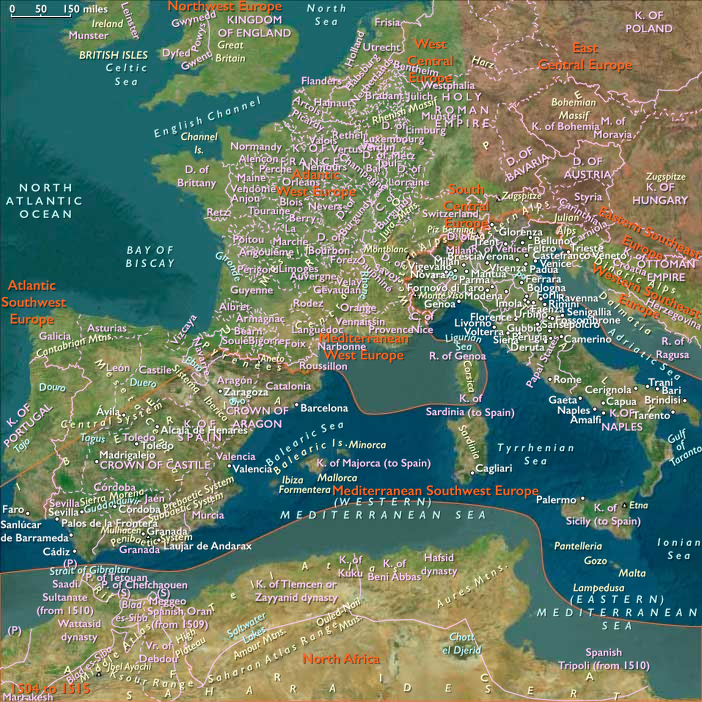
The protagonist of Amadis de Gaula (“Amadis of Gaul”), a Spanish novel of chivalry based on an early fourteenth-century romance and written and published in Zaragoza in 1508 by Garci Rodríguez de Montalvo, overcomes incredible odds to win his lady.
Other Spanish prose forms of the age include pastoral romances, sentimental allegorical novels about love, and Moorish novels featuring impossibly gallant heroes.
The narrative originates in the late post-Arthurian genre and had certainly been read as early as the fourteenth century by the chancellor Pero López de Ayala as well as his contemporary Pero Ferrús.
Montalvo himself confesses to have amended the first three volumes, and to be the author of the fourth.
Additionally, in the Portuguese Chronicle by Gomes Eannes de Azurara (1454), Amadis is attributed to Vasco de Lobeira, who was knighted after the Battle of Aljubarrota (1385).
However, although other sources claim that the work was, in fact, a copy of one João de Lobeira, not troubadour Vasco de Lobeira, and that it was a translation into Castilian Spanish of an earlier work, probably from the beginning of the fourteenth century, no primitive version in the original Portuguese is known.
The inspiration for the "Amadis de Gaula" appears to be the blocked marriage of Infanta Constanza of Aragon with Henry of Castile in 1260, as blocked was also Oriana's marriage to Amadis.
In his introduction to the text, Garci Rodríguez de Montalvo explains that he has edited the first three books of a text in circulation since the fourteenth century.
Montalvo also admits to adding a fourth as yet unpublished book as well as adding a continuation (Las sergas de Esplandián), which he claims was found in a buried chest in Constantinople and transported by a Hungarian merchant to Spain.
Locations
Subjects
Regions
Southwest Europe
View →Subregions