The Protogeometric style emerges around the mid-eleventh…
1053 BCE to 910 BCE
The Protogeometric style emerges around the mid-eleventh century BCE as the first expression of a reviving civilization after the collapse of the Mycenaean-Minoan Palace culture and the ensuing Greek Dark Ages.
Following on from the development of a faster potter's wheel, vases of this period are markedly more technically accomplished than earlier Dark Age examples.
The decoration of these pots is restricted to purely abstract elements and is best characterized by broad horizontal bands about the neck and belly and concentric circles applied with compass and multiple brushes.
Some of the innovations include some new Mycenaean influenced shapes, such as the belly-handled amphora, the neck handled amphora, the krater, and the lekythos.
Attic artists have redesigned these vessels using the fast wheel to increase the height and therefore the area available for decoration.
The Iron Age civilization that arises in Greece is based on rain-watered agriculture and employs the implements of the new metallurgy.
The Greeks now use metal styli to mark their waxed tablets.
Changes in material culture, such as the introduction of iron, new weapons, and changes in burial practices from Mycenaean group burials in tholos tombs to individual burials and cremation, are associated with the culture of the Dorians.
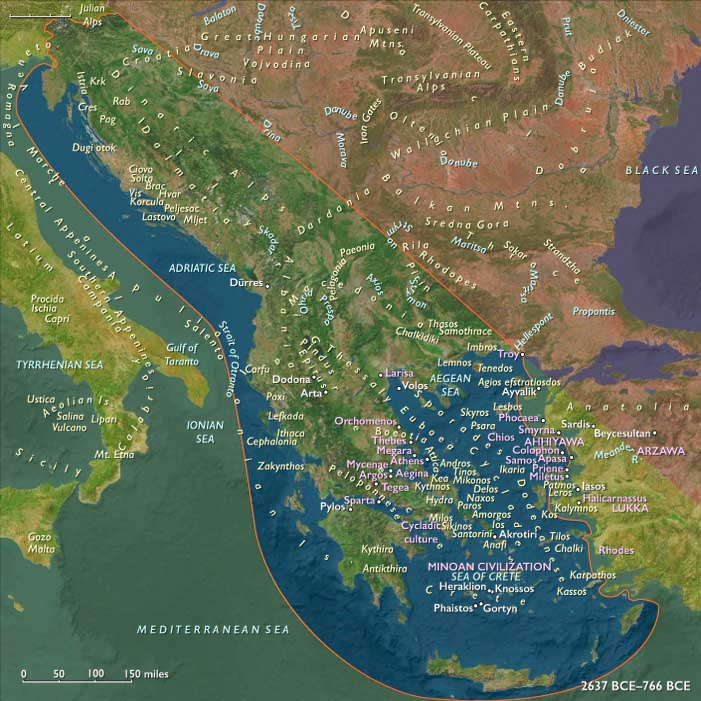
The recorded history of Sparta begins with the Dorian invasions, when the eastern Peloponnesus is settled by Illyrian tribes coming from Epirus and Macedonia through the northeast region of Greece, submitting or displacing the older Achaean Greek inhabitants.
The Mycenaean Sparta of Menelaus described in Homer's Iliad was an older Greek civilization, whose link to Hellenic or Classical Sparta was only by name and location.
The state and culture widely known today as ancient Sparta refers to that formed in the valley of Lacedaemon by the Dorian Greeks, who establish their capital at Sparta, an evolution of four original villages.
The Dorian Spartans apparently reduce the remaining natives to serfdom, calling them helots.
Tradition describes how, some sixty years after the Trojan War, a Dorian migration from the north took place and eventually led to the rise of classical Sparta, a consolidation of four original villages in the Peloponnesian valley of Lacedaemon.
This tradition is, however, contradictory and was written down at a time long after the events they supposedly describe.
Hence, skeptics like Karl Julius Beloch have denied that any such event occurred.
Chadwick has argued, on the basis of slight regional variations that he detected in Linear B, that the Dorians had previously lived in the Dorian regions as an oppressed majority, speaking the regional dialect, and emerged when they overthrew their masters.
Archaeologically, Sparta itself only begins to show signs of settlement around 1000 BCE, some 200 years after the collapse of Mycenaean civilization.
Of the four villages that make up the Spartan polis, Forrest suggests that the two closest to the Acropolis were the originals and the two more far flung settlements, were of later foundation.
The dual kingship peculiar to Sparta may originate in the fusion of the first two villages.
One of the effects of the Mycenaean collapse had been a sharp drop in population.
Following that there was a significant recovery, and this growth in population is likely to have been more marked in Sparta, as it is situated in the most fertile part of the plain.
Locations
Topics
Subjects
Regions
Southeast Europe
View →Subregions