
The refusal of Justin II to continue…
566 CE
The refusal of Justin II to continue the payment of tribute to Avar or Persian preserves the resources of the treasury, which he further increases by levying new taxes.
Praiseworthy as his refusal to submit to blackmail may seem, Justin's intransigence only increases the menace to the empire.
Locations
Groups
Commodities
Subjects
Regions
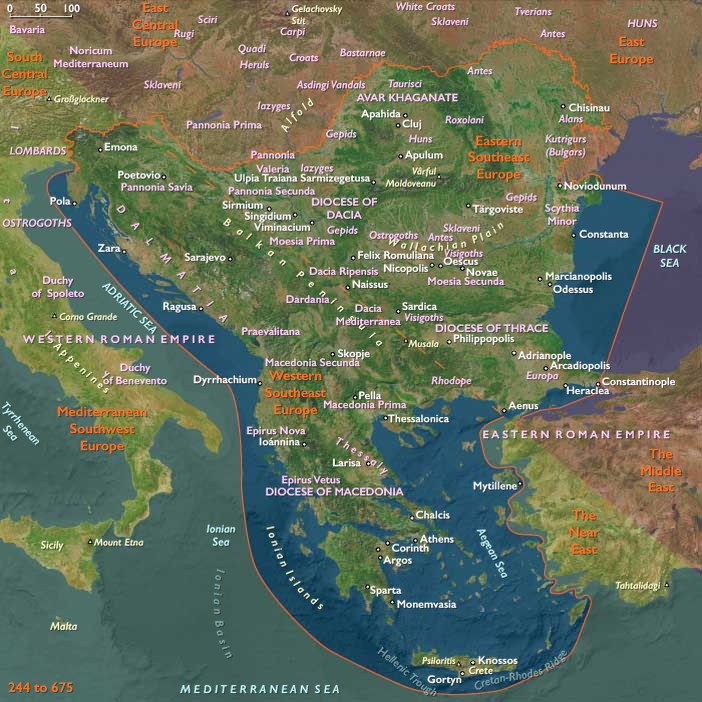
Southeast Europe
View →Subregions
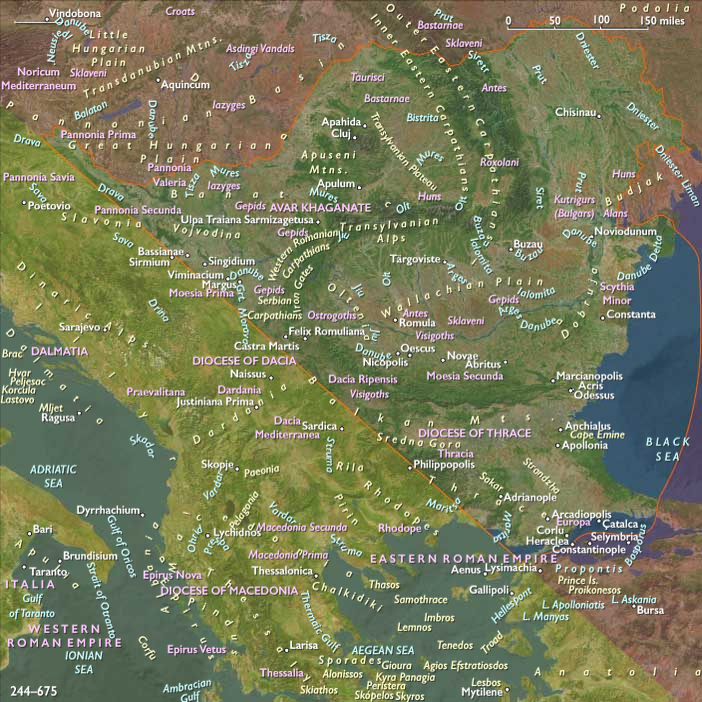
Eastern Southeast Europe
View →Related Events
No active filters.
Showing 10 events out of 57511 total
Alboin, faced with the possibility of annihilation, makes an alliance in 566 with the Avars under Bayan I, at the expense of some tough conditions; the Avars demand a tenth of the Lombards' cattle, half of the war booty, and on the war's conclusion all of the lands held by the Gepids.
The Lombards play on the pre-existing hostility between the Avars and Constantinople, claiming that the latter is allied with the Gepids.
Cunimund, on the other hand, encounters hostility when he once again asked the Emperor for military assistance, as Constantinople has been angered by the Gepids' failure to cede Sirmium to the empire, as had been agreed.
Moreover, Justin II is moving away from the foreign policy of Justinian, and believes in dealing more strictly with bordering states and peoples.
Attempts to mollify Justin II with tributes fail, and as a result the Empire remains neutral if not outright supportive of the Avars.
The Avars do defeat Sigebert in 566 but have nonetheless to stop; in the meantime the Göktürks, in pursuit of their former subjects, remain a real danger.
The Avars, traditionally a nomadic people, desperately need both shelter and pasture for their livestock, but the route to Pannonia is blocked by impassable mountains covered with thick forests: the Carpathian range.
It is in the critical winter of 566-567 that the Avars, stuck in what is now eastern Germany, are sent feelers by Alboin, the strong ruler of the Lombards and brother-in-law of Sigebert, who seeks an alliance to crush his old enemies the Gepids.
These last ones, by chance, control the only practical way from the Lower Danube to the Pannonian pastures craved by the Avars, who are skilled in a sort of perfidious diplomacy that will help them pursue their objectives.
John III, patriarch of Constantinople, organizes a compromise between the Chalcedonians and Monophysites.
Cunimund makes the same offer to Justin II as he had before, and this time when Justin accepts, the Gepid king hands Sirmium over to the Empire.
As it turns out, however, the imperial troops neglect to join the Gepids in their fight but keep Sirmium, and although the Avars do not show up either, the Lombards soundly defeat Cunimund in 567, crushing their foes in a pincer movement.
According to the writings of Paul the Deacon, Alboin killed the defeated king and had his skull converted into a drinking cup known as a scala or patera.
The Avars now conquer Transylvania, and the surviving Gepidae are hereafter absorbed into the Lombard nation or become submerged in Avar domains.
Sigebert I and Chilperic I: A Fraternal War for Frankish Dominance (562–575 CE)
Following the death of Chlothar I in 561 CE, his sons Sigebert I and Chilperic I inherit different regions of the Frankish kingdom, but their reigns are marked by intense rivalry, betrayal, and a bloody civil war. Their conflict sets the stage for decades of internecine struggles within the Merovingian dynasty.
1. The Division of the Frankish Kingdom (561 CE)
After Chlothar’s death, his kingdom is divided:
- Sigebert I inherits Austrasia, the eastern Frankish kingdom, moving his capital from Reims to Metz (c. 562 CE)to strengthen his rule.
- Chilperic I controls Neustria, with Soissons as his power base.
- Guntram rules Burgundy, and Charibert I takes Aquitaine (though his death in 567 CE further destabilizes the Frankish realm).
Despite their family ties, Sigebert and Chilperic become fierce rivals, vying for control over more territory and influence.
2. Marriages to Visigothic Princesses and Political Intrigues
Both kings strengthen their political positions through strategic marriages to Visigothic princesses, daughters of King Athanagild of the Visigoths:
- Sigebert I marries Brunhilda, a cultured and powerful Visigothic noblewoman, further cementing Austrasia’s ties to the Visigoths in Spain.
- Chilperic I marries Galswintha, Brunhilda’s older sister, likely to balance Sigebert’s alliance and gain Visigothic favor.
However, Chilperic’s marriage to Galswintha ends in tragedy:
- He soon grows discontented and, under the influence of his mistress Fredegund, Galswintha is murdered (c. 568 CE).
- Chilperic then marries Fredegund, making her his queen and primary political partner.
- This enrages Brunhilda, who demands revenge for her sister’s murder—leading to a long and bloody war between Austrasia and Neustria.
3. The Austrasian-Neustrian War (562–575 CE)
- Sigebert and Chilperic’s rivalry explodes into open warfare, with both rulers seeking territorial dominance.
- The conflict is characterized by sieges, assassinations, shifting alliances, and brutal warfare, plunging the Frankish realm into chaos.
- Guntram of Burgundy often plays the role of mediator, attempting to maintain stability between his feuding brothers.
The war escalates in 575 CE, when Sigebert gains the upper hand:
- Sigebert defeats Chilperic in battle and drives him back into Tournai.
- At the height of his triumph, Sigebert is assassinated—likely orchestrated by Fredegund, Chilperic’s vengeful wife.
4. The Legacy of the Conflict
- Chilperic regains control of Neustria, but his rule remains tenuous and violent.
- Brunhilda survives, becoming a major political player in the ongoing power struggles.
- The feud between Fredegund and Brunhilda will continue for decades, shaping the later course of Merovingian politics.
Conclusion: A Dynasty Torn by Blood Feud
The war between Sigebert I and Chilperic I represents the deep fractures within the Merovingian dynasty. Their rivalry not only weakens the Frankish kingdom but also paves the way for continued instability, ultimately leading to Merovingian decline and the eventual rise of the Carolingians.
The Second Council of Tours (567 CE): Enforcing Clerical Discipline
The Second Council of Tours, convened in 567 CE, further regulates clerical conduct, reinforcing the Church’s expectations for moral discipline among its clergy. One of its most notable decrees mandates that:
Any cleric found in bed with his wife will be excommunicated.
1. The Growing Demand for Clerical Celibacy
- At this time, clerical celibacy was not yet universally enforced, but the Church increasingly discouraged married priests from engaging in sexual relations.
- The ruling at Tours did not prohibit marriage outright but imposed strict penalties on clergy who continued marital relations.
- The decision reflects a transition toward stricter clerical celibacy, which would become a cornerstone of medieval Catholicism.
2. The Purpose of the Decree
- To elevate the moral and spiritual status of priests, ensuring their separation from worldly concerns.
- To reinforce the authority of the Church, particularly as clerical power expanded under Frankish rule.
- To prevent nepotism and hereditary priesthood, which were concerns in Merovingian Gaul, where many clerical positions were passed through families.
3. The Legacy of the Council’s Ruling
- The Second Council of Tours is part of the broader movement toward clerical celibacy, which would become fully mandated in the 11th century.
- It reflects the merging of Frankish royal authority with Church discipline, as the Merovingians increasingly used the Church to legitimize their rule.
- This decree is a key step in the evolution of Church law, influencing later canon law codifications.
Conclusion: A Step Toward Ecclesiastical Reform
The Council of Tours (567 CE) marks a turning point in the regulation of clergy, further strengthening the moral authority of the Catholic Church. By imposing excommunication on married clerics who remained sexually active, the Church asserts greater control over its clergy, paving the way for the later mandate of full celibacy in the medieval period.
Emperor Pyeongwon, the twenty-fifth ruler of Goguryeo, the northernmost of the Three Kingdoms of Korea, is said to have been courageous, and skilled in horsemanship and archery.
By this time, the royal power has been significantly eroded by the aristocracy.
Concerned for the people, Pyeongwon has encouraged agricultural and sericultural developments, and maintained tense but relatively peaceful relations with the Gökturks and the various Chinese dynasties, briefly battling the Northern Zhou in the Liaodong Peninsula.
East Central Europe (568–579 CE): Avar Khaganate Established, Slavic Consolidation, and Roles of Thuringia and Bavaria
Between 568 and 579 CE, East Central Europe—encompassing Poland, Czechia, Slovakia, Hungary, and those portions of Germany and Austria lying east of 10°E and north of a line stretching from roughly 48.2°N at 10°E southeastward to the Austro-Slovenian border near 46.7°N, 15.4°E—underwent significant geopolitical transformations. The migration of the Lombards into Italy (568 CE) left the Pannonian Avars firmly established as regional rulers, forming their powerful Avar Khaganate in the Carpathian Basin. Simultaneously, Slavic populations expanded dramatically, solidifying control over territories vacated by Germanic tribes. On the region's western periphery, the semi-autonomous Germanic duchies of Thuringia and Bavaria continued to play crucial roles, significantly influencing economic interactions, diplomatic alignments, and cultural exchanges between Frankish and Avar realms.
Political and Military Developments
Avar Khaganate and Byzantine Frontier Diplomacy
-
After Lombard withdrawal (568 CE), the Avar Khaganate rapidly established control, dominating former Gepid and Lombard territories across modern Hungary, Slovakia, Czechia, and eastern Austria.
-
Byzantium intensified diplomatic engagements with the Avars, employing tribute and negotiation to secure its Danube frontier against incursions and maintain regional stability.
Thuringia and Bavaria: Western Influences
-
Thuringia, previously conquered by the Franks in 531 CE, operated as a Frankish-dominated region that retained substantial cultural independence. It became a frontier zone interacting with newly consolidated Slavic groups, facilitating trade and cultural exchanges.
-
Bavaria, centered around Regensburg, emerged distinctly as a semi-autonomous duchy under Frankish political influence. Bavaria played a strategic intermediary role between the Frankish west, Avar east, and Slavic north, managing careful diplomacy and commercial relationships with multiple powers, thus becoming a critical political and economic player.
Extensive Slavic Territorial Consolidation
-
Slavic groups (Sclaveni, Antes, Polanes, Vislanes, Sorbs, Veleti, Obotrites, Pomeranians, and White Croats) rapidly consolidated control over regions vacated by Germanic tribes, establishing permanent settlements that transformed the demographic landscape.
Economic and Technological Developments
Avar Economic Stability and Bavarian Trade Networks
-
Under Avar governance, regional economies flourished, maintaining robust agricultural productivity, livestock husbandry, and extensive trade connections.
-
Bavarian territories facilitated critical trade routes between western Europe (Frankish territories), Lombard-controlled Italy, and the Avar-controlled east, enhancing the region's overall economic connectivity and prosperity.
Infrastructure Maintenance
-
Both Avars and Bavarians maintained vital trade routes, roads, bridges, and fortifications, ensuring regional stability and economic resilience.
Cultural and Artistic Developments
Cultural Exchanges: Avar, Bavarian, and Slavic Influences
-
The Avars introduced distinctive Central Asian steppe traditions into regional art, including metalwork, jewelry, and ceramics.
-
Bavaria and Thuringia maintained and blended Germanic artistic traditions with influences from neighboring Slavic and Frankish cultures, creating unique regional hybrid forms.
Slavic Cultural Identity
-
Slavic communities across East Central Europe solidified distinct cultural identities, evident through settlement patterns, ceramics, and communal customs, contributing significantly to regional cultural diversity.
Settlement and Urban Development
Continuity in Avar-Controlled Settlements
-
Strategic urban centers such as Augusta Vindelicorum (Augsburg), Vindobona, and Aquincum remained economically and administratively central under Avar rule.
Bavarian and Thuringian Settlement Stability
-
Bavarian settlements, notably Regensburg, flourished economically and culturally, benefiting from active trade and diplomacy with Avar and Slavic territories.
-
Thuringian communities, despite Frankish oversight, retained cultural independence and economic stability, becoming key contact points between Frankish, Slavic, and Avar spheres.
Rapid Expansion of Slavic Settlements
-
Slavic villages rapidly proliferated, permanently reshaping demographic landscapes and laying foundations for future medieval states.
Social and Religious Developments
Hierarchical Societies of Avars and Bavarians
-
The Avar Khaganate introduced hierarchical structures rooted in Central Asian traditions, creating clearly defined military and administrative classes.
-
Bavarian and Thuringian societies, though influenced by Frankish governance, maintained distinct Germanic social structures centered around ducal leadership, noble hierarchies, and tribal traditions.
Slavic Social Cohesion
-
Slavic tribes continued forming robust communal social structures and leadership hierarchies, enabling successful territorial consolidation.
Long-Term Consequences and Historical Significance
The era 568–579 CE was pivotal for East Central Europe. The establishment of the Avar Khaganate decisively reshaped geopolitical dynamics, while the significant roles played by Thuringia and Bavaria facilitated critical economic, diplomatic, and cultural exchanges. Simultaneously, Slavic territorial consolidation established lasting demographic and cultural foundations. These developments set enduring historical trajectories, shaping the medieval landscape and cultural identity of the region profoundly.