
Approximately one hundred men of suitable age…
December 1756 CE
Within three years, most of North Carolina's population increase, driven mainly by the immigration of Scots-Irish and German settlers traveling from Pennsylvania on the Great Wagon Road, was occurring in seven western counties created after 1740.
By 1754, six western counties—Orange, Granville, Johnston, Cumberland, Anson, and Rowan—held around twenty-two thousand residents of the colony's total population of sixty-five thousand.
Governor Arthur Dobbs in 1755 had ordered the construction of a fortified log structure for the protection of settlers in Rowan County from various Native American threats, including assaults from Cherokee, Catawba, Shawnee, and Delaware raiding parties.
The new frontier settlements require regular protection, as the settlers in the area attribute many crimes and forms of harassment to denizens of nearby Catawba and Cherokee towns.
Furthermore, Governor Dobbs is concerned for his own investments, as he owns more than two hundred thousand acres (eighty-one thousand hectares; three hundred and ten square miles) of land on the Rocky River, approximately fifteen miles (twenty-four kilometers) south of the Fourth Creek Meeting House.
The North Carolina Legislature set aside a sum of ten thousand pounds for the construction of the fort in 1755, as well as for the raising of several companies of provincial soldiers to defend the frontier.
Provincial soldiers, known by the shortened name "provincials", are soldiers raised, clothed, and paid by the individual British colonies, although they are at various times armed and supplied by the regular British Army.
The total cost of the fort is only a thousand pounds.
Dobbs likely had a role in designing the fort, as he had designed at least one other fort in North Carolina, as well as a number of structures in Ireland.
Hugh Waddell, a Scotch-Irish soldier who has close ties to Governor Dobbs and who was the commander of a company of provincial soldiers in 1755, builds the fort's blockhouse and palisade using labor provided by his soldiers, and names it after the governor.
Born around 1734 in Lisburn, County Down, Ireland, to Hugh and Isabella Brown Waddell who were of Scotch-Irish origin, Hugh, as a family friend to the aristocrat Arthur Dobbs of County Antrim, who had just been appointed as Governor of North Carolina, had been sent to the colonies in 1753 or 1754, and enlisted in the service of the acting Governor, Matthew Rowan, as a lieutenant.
Waddell had been sent to Virginia in 1754 under the command of Colonel James Innes, who was commander-in-chief of all colonial forces then in Virginia under the authority of the governor of that state, Robert Dinwiddie.
After seeing no action, but having been promoted to captain, Waddell had returned to North Carolina in late 1754, where he then spent a substantial portion of the early phase of the war that would go on to define his career as a commander supervising the construction, maintenance, and staffing of Fort Dobbs, near what is now Statesville, North Carolina.
The land on which the fort is located is a part of a five hundred and sixty-acre-acre (two hundred and thirty-acre hectare; 0.88 square mile) tract owned first by one James Oliphant, then by a Fergus Sloan.
Part of the same tract had been used for the Fourth Creek Congregation Meeting House (so named because the settlement is on the fourth creek one would pass traveling west on the South Yadkin River from Salisbury) in 1755, which is the principal structure around which the modern city of Statesville will be founded.
After construction is completed, Fort Dobbs is the only military installation on the colonial frontier between Virginia and South Carolina.
Fort Dobbs' primary structure is a blockhouse with log walls, surrounded by a palisade and moat.
It is intended to provide protection against Cherokee, Catawba, Shawnee, Delaware and French raids into North Carolina.
Francis Brown and future governor Richard Caswell, commissioners appointed by Dobbs to inspect frontier defenses.
The commissioners generally find the defenses of the rest of the North Carolina frontier to be inadequate.
In 1756, the North Carolina General Assembly petition King George II for assistance, stating that the frontier remains in a relatively defenseless state.
The address to the king further noted that after the fall of Fort Oswego to the French and their native allies in this year, the legislators do not believe that Fort Dobbs will provide a substantial defensive advantage.
Waddell, having substantially completed construction on the fort by June 1756, is recruited by Virginia's Lieutenant Governor Robert Dinwiddie to serve as a "Commissioner of Peace" to the Cherokee and Catawba tribes.
Waddell is the sole representative of North Carolina in these negotiations, which secures the temporary cooperation of those tribes against the French and their native allies.
People
Groups
Lenape or Lenni-Lenape (later named Delaware Indians by Europeans)
View →
Catawba people (Amerind tribe)
View →
Cherokee, or Tsalagi (Amerind tribe)
View →
Shawnees, or Shawanos (Amerind tribe)
View →
France, (Bourbon) Kingdom of
View →
Virginia (English Crown Colony)
View →
Britain, Kingdom of Great
View →
South Carolina, Province of (British Colony)
View →
North Carolina, Province of (British Colony)
View →
Topics
Regions
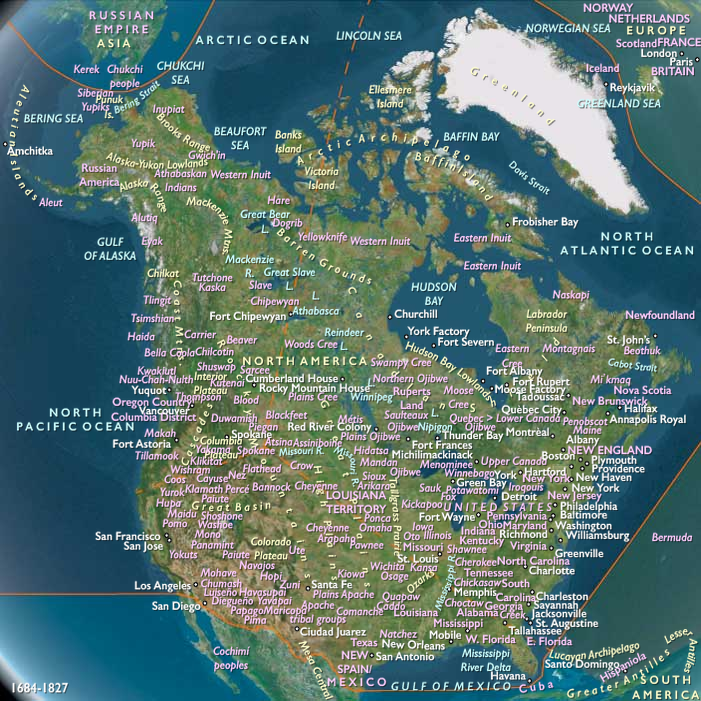
Northern North America
View →Subregions
