The Migration and Integration of the Salian…
244 CE to 387 CE
The Migration and Integration of the Salian Franks and the Decline of the Frisii (3rd–4th Century CE)
During the third and fourth centuries CE, significant tribal movements and climatic shifts reshaped the northern frontier of the Roman Empire, particularly in the Low Countries and along the Rhine frontier.
The Emergence of the Salian Franks and Their Role in Roman Gaul
- The Batavi, once a distinct Germanic tribe allied with Rome, gradually merged with other tribes into the Salian Franks, whose identity emerged in the first half of the 3rd century CE.
- The Salian Franks appeared in Roman texts as both allies and enemies, alternately serving as Roman auxiliaries or raiding Roman territories.
The Salian Franks Cross the Rhine (4th Century CE)
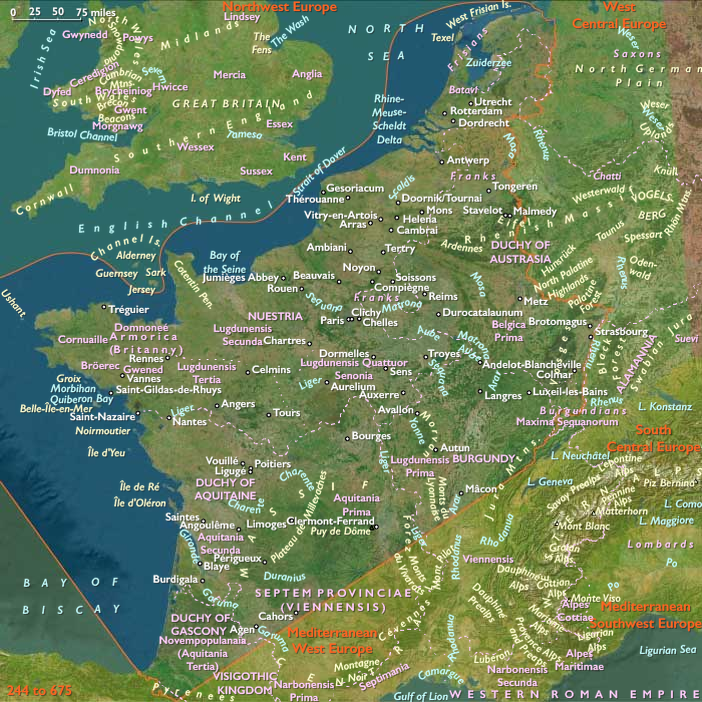
- Forced westward by the expanding Saxon confederation, the Salian Franks moved across the Rhine into Roman territory in the early 4th century.
- From their new bases in West Flanders and the southwestern Netherlands, they raided the English Channel, disrupting trade and coastal settlements.
Roman Response: Pacification and Settlement as Foederati
- Roman forces pacified the region but did not expel the Franks, instead choosing to integrate them into the imperial system.
- By 358 CE, during the reign of Julian the Apostate, the Salian Franks were officially allowed to settle as foederati (federated allies) in Toxandria (modern North Brabant and Limburg).
- This marked the beginning of the Franks' deeper integration into the Western Roman Empire, eventually leading to the rise of the Merovingian Frankish Kingdom.
The Decline and Disappearance of the Frisii (3rd–4th Century CE)
- The Frisii, another Germanic tribe inhabiting the northern Netherlands, faced severe challenges from both climate change and Roman policy.
- By around 296 CE, as the Romans withdrew from the northern frontier, the Frisii likely resettled within Roman territory as laeti (semi-free settlers obligated to provide military service).
- Coastal lands in the northern Netherlands became largely unpopulated for the next two centuries, possibly due to:
- Deteriorating climate conditions, leading to rising sea levels and flooding.
- Economic and military instability, making the region difficult to defend or sustain large populations.
Long-Term Impact
- The settlement of the Salian Franks within Roman borders set the stage for the eventual Frankish dominance in Gaul.
- The decline of the Frisii and the depopulation of the northern Netherlands created a power vacuum, later filled by new Germanic groups in the early medieval period.
- By the late 5th century CE, the Franks had established themselves as the dominant power in Western Europe, culminating in the rule of Clovis I and the Merovingian dynasty.
The migration and integration of the Salian Franks and the decline of the Frisii illustrate the shifting dynamics along Rome’s northern frontier, foreshadowing the eventual fall of the Western Roman Empire and the rise of medieval European kingdoms.
People
Groups
Frisii (East Germanic tribe)
View →
Franks
View →
Germania Inferior (Roman province)
View →
Gallia Belgica (Roman province)
View →
Roman Empire (Rome): Non-dynastic
View →
Roman Empire: Tetrarchy
View →
Roman Empire: Constantinian dynasty (Nicomedia)
View →
Roman Empire: Constantinian dynasty (Constantinople)
View →
Roman Empire: Valentinian dynasty (Rome)
View →
Roman Empire: Theodosian dynasty (Constantinople)
View →
Commodities
Regions
West Europe
View →Subregions