
After defeating the Numantians in 133 BCE,…
133 BCE
Topics
Commodities
Subjects
Regions
Southwest Europe
View →Subregions

Atlantic Southwest Europe
View →Related Events
No active filters.
Showing 10 events out of 63051 total
Antiochus III the Great had had to give up Asia (today’s Asia Minor, or Anatolia) when the Romans crushed his army at the historic battle of Magnesia, in 190 BCE.
After the Treaty of Apamea (188 BCE), the entire territory had been surrendered to Rome and placed under the control of a client king at Pergamon.
Attalus III, of whose reign little is known, is he son of Eumenes II and nephew of Attalus II Philadelphus, who he had succeeded in 138.
Attalus III is said to have behaved tyrannically at first, but evidently settled down to a quiet and studious life, devoting his time the study of medicine, botany, gardening, and other pursuits.
He dies in 133 without male issue, bequeathing Pergamon to the Roman people.
Rome has always been very reluctant to involve itself in matters to the east, typically relying on allies to arbitrate in the case of a conflict.
Very rarely does Rome send delegations to the east, much less have a strong governmental presence.
This apathy does not change much even after the gift from Attalus, whose motives for this odd, though perhaps realistic bequest, are obscure.
It arouses opposition, led by a pretender named Aristonicus, who is driven by a combination of personal ambition, nationalist resentment, and utopian idealism.
Because the Romans are slow in securing their claim, Aristonicus, who claims to be the illegitimate son of the earlier Pergamene King Eumenes II, fills the power vacuum, claiming the throne and taking the dynastic name Eumenes III.
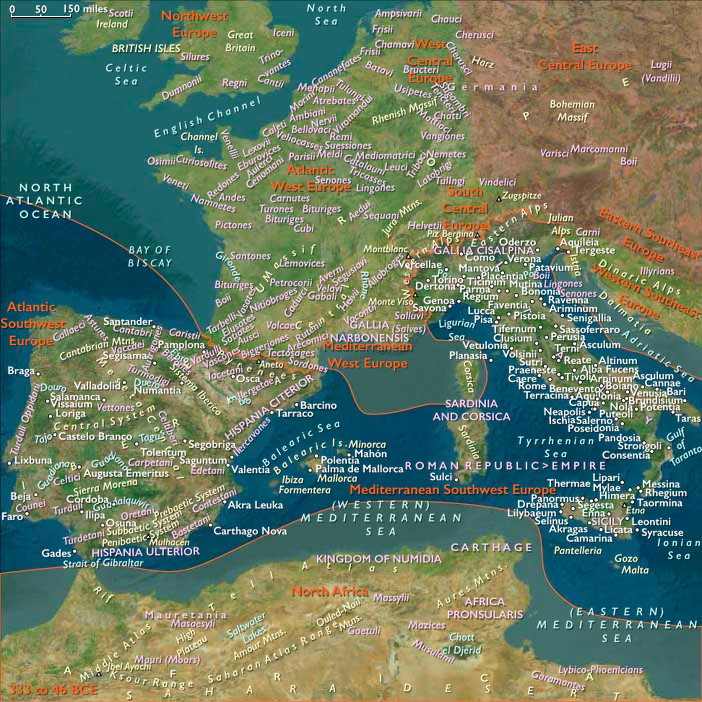
The Romans establish the city of Valentia Edetanorum on the site of a former Iberian town, by the river Turia.
Situated in eastern Spain about one hundred and ninety miles (three hundred kilometers) southeast of present Madrid in a fertile plain, the new city is cut off from the rest of Spain by the mountainous rim of the Meseta.
About two thousand Roman colonists are settled there in 138 BCE during the rule of consul Decimus Junius Brutus Galaico, who, according to the Roman historian Florus, transferred the soldiers who had fought under him to this province, Edetania.
This is a typically Roman city in its conception, strategically located near the sea on a river island crossed by the Via Augusta, the imperial road which connects the province to Rome, the capital of the empire.
Modern Valencia is today the third largest city in Spain after Madrid and Barcelona.
Tiberius, elected to the office of tribune in 133 BCE, immediately begins pushing for a program of land reform, partly by invoking an old Licinian law that limits the amount of land that could be owned by a single individual.
Using the powers of Lex Hortensia, Tiberius establishes an agrarian commission to oversee the redistribution of land holdings from patricians to peasants.
The commission consists of himself, his father-in-law Appius, and his brother Gaius.
Their post allows them to survey the ager publicus, publicly owned land that Tiberius wants to distribute among veterans of the Punic War.
Another faction in the Senate opposes them, as does the city’s conservative Optimate faction.
Even liberal senators are agitated, fearing their own lands would be confiscated.
Senators arranged for other tribunes to oppose the reforms.
The Senate gives trivial funds to the commission.
However, late in 133 BCE, Attalus III of Pergamon having died and left his entire fortune (including the whole kingdom of Pergamon) to Rome, Tiberius sees his chance and immediately uses his tribunician powers to allocate the fortune to fund the new law.
This is a direct attack on Senatorial power, since it is traditionally responsible for the management of the treasury and for decisions regarding overseas affairs.
The opposition of the Senate to Gracchus increases.
His overruling of the tribunician veto is considered illegal, and his opponents are determined to prosecute him at the end of his one year term, since he is regarded as having violated the constitution and having used force against a tribune.
Tiberius now appeals to the people, and argues that a tribune who opposes the will of the people in favor of the rich is not a true tribune.
The senators are left with only one constitutional response – to threaten prosecution after Tiberius's term as a tribune ends.
To protect himself further, Tiberius Gracchus seeks reelection to the tribunate, promising to shorten the term of military service, abolish the exclusive right of senators to act as jurors, and admit allies to Roman citizenship.
As the voting proceeds, violence breaks out on both sides.
Tiberius' cousin, Publius Cornelius Scipio Nasica, saying that Tiberius wishes to make himself king, leads the senators down towards Tiberius.
In the resulting confrontation, Tiberius is beaten to death with the chairs of the senators and thrown into the Tiber.
They also had gathered an ad hoc force, with several of them personally marching to the Forum.
Some three hundred of Tiberius’ followers, who were waiting outside the senate, perish with him, clubbed to death.
This is the first open bloodshed in Roman politics for nearly four centuries.
Plutarch says, "Tiberius' death in the senate was short and quick.
Although he was armed, it did not help him against the many senators of the day."
Eunus, the chief of Sicily’s rebellious enslaved population, has at one time two hundred thousand men and women as his followers, probably including children.
Little is known about Eunus's actual participation in the war.
Only his enemies leave accounts of him, and they give credit for his victories to his general, Cleon, but Eunus must have been a man of considerable ability to have maintained his leadership position throughout the war and to have commanded the services of those said to have been his superiors.
Archaeologists have found a small bronze coin, minted at Enna, which bears the inscription "King Antiochus."
It is likely that the Antiochus in question is Eunus.
Aristonicus, as Eumenes III, initially tries to gain support by promising freedom to the Greek cities of the coast.
When this fails he seeks support in the interior promising freedom to both slaves and serfs.
To what extent he is a social revolutionary or simply a dynastic contender to the throne is uncertain.
He is joined by Blossius of Cumae, the Stoic who had been a supporter of the failed reforms of the Gracchi in Rome and promises to found a state called Heliopolis, its capital a utopian “City of the Sun,” in which all are to be free.
The movement spreads among the oppressed.
Sicily’s slave revolt (the so-called First Servile War) has pinned down Roman armies for three years.
Enna, which from its central position and great natural strength has become the center of Eunus’s operations, and the receptacle, of the plunder of Sicily, is the last place that holds out against the proconsul Rupilius, and is at length betrayed into his hands, its impregnable strength having defied all his efforts.
Cleon falls in battle in 132.
After Eunus’s army is defeated by a Roman army under the leadership of Perperna, Eunus, with members of his "court," takes refuge in a cavern, where he is subsequently captured, but dies before he can be punished.
According to Strabo, Enna suffered severely upon this occasion (which, indeed, could scarcely be otherwise); he regards this period as the commencement of its subsequent decline.
The Wisdom of Sirach, a collection of ethical teachings, is thought to have been written by Jesus ben Sirach, a Jewish scribe who had been living in Jerusalem and may have authored the work in Alexandria, Egypt in about 180–175 BCE, where he is thought to have established a school.
The Greek translator of the work states in his preface that he is the grandson of the author, and that he had come to Egypt in the thirty-eighth year of the reign of "Euergetes".
This epithet was borne by only two of the Ptolemies.
Of these, Ptolemy III Euergetes reigned only twenty-five years (247-222 BCE) and thus Ptolemy VIII Euergetes must be intended; he ascended the throne in the year 170 BCE, together with his brother Philometor, but he soon became sole ruler of Cyrene, and from 146 to 117 held sway over all Egypt.
He dated his reign from the year in which he received the crown (i.e., from 170).
The translator must therefore have gone to Egypt in 132 BCE.
Ptolemy VIII Eugertes, called Physcon, had seduced and married Cleopatra III, who is his wife's daughter, without divorcing Cleopatra II, who is infuriated, and by 132 BCE or 131 BCE, the people of Alexandria riot and set fire to the royal palace.
Physcon, Cleopatra III, and their children escape to Cyprus, while Cleopatra II has their twelve-year-old son Ptolemy Memphitis acclaimed as king.
Physcon is however able to get hold of the boy and kills him, sending the dismembered pieces to Cleopatra.
The ensuing civil war pits Cleopatra's Alexandria against the countryside, which supports Physcon.
Cappadocia under Ariarathes IV had come into relations with Rome, first as a foe espousing the cause of Antiochus the Great, then as an ally against Perseus of Macedon.
The kings henceforward had throws in their lot with the Republic as against the Seleucids, to whom they had been from time to time tributary.
Ariarathes V marches with the Roman proconsul Publius Licinius Crassus Dives Mucianus against Aristonicus, a claimant to the throne of Pergamon, and their forces are annihilated in 130 BCE.
The imbroglio that follows his death will ultimately lead to interference by the rising power of Pontus and the intrigues and wars that end in the failure of the dynasty.
Antiochus, with Palestine secured, now devotes his attention to recovering the Seleucid domains in the east.
He assembles a powerful army, which once more includes men of Persis and Elymais.
The strength in numbers and the wealth of this army make an impression on contemporaries, who report that even the simple soldiers wear shoes cobbled with gold.
With enthusiastic support from the Hellenized cities, …
…Antiochus drives the Parthians from Mesopotamia and Babylonia and …