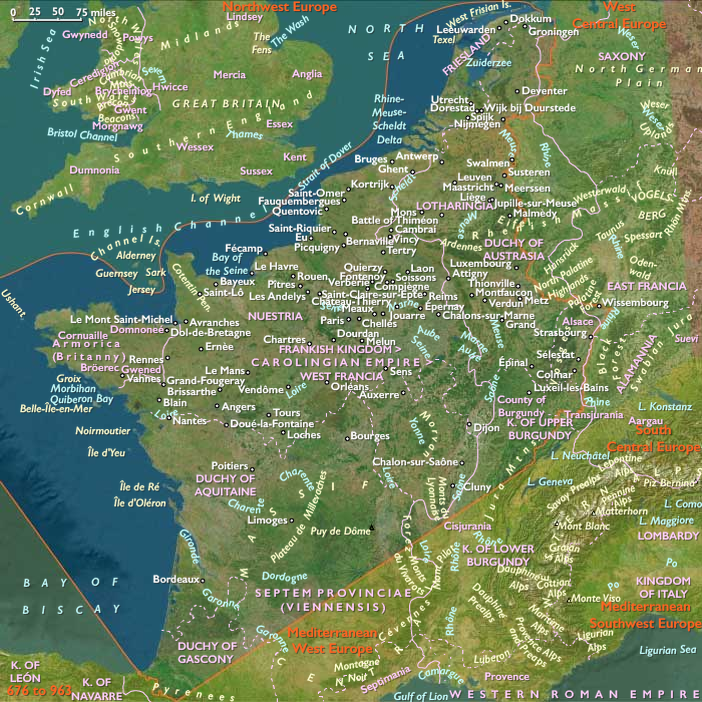
The Fall of Zwentibold and the Lotharingian…
August 900 CE
The Fall of Zwentibold and the Lotharingian Succession Crisis (900)
Zwentibold, illegitimate son of Emperor Arnulf of Carinthia, was installed as King of Lotharingia as part of his father’s plan to integrate the region into East Francia. His reign, however, faced severe resistance from the local nobility, leading to his eventual downfall and death in 900.
Zwentibold’s Reign and Unpopularity
- Backed by Archbishops Herman I of Cologne and Ratbod of Trier, Zwentibold attempted to rule Lotharingia as an extension of East Francia, enforcing royal authority over the nobility.
- However, his favoritism toward the common people alienated the powerful aristocracy, who had expected greater autonomy.
- By 899, Zwentibold was engaged in an ongoing struggle against unruly nobles, a conflict that escalated after the death of his father Arnulf in December 899.
The Lotharingian Nobles Turn Against Zwentibold
- With Arnulf dead, the East Frankish throne passed to his six-year-old son, Louis the Child, leaving Zwentibold without strong imperial backing.
- Reginar I (also called Reginar Longneck), Count of the Maasgau, had originally been a supporter of Zwentibold in 895 but turned against him in 898.
- Along with other powerful nobles, Reginar had invited Charles the Simple of West Francia to claim the Lotharingian throne, viewing him as a better alternative to Zwentibold.
- Zwentibold confiscated Reginar’s lands, but Reginar refused to surrender them and fortified himself at Durfost, near Maastricht.
The Fall of Zwentibold and the Battle of Susteren (August 13, 900)
- The nobility now unanimously supported Louis the Child, calling for imperial intervention to depose Zwentibold.
- In 900, representatives of Charles the Simple, Zwentibold, and Louis the Child met at Sankt Goar and determined that Lotharingia should return to East Francia under Louis the Child.
- A rebellion erupted, and Zwentibold was killed in battle near Susteren on August 13, 900, ending his short-lived Lotharingian kingdom.
Aftermath: Lotharingia Under East Francia
- Louis the Child was now officially recognized as King of Lotharingia, though his rule remained weak due to his young age.
- Reginar I regained his lands and emerged as the most powerful noble in Lotharingia, eventually becoming Duke of Lotharingia and Count of Hainaut.
- The failed reign of Zwentibold highlighted the increasing autonomy of local noble families, a trend that would lead to further feudalization of Lotharingia in the coming decades.
Legacy of Zwentibold
- First and last non-Carolingian ruler of Lotharingia → His death marked the return of Lotharingia to the Carolingian line, at least nominally.
- A warning sign of Carolingian decline → His inability to control the Lotharingian nobility foreshadowed the weakening of East Francia’s royal power.
- Lotharingia’s shifting allegiances → After Zwentibold’s fall, Lotharingia continued to oscillate between West Francia and East Francia, leading to centuries of territorial disputes.
Zwentibold’s downfall in 900 serves as a turning point in Lotharingian history, marking the region’s transition from royal control to increasing noble autonomy, setting the stage for the eventual fracturing of the Carolingian realm into smaller feudal states
Locations
People
Groups
Commodities
Subjects
Regions
West Europe
View →Subregions