
The Samian landed oligarchy has been overturned …
Years: 537BCE - 526BCE
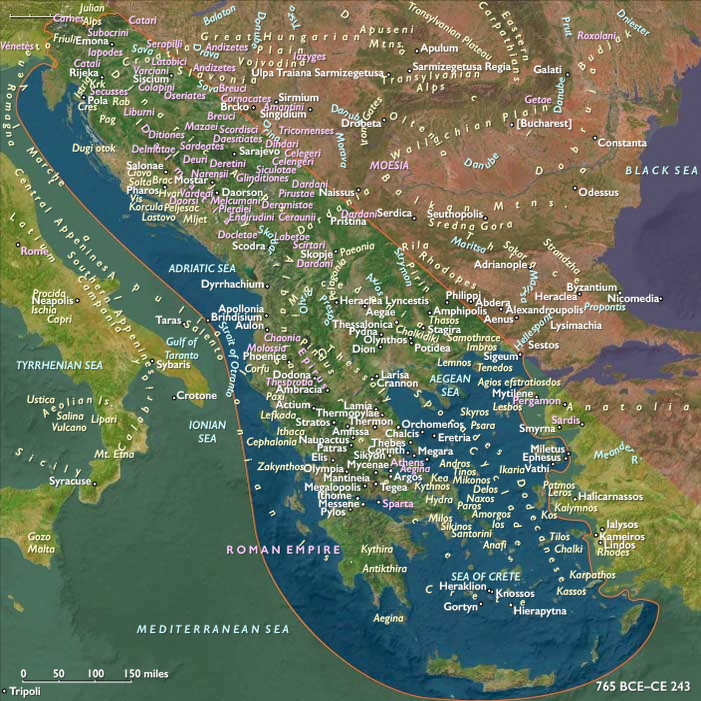
The Samian landed oligarchy has been overturned by the tyrant Polycrates, who with his two brothers Pantagnotus and Syloson had seized control of the city of Samos in 538 BCE during a celebration of a festival of Hera outside the city walls.
At first sharing his power with his siblings, he soon had Pantagnotus killed and exiled Syloson to assume sole control, establishing a despotism.
He allies with Amasis II, pharaoh of Egypt, as well as the tyrant of Naxos, Lygdamis.
With a navy of one hundred penteconters and an army of one thousand archers, he plunders the islands of the Aegean Sea and the cities on the Ionian coast of Asia Minor, defeating and enslaving the navies of Lesbos and Miletus.
He also conquers the small island of Rhenea, which he chains to nearby Delos as a dedication to Apollo.
He has a reputation as both a fierce warrior and an enlightened tyrant.
On Samos he builds an aqueduct, a large temple of Hera (the Heraion, to which Amasis dedicates many gifts), and a palace that will later be rebuilt by the Roman emperor Caligula.
The aqueduct, constructed by the Greek engineer Eupalinus in 530 and modeled after Sennacherib’s aqueduct at Ninevah, runs partially underground through a one mile-long (one point six-kilometer) tunnel more than eight feet (two meters) in diameter.
It is the second known tunnel in history to be excavated from both ends and the first with a methodical approach in doing so.
Being also the longest tunnel of its time, the Tunnel of Eupalinos is regarded as a major feat of ancient engineering.
Eupalinos is supposed to be the first hydraulic engineer in history whose name has been passed down.
Apart from that, though, nothing more is known about him.
Pythagoras, the son of Mnesarchus, a gem-engraver or a merchant, attempts to explain all aspects of the universe in terms of counting numbers, which he frequently represents by sets of objects arranged in geometric shapes.
He is said to have undertaken extensive travels for the purpose of collecting all available knowledge, and especially to learn information concerning the secret or mystic cults of the gods.
Many mathematical and scientific discoveries are attributed to Pythagoras, including his famous theorem, as well as discoveries in the field of music, astronomy, and medicine, but it is the religious element which makes the profoundest impression upon his contemporaries.
Pythagoras, at about age forty around 530 BCE, moves after his travels to Croton, in Italy (Magna Graecia).
Possibly, the tyranny of Polycrates has made it difficult for him to achieve his schemes in Samos.
Locations
People
Groups
- Lesbos, Greek City-State of
- Miletus (Ionian Greek) city-state of
- Greece, classical
- Samos, Ionian Greek city-state of
- Naxos (Ionian Greek) city-state of
- Magna Graecia
- Egypt (Ancient), Late Period of
Topics
Commodoties
Subjects
- Commerce
- Watercraft
- Engineering
- Environment
- Labor and Service
- Conflict
- Mayhem
- Faith
- Government
- Technology
- Mathematics
- Philosophy and logic
Regions

Subregions
Related Events
Showing 10 events out of 65787 total
Years: 537BCE - 526BCE
Locations
People
Groups
- Lesbos, Greek City-State of
- Miletus (Ionian Greek) city-state of
- Greece, classical
- Samos, Ionian Greek city-state of
- Naxos (Ionian Greek) city-state of
- Magna Graecia
- Egypt (Ancient), Late Period of
Topics
Commodoties
Subjects
- Commerce
- Watercraft
- Engineering
- Environment
- Labor and Service
- Conflict
- Mayhem
- Faith
- Government
- Technology
- Mathematics
- Philosophy and logic
Regions
Subregions