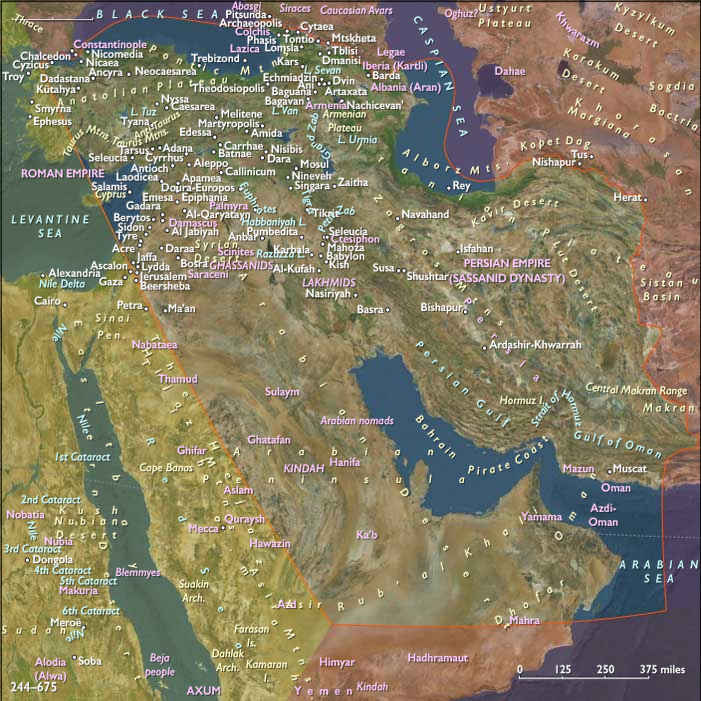
The Sassanid Empire, with the threat from…
November 636 CE
The Sassanid Empire, with the threat from Constantinople ended, remains a formidable power with vast manpower reserves, and the Muslim Arabs soon find themselves confronting a huge Persian army with troops drawn from every corner of the empire and commanded by its foremost generals.
Among the troops are fearsome war elephants that the Persian commander brings with him for the sole purpose of frightening and vanquishing the Muslims.
Within three months, Saad defeats the Persian army in the Battle of al-Qādisiyyah, effectively ending Sassanid rule west of Persia proper.
From this battle, the Arab Muslims gain a large amount of spoils, including the famed jewel-encrusted royal standard, called the Derafsh-e-Kāveyān (the 'flag of Kāveh').
The jewel is cut up and sold in pieces in Medina.
The Arab fighters become known as ‘’ahl al-Qādisiyyah’’ and will hold the highest prestige of the later Arab settlers within Iraq and its important garrison town, Kufa.
Once the battle of Qadisiyya is over, Sa'ad sends a report of the Muslim victory to Umar.
The battle shakes the Sassanian rule in Iraq to its foundations but is not the end of their rule in Iraq.
As long as the Sassanids hold their capital Ctesiphon, there is always the danger that at some suitable moment they will make an attempt to recover what they had lost and drive away the Arabs from Iraq.
Caliph Umar thus sends instructions to Saad that as a sequel to the battle of Qaddisiyyah, the Muslims should push forward to capture Ctesiphon.
Locations
People
Groups
Topics
Subjects
Regions

The Near and Middle East
View →Subregions