
Sculptures of chariots found in ancient Chinese…
1341 BCE to 1198 BCE
Sculptures of chariots found in ancient Chinese tombs reveal that the spoked wheel (evidenced by sculptures of chariots in contemporary Chinese tombs) arrives in China by the thirteenth century BCE, effectively completing the diffusion of the wheel to the major centers of Old World civilizations.
Locations
Subjects
Regions
East Asia
View →Subregions
Maritime East Asia
View →Related Events
No active filters.
Showing 10 events out of 67397 total
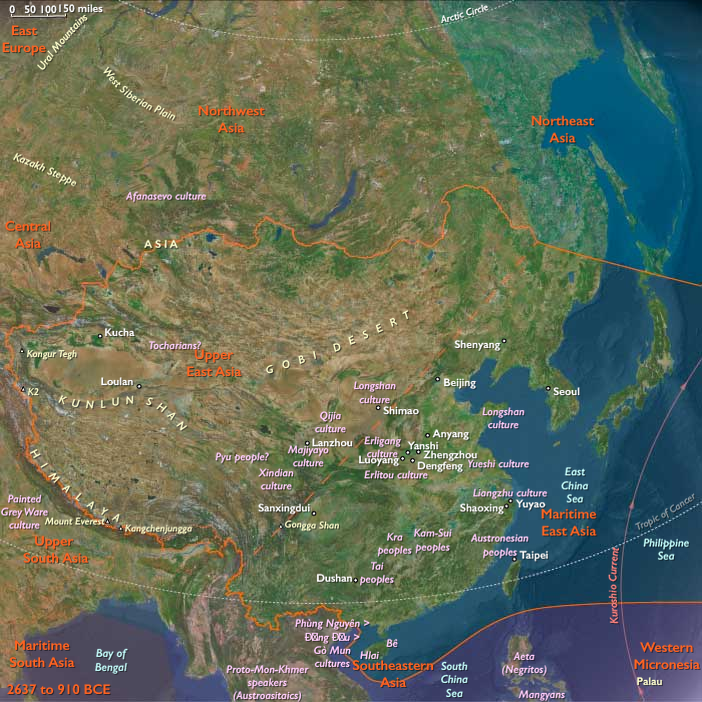
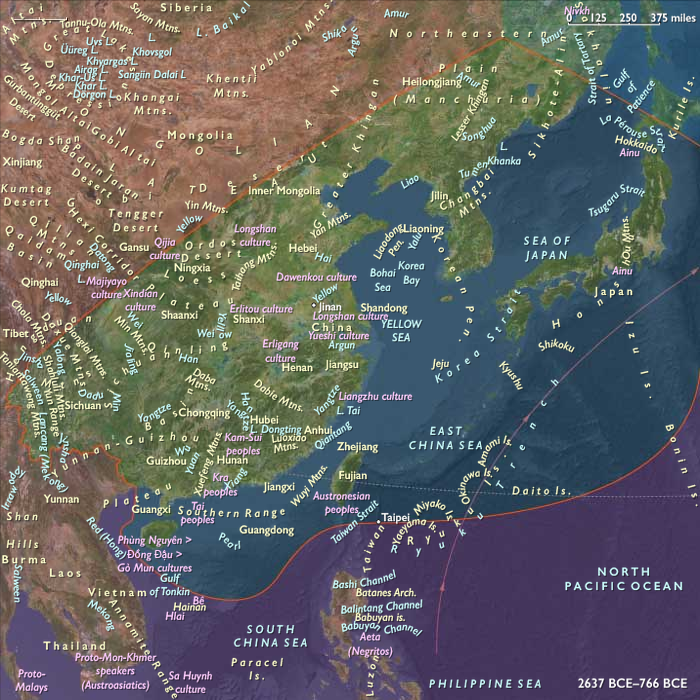
The Shang rule from the city of Yin, near modern Anyang, beginning about 1350 BCE.
The new capital city includes defensive walls plus palaces, temples, tombs for the elite, facilities for storage of grain, and army barracks.
The Chinese begin around 1300 BCE to use a cyclical system to count days.
The system consists of two groups of ideographs, the twelve branches and the ten stems, which are combined in couples, odd-to-odd and even to even, to form an endlessly repeating cycle of sixty units.
The system, known as the Sexagenary cycle of the Heavenly Stems and Earthly Branches, consists of two groups of ideographs, the twelve branches and the ten stems, which are combined in couples, odd to odd and even to even.
Chinese texts of the early thirteenth century BCE record quadrants of the moon.
Chinese astronomers begin to catalogue and name the brightest stars.
Star names later categorized in the twenty-eight mansions have been found on oracle bones unearthed at Anyang, dating back to the middle Shang Dynasty (Chinese Bronze Age), and the mansion system's nucleus seems to have taken shape by the time of the ruler Wu Ding (1339-1281 BCE).
Shang astronomers have also sighted Mars and various comets.
The Shang dynasty has a fully developed system of writing; its complexity and state of development indicates an earlier period of development, which is still unattested.
Two distinct forms of Chinese writing (readable today) date from around the thirteenth century BCE (still earlier forms are as yet undeciphered).
Pictographic script writing continues to be written on oracle bones, pottery, jade and stone, wooden table surfaces, and silk-covered bamboo.
Shang artisans of the thirteenth century BCE produce glazed pottery, carving in marble and jade, and exquisite bronze casting.
At Anyang, bronze casters of the Shang Dynasty produce distinctive vessels, drums and bells, some with calligraphic ornamentation.
The bronze is commonly used for art rather than weapons, although Shang troops fight frequent wars with neighboring settlements and nomadic herdsmen from the inner Asian steppes.
The Shang king, who often performs oracle bone divinations himself, repeatedly shows concern about the fang groups, which represent barbarians outside of the civilized tu regions that make up the Shang center.
In particular, the tufang group of the Yan Shan mountain region is regularly mentioned as hostile to the Shang.
Shang influence, though not political control, extends as far northeast as modern Beijing, where early pre-Yan culture shows evidence of Shang material culture.
At least one burial in this region during the Early Shang period contains both Shang-style bronzes and local-style gold jewelry.
The discovery of a Chenggu-style ge dagger-ax at Xiaohenan demonstrates that even at this early stage of Chinese history, there is some level of connection between the distant areas of north China.
Scandinavia has been characterized by a warm climate comparable to that of present-day Mediterranean since the climate change that had occurred around 2700 BCE, permitting a relatively dense population and good farming; for example, grapes are grown in Scandinavia at this time.
The Nordic Bronze Age (also Northern Bronze Age) is the name given by Oscar Montelius to a period and a Bronze Age culture in Scandinavian prehistory, around 1800 BCE to 500 BCE, with sites that reach as far east as Estonia.
Succeeding the Corded Ware culture in Denmark, Sweden, and parts of Norway, it is generally considered the direct predecessor and origin of the Proto-Germanic culture of the Pre-Roman Iron Age.
This civilization is presumably founded in amber trade, through contacts with Central European and Mediterranean cultures.
Powerful centers emerge around 1800 in such key areas of Scandinavia as the shores of the Limfjord, a shallow sound in Denmark that separates the island of Vendsyssel-Thy from the rest of Jutland Peninsula.
The Nordic Bronze Age period in Denmark would be marked by a culture that buries its dead, with their possessions, beneath burial mounds.
Many dolmens and rock tombs (especially "passage graves") date from this period, from which the many bronze finds include beautiful religious artifacts and musical instruments, and the earliest evidence of social classes and stratification.
Amber is moved from northern Europe to the Mediterranean area from at least the sixteenth century BCE.
The breast ornament of Egyptian pharaoh Tutankhamen, who reigned in around 1333 BCE to 1324 BCE) contains large Baltic amber beads.
The quantity of amber in the Royal Tomb of Qatna, Syria, is unparalleled for known sites of the second millennium BCE in the Levant and the Ancient Near East.The Baltic amber trade, which appears to have extended to the Mediterranean Sea, has been traced by archaeologists back to the Nordic Bronze Age; its major center is located in the region of Sambia.
This trade probably existed prior to the historical Trojan War in the thirteenth century BCE, as amber is one of the substances in which the palace of Menelaus at Sparta was said to be rich in Homer's The Iliad.
Heinrich Schliemann will find Baltic amber beads at Mycenae, as shown by spectroscopic investigation.