
The so-called Elamite Middle Period, an era…
1305 BCE to 1294 BCE
The so-called Elamite Middle Period, an era of increasing power and prosperity which begins around 1300, sees a surge of spectacular architecture and sculpture at such Elamite centers as Dur-Untash.
Subjects
Regions
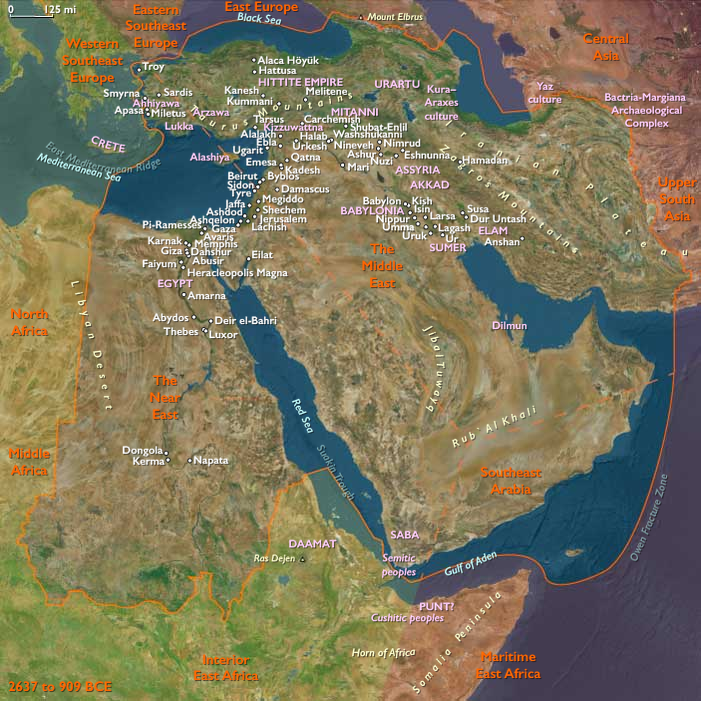
The Near and Middle East
View →Subregions

Middle East
View →Related Events
No active filters.
Showing 10 events out of 67259 total
The Hittite empire, at its peak during the reign of Mursili II, stretches from Arzawa in the west to Mitanni in the east, many of the Kaskian territories to the north including Hayasa-Azzi in the far northeast, and on south into Canaan approximately as far as the southern border of Lebanon, incorporating all of these territories within its domain.
By the time of his death, followed by the succession of Muwattali in 1295, the Hittite Empire, now firmly established, is effectively governed through a widespread system of treaty relationships with allies and vassal states.
A rock-fill dam, used to irrigate fields near the present city of Homs, is constructed on the Orontes River in Syria about 1300.
Egypt's power and confidence has once again been restored under Horemheb after the chaos of the Amarna period.
Horemheb is a prolific builder: in his lifetime, he builds numerous temples and buildings throughout Egypt.
He constructs the Second, Ninth and Tenth Pylons of the Great Hypostyle Hall in the Temple at Karnak, using recycled talatat blocks from Akhenaten's own monuments as building material for the first two Pylons.
The Egyptians (presumably) undertake deep underground mining by 1300 in the Nubian desert. (One surviving mine is fifteen hundred feet, or four hundred and fifty meters, long and had been excavated to a depth of two hundred and ninety-two feet, or eighty-nine meters).
The people of Tiryns greatly strengthen the city’s fortifications around 1300.
Assyria allies for a brief time with a diminished Mitanni to liberate the Mitanni subkingdom of Hangibat from Hittite control.
A widespread system of treaty relationships with allies and vassal states effectively governs the now firmly established new Hittite Empire.
The Hittite Empire concludes a peace treaty with Egypt in 1285.
Adad-nirari, who has succeeded his father Arik-den-ili, is the earliest Assyrian king whose annals survive in any detail.
A few years after his accession in 1295, he defeats the Kassite king Nazimaruttash of Babylonia, forcing his retreat.
Horemheb, the last pharaoh of the Eighteenth dynasty, apparently chooses a commander of his army to succeed him to the throne.
upon Horemheb’s death in 1292 BCE, Ramesses I inaugurates the Nineteenth dynasty.
Ramesses, who plans and begins construction on the colonnaded hall in the temple at Karnak, reigns for little more than a year before dying in 1290 BCE; his son succeeds him as Seti I.
Egypt’s populace abandons Thebes for a new capital at Tell el-Amarna during the brief Egyptian experiment with monotheism.
A concurrent decline in the empire is reversed with the establishment of the Nineteenth dynasty; which establishes a new royal capital at Per-Ramesse ("the house of Ramesses") in the Nile's eastern delta.
Egyptian women of the Nineteenth Dynasty period have a number of legal rights: they may own property and request divorce.
Although barred from holding government office, a woman may fill in for her husband in his absence.
A woman can earn her own living by managing a farm, weaving or dancing.
Mycenaean civilization reaches its height; Mycenae may at this time be the capital of an empire controlling the whole Aegean region.
In Canaan, Hazor reaches its peak with the construction of several temples some containing unusual cult objects and furnished with such objects as Mycenaean pottery, Egyptian scarabs, jewelry, and statuettes.
The Hittites answer Egypt’s campaigns against them at Kadesh on the Orontes River.
Initially surprised and surrounded by a Hittite pincer movement, the Egyptians hold out and escape defeat, counterattacking the Hittite forces when they stop to loot their fallen enemies.