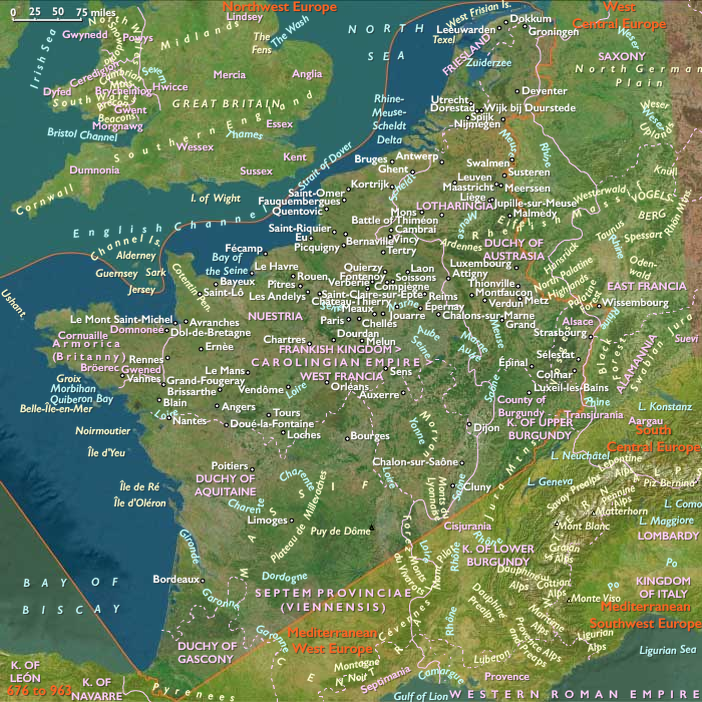
The Oaths of Strasbourg (842): A Landmark…
842 CE
The Oaths of Strasbourg (842): A Landmark in Political and Linguistic History
The Oaths of Strasbourg, sworn in 842 between Louis the German and Charles the Bald, represent a crucial political alliance and a milestone in the development of the French language. These mutual pledges of allegiance and solidarity are made in opposition to their eldest brother, Lothair I, who, as ruler of Middle Francia and nominal Holy Roman Emperor, seeks to maintain dominance over the entire Carolingian realm.
The Strategic Context
- Following the Battle of Fontenoy (841), where Lothair suffered a crippling defeat, Louis the German and Charles the Bald consolidate their alliance.
- To reinforce their unity and secure the loyalty of their respective armies, they convene at Strasbourg in 842, where both rulers and their assembled troops swear oaths of allegiance.
- This event marks a key moment in the civil war that will lead to the Treaty of Verdun (843), permanently dividing the Carolingian Empire.
Linguistic Significance
The Oaths of Strasbourg are the earliest known written text of substantial length in a Romance language, serving as a linguistic bridge between Latin and early French. They are recorded in three languages:
- Medieval Latin – The official scriptural language of the Frankish Empire.
- Old High German (Rhenish Franconian dialect) – The language of Louis the German's soldiers.
- Proto-French (Old French) – The language of Charles the Bald’s troops, marking one of the first clear instances of French as a distinct language from Latin.
The Pledges and Their Implications
- Louis and Charles each swear allegiance to the other in the language of the other's troops—ensuring their pledges are understood by their respective armies.
- The soldiers in attendance also swear separate oaths, pledging that if their own king breaks his agreement, they will not support him against the other monarch. This groundbreaking condition underscores the importance of mutual trust and signals an early form of political accountability.
Historical Impact
- The Oaths of Strasbourg mark the growing cultural and linguistic divide between the Germanic East Francia and Romance-speaking West Francia, foreshadowing the later emergence of France and Germany as distinct nations.
- The document establishes an early precedent for political contracts and military alliances, where loyalty is not solely dependent on feudal ties but also on collective responsibility.
- It directly leads to the Treaty of Verdun (843), which formalizes the partition of the Carolingian Empire, creating the borders of medieval Europe.
Legacy
The Oaths of Strasbourg are not just a political agreement; they represent a cultural and linguistic turning point in European history. By recording early Old French and Old High German, they mark the moment when Latin begins to fragment into distinct national languages, setting the stage for the evolution of modern European identities.
Locations
Regions

West Europe
View →Subregions