
The southern Italian princes have paid homage …
Years: 1055 - 1055
April
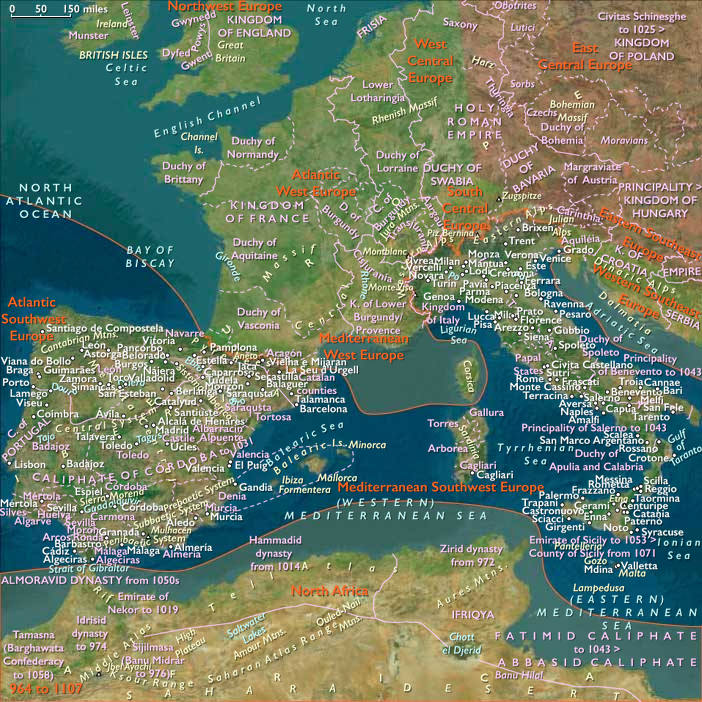
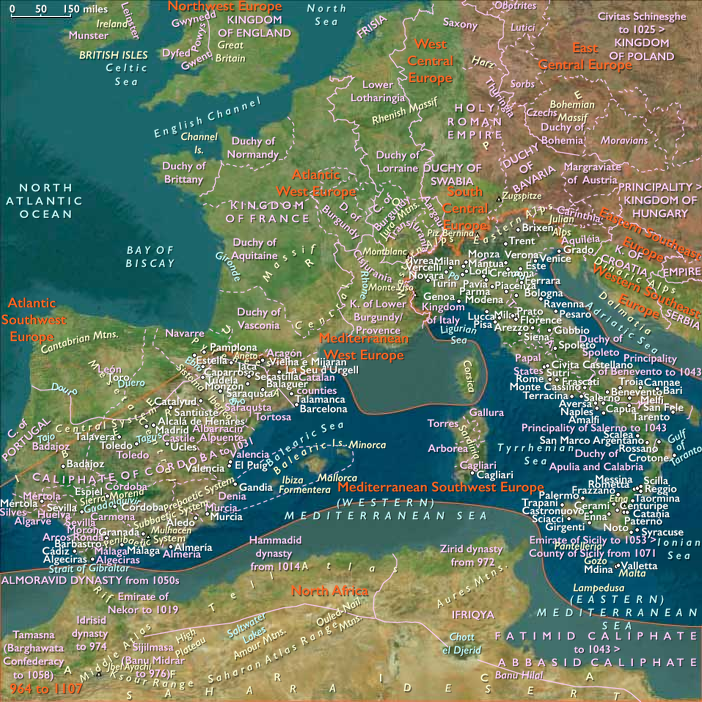
The southern Italian princes have paid homage to Emperor Henry III, who, through war and diplomacy, has induced the rulers of Poland, Bohemia, and Hungary to do the same.
The marriage of Upper Lorraine’s troublesome Duke Godfrey with Beatrice of Tuscany in 1054 had created a threat in Italy that Henry seeks to counter in 1055.
Henry has by Easter arrived in Mantua.
The emperor holds several courts, one at Roncaglia, where, a century later (in 1158), Frederick Barbarossa will hold a far more important diet, sending out his missi dominici to establish order.
Godfrey, ostensibly the reason for the visit, is not well received by the people and returns to Flanders.
Locations
People
- Baldwin V of Flanders
- Godfrey III, Duke of Lower Lorraine
- Henry III, Holy Roman Emperor
- Peter Damian
Groups
- Lombards (West Germanic tribe)
- Papal States (Republic of St. Peter)
- Tuscany, Margravate of
- Flanders, County of
- German, or Ottonian (Roman) Empire
- Italy, Kingdom of (Holy Roman Empire)
- Lorraine (Lothier), Lower, (second) Duchy of
- Christians, Roman Catholic
Topics
Commodoties
Subjects
Regions
Subregions
Related Events
Filter results
Showing 10 events out of 51127 total
Construction on the stone and brick pagoda of Kaiyuan Monastery, Dingzhou, had begun in the year 1001 during the reign of Emperor Zhenzong of Song, and is completed in 1055 during the reign of Emperor Renzong of Song.
Upon completion , the Liaodi Pagoda surpasses the height of China's previously tallest pagoda still standing, the central pagoda of the Three Pagodas, which stands at 69.13 meters (two hundred and thirty feet).
The tallest pagoda in pre-modern Chinese history had been a one hundred-meter-tall (three hundred and thirty feet feet) wooden pagoda tower in Chang'an built in 611 by Emperor Yang of Sui, yet this structure no longer stands.
The Liaodi Pagoda, today the tallest existing pre-modern Chinese pagoda and tallest brick pagoda in the world, stands at a height of eighty-four meters (two hundred and seventy-six feet), resting on a large platform with an octagonal base.
Emperor Zhenzong had intended to have Buddhist scriptures gathered by the Chinese monk Huineng from India stored at the pagoda's site.
Due to its location at a strategic military location, the height of the pagoda made it useful as a watchtower, which could be used to spot enemy movements coming from the northern Liao Dynasty headed by the Song's Khitan rivals.
Initially the pagoda was called the Kaiyuan Pagoda, but as a result of its military use it became known as the 'Liaodi' pagoda, literally meaning 'foreseeing the enemy's intention’.
The councilors of Emperor Constantine IX Monomachos, chiefly the logothetes tou dromou John, persuade the dying emperor to pass the throne to the doux of Bulgaria, Nikephoros Proteuon.
Their plans are preempted, however, by Constantine's aged sister-in-law Theodora, the last descendant of the Macedonian dynasty, who is brought out of her retirement in a convent and proclaimed "emperor" by the imperial guard shortly before Constantine's death on January 11, 1055.
In spite of her seventy years, Theodora reasserts her dormant rights with vigor and frustrates an attempt to supersede her on behalf of the general Nikephoros Bryennios, the empire's commander in Albania.
A purge of senior officials and the leadership of the European military units followed.
Bryennios, whom the western tagmata apparently wanted to proclaim him emperor instead, is also dismissed and exiled.
Tughril soon decides to put an end to the Buyid state in Iraq.
Under cover of intended pilgrimage to Mecca, the Seljuq ruler enters Iraq with a heavy force, and, assuring the Caliph of pacific views and subservience to his authority, begs permission to visit the capital.
He makes it known that after he returns, he will make war with the Fatimids.
The caliph, who had initially preferred the weak Buyids over the strong Seljuqs despite the latter's Sunni orthodoxy, declares that Tughril’s name should be recited before that of al-Malik al-Rahim in the Friday sermons.
The amir thereupon becomes a vassal of the Seljuqs.
A few days after, on December 17, 1055, Tughril himself—having sworn to be true not only to the Caliph, but also to the Buuid amir, Abu Nasr al-Malik al-Rahim, makes his entry into the capital, where he is well received both by chiefs and people.
Barely a week passes, however, before the citizens of Baghdad begin to complain to the amir about looting committed by the Seljuq troops, asking him to expel them out of the city.
Tughril then summons him to his camp to negotiate over the issue.
When he arrives, he is accused of acts of retribution against the Seljuq troops, and is arrested over the caliph's protests.
The last Buyid ruler of Iraq, Al-Malik al-Rahim will die a prisoner in Ray in 1058 or 1059.
Henry returns from Italy via Zürich and here betroths his young son to Bertha, daughter of Count Otto of Savoy.
Al-Bakri, in his Book of Routes and Realms, completed in 1068, gives the only detailed description that we have for Aoudaghost.
Al-Bakri made use of earlier sources and it is likely that his description of Aoudaghost comes from the writings of Muhammad b. Yusuf al-Warraq (904-973) whose own account has not survived:
Then to Awdaghust which is a large town, populous and built on sandy ground, overlooked by a big mountain, completely barren and devoid of vegetation.
... there is one cathedral mosque and many smaller ones... Around the town are gardens with date palms.
Wheat is grown there by digging with hoes, and it is watered with buckets...Excellent cucumbers grow there, and there are a few small fig trees and some vines, as well as plantations of henna which produce a large crop... [there are] wells with sweet water.
Cattle and sheep are so numerous... Honey ... is abundant, brought from the land of the Sudan.
The people of Awdaghust enjoy extensive benefits and huge wealth.
The market there is at all times full of people... Their transactions are in gold, and they have no silver.
Most of the inhabitants ... are natives of Ifriqiya [Tunisia]... but there are also a few people from other countries... [They own] slaves so numerous that one person from among them might possess a thousand servants or more.
Al-Bakri also describes the capture of the town by the Almoravids which had occurred just a few years before he wrote his account: In the year 1054-5 'Abd Allah b. Yasin invaded the town of Aoudaghost, a flourishing locality, and a large town containing markets, numerous palms and henna trees....
This town used to be the residence of the King of the Sudan who was called Ghana before the Arabs entered (the city of) Ghana...
This (former) city was inhabited by Zenata together with Arabs who were always at loggerheads with each other.
...
The Almoravids violated its women and declared everything that they took there to be booty of the community.
...
The Almoravids persecuted the people of Aoudaghost only because they recognized the authority of the ruler of Ghana.
It is unclear from this text how long prior to the arrival of the Almoravids the town had been part of the Ghana Empire.
The Siege of Antwerp and the Changing Character of Henry III’s Reign (1054–1055)
By 1054–1055, Emperor Henry III found himself once again confronting Baldwin V of Flanders and Godfrey the Bearded, who had resumed their rebellion by besieging Antwerp. However, their efforts were once again thwarted, reaffirming Henry’s continued dominance in the region. Despite this victory, Henry’s reign was undergoing a profound shift, as old foes and longtime allies alike were dying off, leaving the emperor to reshape his rule in a changing political landscape.
The Renewed Rebellion: Baldwin and Godfrey Besiege Antwerp
- Baldwin V of Flanders, despite previous setbacks, remained defiant, seeking to expand his influence along the imperial frontier.
- Godfrey the Bearded, though previously reconciled with Henry III, had again become involved in anti-imperial activities, aligning himself once more with Baldwin.
- Together, they laid siege to Antwerp, a crucial imperial stronghold in Lower Lorraine that was vital for controlling trade and military movements in the region.
- Henry responded swiftly and decisively, mobilizing his forces and once again defeating the rebels.
The Changing Nature of Henry III’s Reign
- By 1055, Henry III’s rule was entering a new phase—the era of constant rebellions and noble uprisings was fading, replaced by a different set of political challenges.
- Many of his old adversaries and supporters were dying or declining in power, including:
- Dirk IV of Holland, killed in 1049.
- Godfrey the Bearded, whose repeated failures were gradually diminishing his political influence.
- Geoffrey Martel of Anjou, who was aging and increasingly focused on internal Angevin affairs.
- At the same time, old allies and imperial loyalists were also passing away, requiring Henry to forge new alliances and maintain stability within the empire.
Consequences and Legacy
- Baldwin and Godfrey’s continued failures solidified Henry III’s control over the Low Countries, preventing Flanders from becoming an independent power outside imperial oversight.
- The defeat at Antwerp further weakened Godfrey’s standing, pushing him closer to seeking reconciliation with the emperor once again.
- As Henry’s longstanding rivals disappeared, he found himself facing a different political landscape, one where the nature of his rule would have to adapt to maintain imperial power.
Henry III’s reign was clearly transitioning—where once he had fought regional noble uprisings, he was now dealing with new threats and internal shifts, shaping the next phase of the Holy Roman Empire’s stability and governance.
Henry appoints his confessor, Anno, as the successor of Herman of Cologne at the latter's death in 1055.
Godwin's son Sweyn had died on pilgrimage to Jerusalem, and it was probably at this stage that Ralph, later called Ralph the Timid, whose mother was Godgifu, the daughter of King Æthelred the Unready and his second wife Emma, was given Sweyn's earldom of Hereford, which includes Oxfordshire.
Ælfgar, the son of Leofric, Earl of Mercia, by his well-known wife—another Godgifu (Lady Godiva)—had gained in 1051 from the exile of Earl Godwin of Wessex and his sons.
He had been given the Earldom of East Anglia, which had been that of Harold, son of Godwin.
After Earl Godwin and King Edward became reconciled the following year, Harold had been restored to his earldom—but not for long.
When Godwin died in Easter 1053, Harold had succeeded to the earldom of Wessex, and the earldom of East Anglia had returned to Ælfgar.
Ælfgar seems to have learned from the tactics Godwin used to put pressure on King Edward.
When he is himself exiled in 1055, he raises a fleet of eighteen ships in Ireland, then turns to Wales, where King Gruffydd ap Llywelyn agrees to join forces with him against King Edward.
Two miles from Hereford, on October 24, they clash with the army of the Earl of Herefordshire, Ralph.
The Earl and his men eventually take flight, and Gruffydd and Ælfgar pursues them, killing and wounding as they go, and enacting savage reprisals on Hereford.
They despoil and burn the town, killing many of its citizens.
It will later be claimed that Ralph and his Frenchmen had started the rout, resulting in his insulting nickname, 'The Timid'.
King Edward orders an army mustered and puts Earl Harold in charge of it.
This is more formidable opposition, and Ælfgar and Gruffydd flee to South Wales.
However, the issue is resolved by diplomacy and Earl Ælfgar is reinstated.
Cnut, after the Danish conquest of England in 1016, had had Edward, son of Edmund Ironside, said to be only a few months old, and his brother, Edmund, sent to the Swedish court of Olof Skötkonung (who was either Cnut's half-brother or stepbrother), supposedly with instructions to have the children murdered.
The two boys had instead been secretly sent to Kiev, where Olof's daughter Ingigerd was the Queen.
King Edward in 1054 had sent Ealdred to Germany to obtain the help of Emperor Henry III in returning his elder half-brother, known as Edward the Exile, to England.
Ealdred had achieved some success on this mission and obtained insight into the working of the German church during a stay of a year with Hermann II, the Archbishop of Cologne.
He had also been impressed with the buildings he saw, and will later incorporate some of the German styles into his own constructions.
The main objective of the mission, however, had been to secure the return of Edward, but this had failed, mainly because Henry III's relations with the Hungarians are strained, and the emperor had been unable or unwilling to help Ealdred.
Ealdred had been able to discover that Edward was alive, and had a place at the Hungarian court.
Although some sources state that Ealdred attended the coronation of Emperor Henry IV, this is not possible, as on the date that Henry was crowned, Ealdred was in England consecrating an abbot.
Ealdred had returned to England by 1055, and had brought with him a copy of the Pontificale Romano-Germanicum, a set of liturgies.
An extant copy of this work, currently manuscript Cotton Vitellus E xii, has been identified as a copy owned by Ealdred.
It appears likely that the Rule of Chrodegang, a continental set of ordinances for the communal life of secular canons, was introduced into England by Ealdred sometime before 1059.
Probably he brought it back from Germany, possibly in concert with Harold.
Bretislaus, who in a short war has expanded Bohemia-Moravia’s borders beyond the Carpathians into Silesia and as far as Kraków, dies at Chrudim on January 10, 1055, during his preparation for another invasion of Hungary.
Years: 1055 - 1055
April
Locations
People
- Baldwin V of Flanders
- Godfrey III, Duke of Lower Lorraine
- Henry III, Holy Roman Emperor
- Peter Damian
Groups
- Lombards (West Germanic tribe)
- Papal States (Republic of St. Peter)
- Tuscany, Margravate of
- Flanders, County of
- German, or Ottonian (Roman) Empire
- Italy, Kingdom of (Holy Roman Empire)
- Lorraine (Lothier), Lower, (second) Duchy of
- Christians, Roman Catholic
