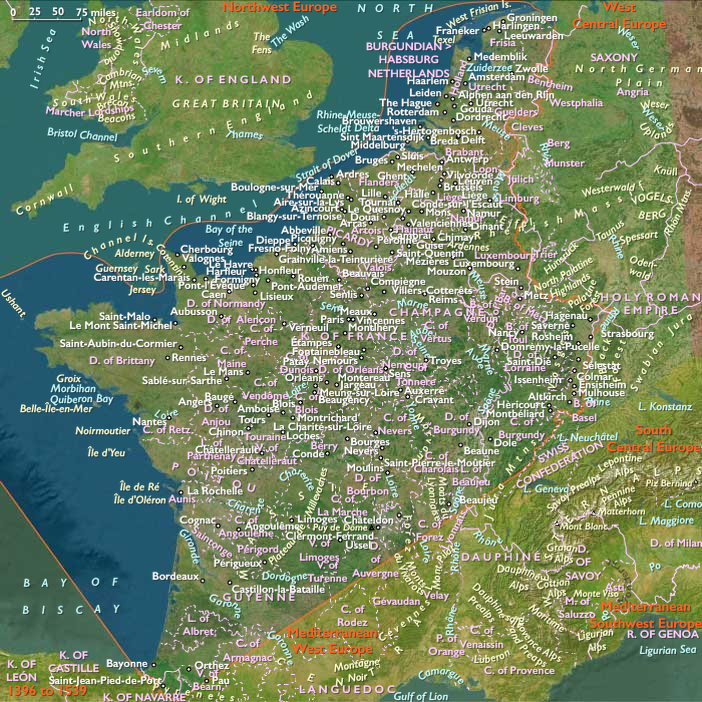
Château d'Amboise: A Strategic Fortress Turned Royal…
1492 CE to 1503 CE
Château d'Amboise: A Strategic Fortress Turned Royal Renaissance Residence (9th–15th Centuries)
Strategically positioned atop a spur overlooking the River Loire, the Château d'Amboise has long occupied a significant place in the political and architectural history of Atlantic West Europe. Originally the site of a Gallic oppidum, the château evolved from a medieval fortress to an elegant Renaissance palace, reflecting broader shifts in politics, power, and artistic sensibilities during the late medieval and early modern periods.
Early Origins and Angevin Ascendancy (9th–10th Centuries)
In the late ninth century, the château came into prominence through Ingelgarius, Viscount of Orléans, whose political rise owed much to family connections and military prowess. Ingelgarius’s marriage to Adelais, a noblewoman whose influential family already controlled Amboise, firmly anchored the castle’s importance within the emerging Angevin power structures. Their son, Fulk I ("the Red"), inherited these domains, placing Amboise alongside Loches and Villentrois as a core holding on the eastern frontier of Angevin territory.
Angevin-Blesois Rivalries: Fulk Nerra’s Defense of Amboise (Late 10th Century)
The château gained further strategic significance under Fulk II (Foulques Nerra) around 987, who faced sustained territorial pressure from rival noble Odo I, Count of Blois. To undermine Angevin strength, Odo coordinated assaults on Fulk's holdings, particularly focusing on Amboise and Loches. Conan, Count of Rennes, alongside Gelduin of Saumur and Abbot Robert of Saint-Florent, raided the region, attempting to isolate these castles from Angevin support. To bolster these threats, fortifications arose at nearby Chaumont and Montsoreau, and garrisons were established at strategic locations like Saint-Aignan, emphasizing the frontier’s vulnerability and the château’s critical defensive role.
Transition to Royal Possession and Popularity (1434–1492)
By the 15th century, Amboise transitioned decisively into royal hands. In 1434, King Charles VII confiscated the château from its lord, Louis d'Amboise, after Louis was implicated in plots against the future Louis XI. Although Louis d'Amboise received a royal pardon, the crown permanently claimed the château, transforming it from a noble fortress into a favored royal residence. Its picturesque setting, combined with strategic convenience, elevated Amboise to a primary royal domicile.
Charles VIII and the Italian Renaissance Influence (1492–1498)
Beginning in 1492, King Charles VIII initiated extensive renovations, transforming the château into a showcase of French and Italian architectural fusion. Initially employing prominent French builders like Colin Biart, Guillaume Senault, and Louis Armangeart, Charles first renovated Amboise in the late-Gothic, Flamboyant style characteristic of French architecture.
After the king's Italian campaign (1494–1495), however, Charles brought home Italian Renaissance craftsmen, most notably the mason-builders Domenico da Cortona and Fra Giocondo, who introduced Renaissance motifs to French architecture. Their innovative decorative vocabulary—classical arches, balustrades, pilasters, and symmetrical gardens—set a precedent, dramatically altering French aesthetic sensibilities and signaling a wider shift towards Renaissance culture.
Among the most influential Italian artists Charles employed was the landscape designer Pacello da Mercogliano, whose innovative gardens at Amboise (and at Blois) reshaped French horticulture, influencing garden designs throughout France.
Significance and Long-Term Legacy
The Château d'Amboise’s architectural transformation from medieval fortress to Renaissance palace symbolizes broader changes in French society, politics, and culture. As a strategic stronghold in the medieval Angevin-Blesois conflicts, it reinforced the political fragmentation typical of feudal Europe. Its later royal appropriation and subsequent Renaissance renovation under Charles VIII represented centralizing royal power and France's integration into wider European cultural and artistic movements.
Amboise thus exemplifies a key moment in Atlantic West Europe’s transition from medieval fragmentation to early modern state centralization, simultaneously heralding the arrival of Renaissance ideas and aesthetics north of the Alps. The château remains emblematic of France’s late-medieval heritage and its early embrace of Renaissance artistic and architectural ideals.
Locations
Regions
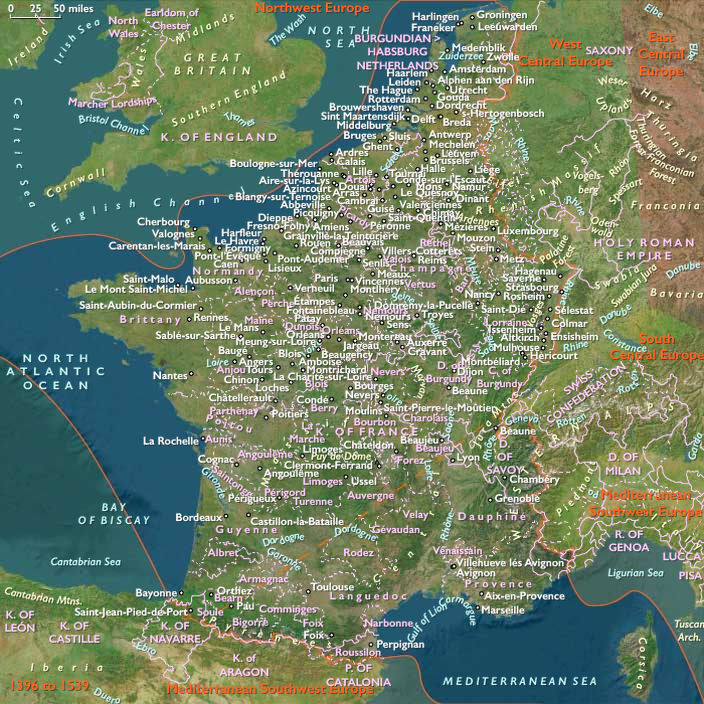
West Europe
View →Subregions