
The Akmak Transition and the Arctic Cultural…
6093 BCE to 5950 BCE
The Akmak Transition and the Arctic Cultural Bridge (6093-5950 BCE): Akmak's Siberian Legacy in Decline
By 7,700 BCE, people at the Onion Portage site were using the Akmak assemblage which includes microblades, with stone tools that included end scrapers, gouges, knives, and shaft straighteners. The period of 6093-5950 BCE represents the twilight of this remarkable Arctic tradition.
The Akmak-Baikal Connection:
The technological signature you mention—tiny chipped flakes and microliths with closest parallels in Siberian tools from the Lake Baikal area—reflects a deeper connection than simple trade. Modern humans have inhabited the Lake Baikal region since the Upper Paleolithic, and recent genome-wide data shows an Upper Paleolithic genome with a direct link to the First Americans. This suggests the Akmak tradition carried forward technological knowledge from shared ancestral populations.
Douglas Anderson noted that during the last centuries of the Bering land bridge and for several millennia afterward, Arctic groups throughout eastern Siberia and Alaska must have remained part of a broad interaction network. The Akmak assemblage represents the material expression of this network's final phase.
The Technological Transition (c. 6000 BCE):
After 18,000 years ago, as glaciers retreated and the tree line gradually advanced northward, humans wielding microblade technology recolonized the Asian north.By 6000 BCE, however, the specific Akmak variant of this technology was beginning its decline at Onion Portage.
The Akmak people carried out activities including hide preparation, butchering, carving on hard and soft materials (perhaps on ivory), planing, chopping, and the manufacture of weapons. Narrow grooved shaft straighteners of basalt suggest that bows and arrows were used, indicating sophisticated hunting technology.
Independent Development After Isolation:
Your observation that "the Akmak tradition seems to have developed independently after its isolation from Siberian influence" aligns with broader patterns. Beginning about 6000 BCE, what had been a relatively cool and moist climate gradually became warmer and drier, with bands becoming larger and somewhat more sedentary.
This climatic shift, combined with rising sea levels that finally submerged the Bering land bridge around 10,000 BCE, created the isolation that allowed the Akmak tradition to develop its distinctive characteristics while retaining its core microlith technology.
The Broader Archaeological Context:
The earliest inhabitants, the Akmak peoples of the Paleoarctic tradition, lived in a treeless environment and were mostly hunters who subsisted off the valley's large caribou population. By 6,500 BCE, Kobuk complex hunters were using campsites along the edges of the Kobuk River, making camp fires of willow branches and, in some cases, of caribou bone.
The Genetic and Cultural Legacy:
The decline of Akmak after 6000 BCE doesn't represent a cultural dead-end but rather a transformation. Paleo-Eskimo-related ancestry is ubiquitous among populations speaking Na-Dene and Eskimo-Aleut languages, suggesting that the people who made Akmak tools contributed to later Arctic populations.
The Paleo-Arctic Tradition covers Alaska and expands far into the east, west, and the Southwest Yukon Territory of Canada, indicating the broad influence of these early technologies.
The 6093-5950 BCE Window:
This 144-year period captures a crucial moment when:
- Siberian Connections Weakened: The microlith technology that linked Akmak to Lake Baikal traditions was becoming increasingly isolated
- Local Adaptation Intensified: Arctic peoples developed region-specific solutions to changing environmental conditions
- Proto-Linguistic Foundations Solidified: The genetic and cultural patterns that would later manifest as distinct language families were crystallizing
Anderson describes good stratigraphy, dates, and lithic artifacts from the last 10,000 years at Onion Portage, which allowed Alaskan archaeologists to first date many cultural traditions. The Akmak decline after 6000 BCE represents a key transition point in this sequence.
Conclusion:
The period 6093-5950 BCE emerges as a hinge moment when the last direct technological echoes of Siberian Lake Baikal traditions were fading in Alaska, replaced by distinctly American Arctic adaptations. The Akmak tradition's decline marks not an ending but a transformation—the final severing of direct technological ties to Asia and the beginning of truly indigenous North American Arctic cultural development.
This transition sets the stage for the emergence of the distinct archaeological traditions that would follow: the Kobuk complex, and eventually the ancestors of the populations that would develop into the diverse language families of the North American Arctic and Subarctic.
Topics
Regions
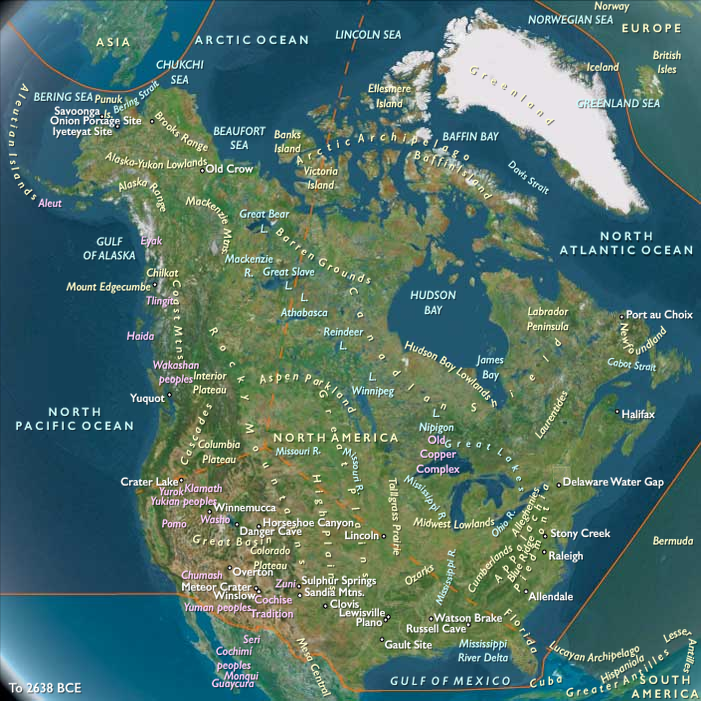
Northern North America
View →Subregions
