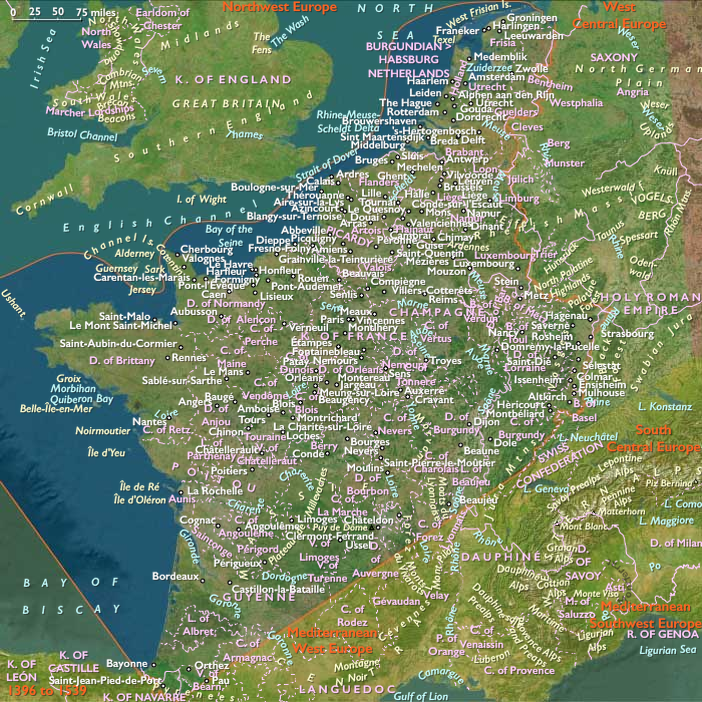
The History of Namur and Its Integration…
1420 CE
The History of Namur and Its Integration into the Burgundian State (Celtic Era–1421)
The town of Namur, strategically located at the confluence of the Meuse and Sambre Rivers, has a long history as a trading and military center. It evolved from a Celtic settlement into a Roman stronghold, later gaining prominence in the early Middle Ages as a Merovingian fortress. By the 10th century, it became a county in its own right, playing a significant role in the feudal structure of the Low Countries.
I. Namur’s Early History: A Crossroads of Trade and Conquest
- The Celtic Aduatuci tribe originally established a trading hub at Namur, benefiting from its strategic position along major trade routes across the Ardennes.
- Following Julius Caesar’s conquest, the Romans fortified the area, using Namur as a military and commercial post.
- During the Merovingian period, a castle or citadel was built atop the rocky spur overlooking the town, reinforcing Namur’s role as a fortified settlement.
II. Namur as a County and the Development of Jambes
- By the 10th century, Namur had been established as an independent county, governing territories along the Meuse and Sambre rivers.
- The town’s development was uneven, due to a landownership divide:
- The Counts of Namur controlled the north bank of the Meuse, fostering economic and military expansion.
- The south bank was owned by the Bishops of Liège, slowing its development into what later became Jambes (now a suburb of Namur).
III. Namur’s Political Shifts: From Flanders to Burgundy (1262–1421)
- In 1262, Namur was absorbed into the County of Flanders, bringing it into the orbit of the powerful Flemish trade economy.
- By 1421, Duke Philip the Good of Burgundy purchased Namur, marking its integration into the expanding Burgundian state.
- This acquisition was part of Burgundy’s broader strategy to consolidate control over the Low Countries, strengthening its territorial and economic dominance.
IV. The Legacy of Namur Under Burgundian Rule
- Under Burgundian control, Namur became an important administrative and military center, reinforcing Burgundian influence in the region.
- The citadel continued to be expanded, serving as a key fortification in later European conflicts.
- Namur’s integration into Burgundy laid the foundation for its later inclusion in the Habsburg Netherlands, continuing its role as a significant strategic and trade hub.
The purchase of Namur by Philip the Good in 1421 marked a turning point in its history, as it transitioned from a feudal county to an integral part of the powerful Burgundian Netherlands, shaping its economic and military significance for centuries to come.
Locations
People
Subjects
Regions
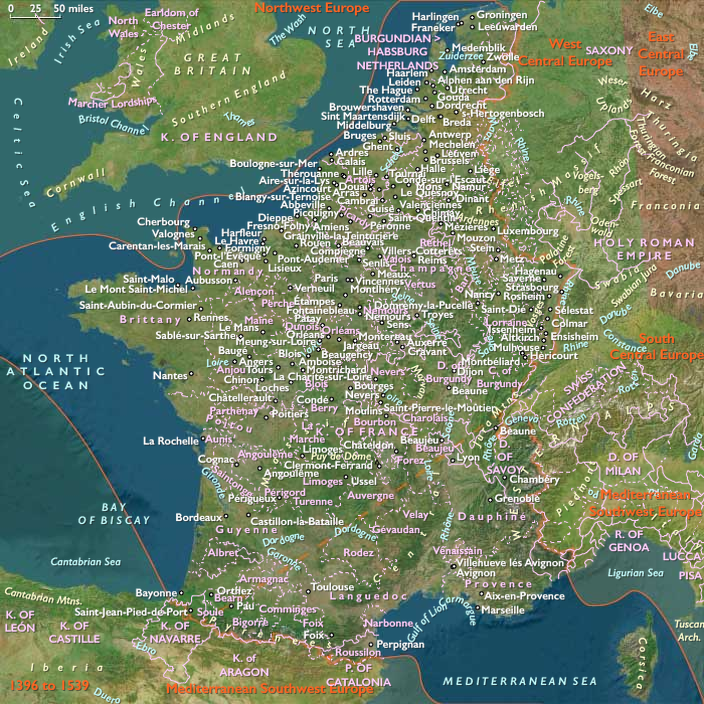
West Europe
View →Subregions