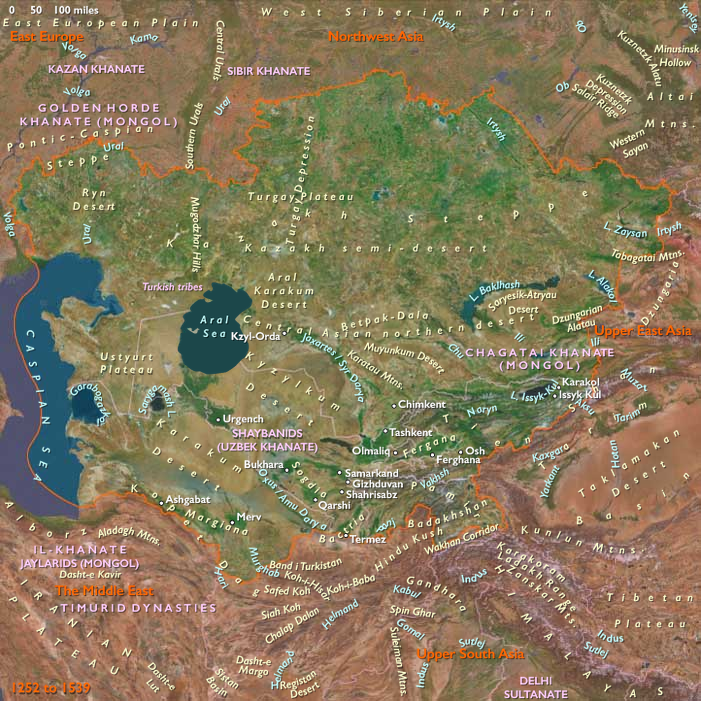
The Mongol Empire had been divided among…
1252 CE to 1395 CE
Despite the potential for serious fragmentation, Mongol law maintains orderly succession for several more generations, and control of most of Mawarannahr stays in the hands of direct descendants of Chaghatai, the second son of Genghis.
Orderly succession, prosperity, and internal peace prevail in the Chaghatai lands, and the Mongol Empire as a whole remains strong and united.
As the empire begins to break up into its constituent parts in the early fourteenth century, however, the Chaghatai territory also is disrupted as the princes of various tribal groups compete for influence.
One tribal chieftain, Timur (Tamerlane), emerges from these struggles in the 1380s as the dominant force in Mawarannahr.
Although he is not a descendant of Genghis, Timur becomes the de facto ruler of Mawarannahr and proceeds to conquer all of western Central Asia, Iran, Asia Minor, and the southern steppe region north of the Aral Sea.
People
Groups
Subjects
Regions
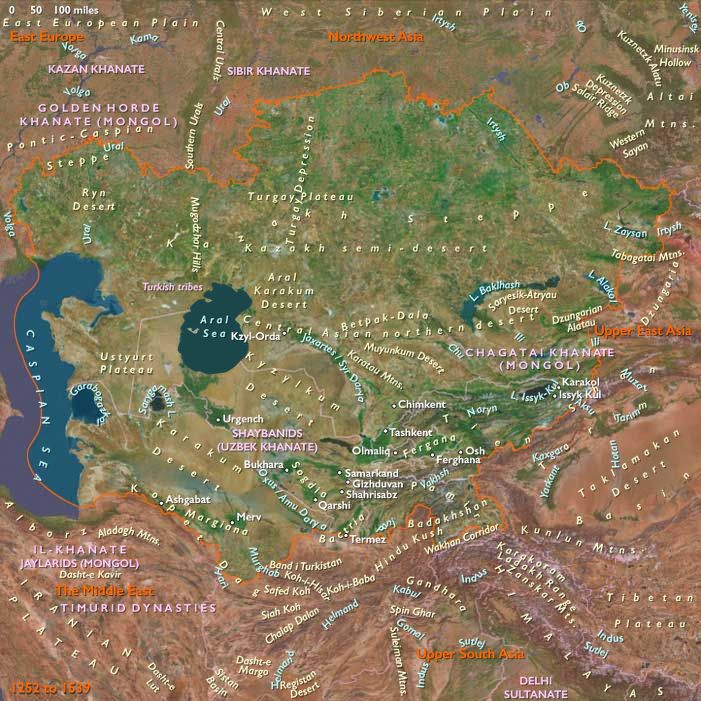
Central Asia
View →Subregions