The use of cuneiform for a non-Sumerian…
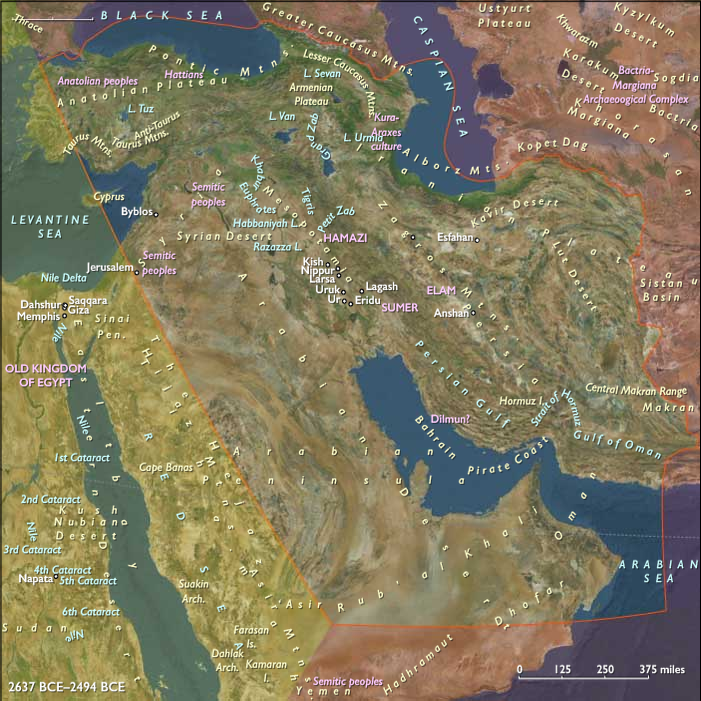
2637 BCE to 2494 BCE
The use of cuneiform for a non-Sumerian language can be demonstrated with certainty from the twenty-seventh century BCE.
Akkadian uses the cuneiform writing system derived ultimately from ancient Sumerian, an unrelated language isolate.
The name of the language is derived from the city of Akkad, a major center of Mesopotamian civilization.
A close cultural symbiosis will develop during the third millennium BCE between the Sumerians and the Akkadians, which includes widespread bilingualism.
The influence of Sumerian on Akkadian (and vice versa) is evident in all areas, from lexical borrowing on a massive scale, to syntactic, morphological, and phonological convergence.
This has prompted scholars to refer to Sumerian and Akkadian in the third millennium as a sprachbund.
Sumerian myths were passed down through the oral tradition until the invention of writing.
Early Sumerian Cuneiform was used primarily as a record-keeping tool; it was not until the late Early Dynastic period that religious writings first became prevalent as temple praise hymns and as a form of "incantation" called the nam-šub (prefix + "to cast").
The Sumerians originally practiced a polytheistic religion, with anthropomorphic deities representing cosmic and terrestrial forces in their world.
Sumerian deities became more anthrocentric during the middle of the third millennium BCE and were "...nature gods transformed into city gods."
Gods like Enki and Inanna were viewed as having been assigned their rank, power and knowledge from An, the heaven deity, or Enlil, head of the Sumerian pantheon.
Groups
Topics
Subjects
Regions
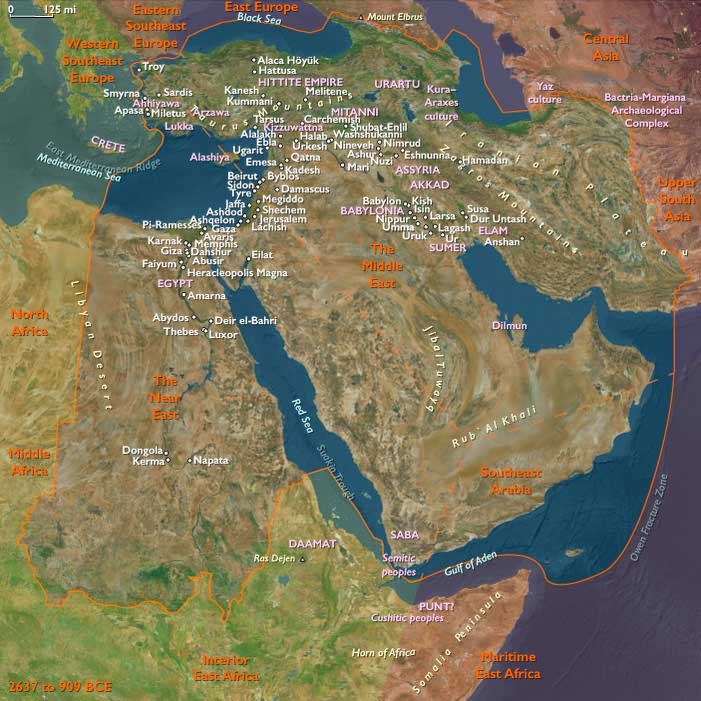
The Near and Middle East
View →Subregions