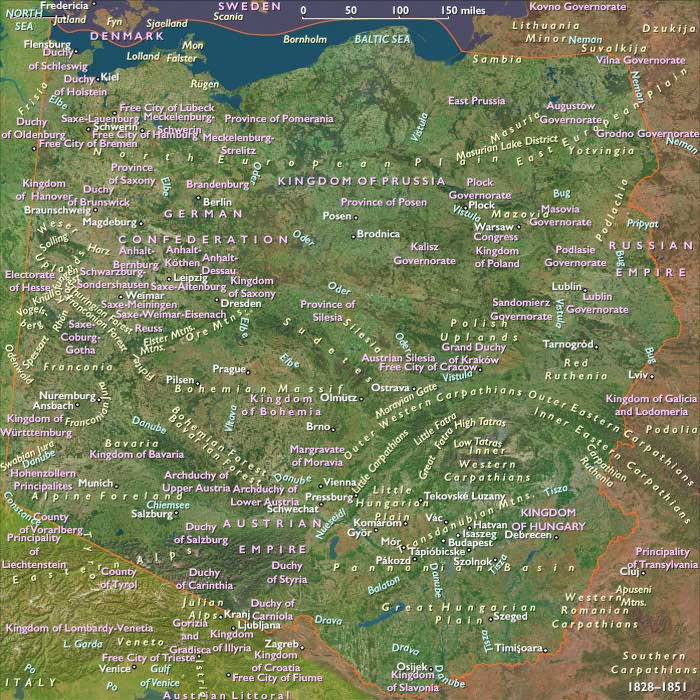
Austria's decision to organize itself as a…
1840 CE to 1851 CE
This contradicted an earlier decision of the assembly, so the assembly had turned from the grossdeutsch (large German) model of a united Germany that included Austria to the kleindeutsch (small German) model that excluded Austria.
The assembly had offered a hereditary crown of a united Germany to the Prussian king.
The conditions under which the offer was made, however, had caused the Prussian king to decline in early April 1849.
Combined with the withdrawal of the Austrian representatives, his rejection effectively ended the
Frankfurt assembly.
The German Confederation is restored, and Franz Joseph's tasks are completed.
However, Austria and Prussia continue to jockey for influence and leadership in Germany.
Initially, the new Austrian government had apparently intended to implement the constitutional political structures promised in March 1849, but on December 31, 1851, Franz Joseph formally revokes the constitution, leaving in place only those provisions that established the equality of citizens before the law and the emancipation of the peasants.
Popular representation is eliminated from all government institutions.
In order to solidify a political base supporting neoabsolutist rule, the government also eliminates the Josephist religious regulations that have been the source of continuing conflict with the church.
Locations
People
Groups
Topics
Regions
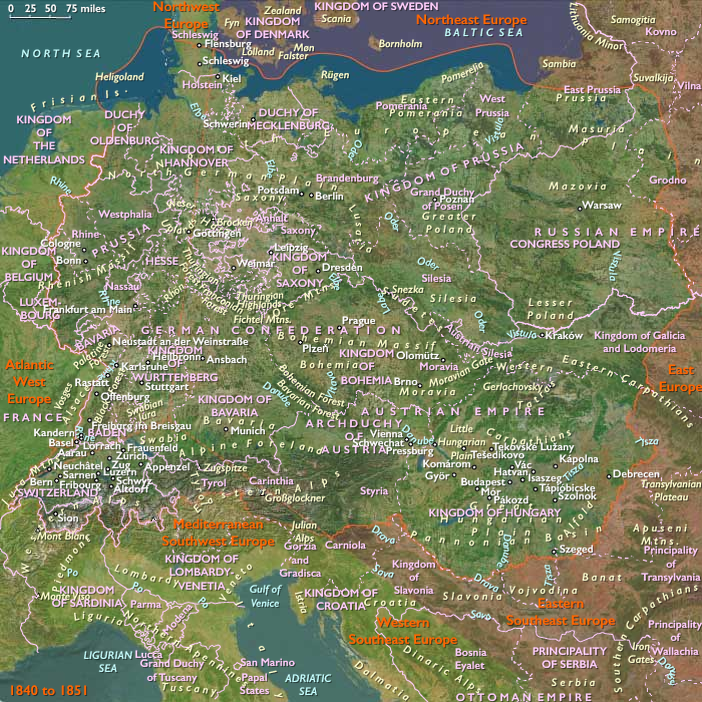
Central Europe
View →Subregions