
Theobald IV, Count of Champagne, succeeds his…
1234 CE
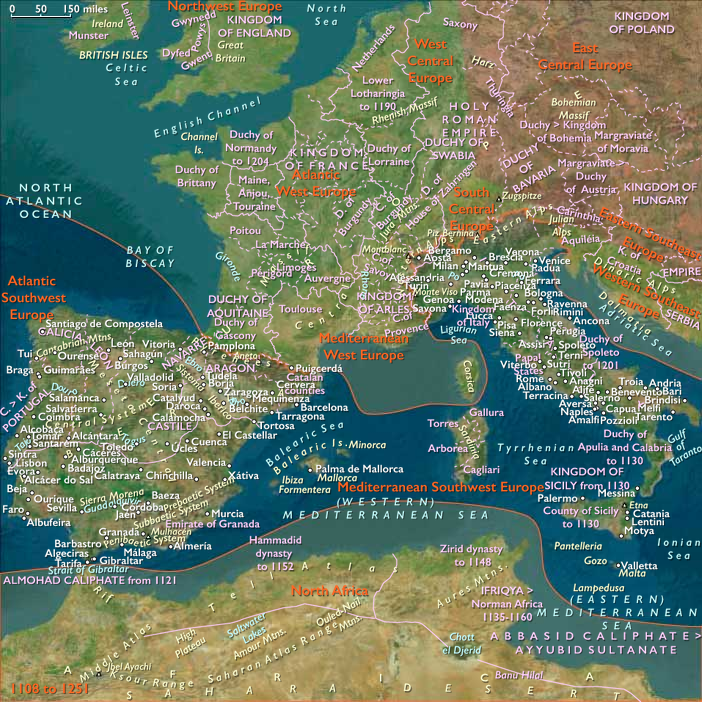
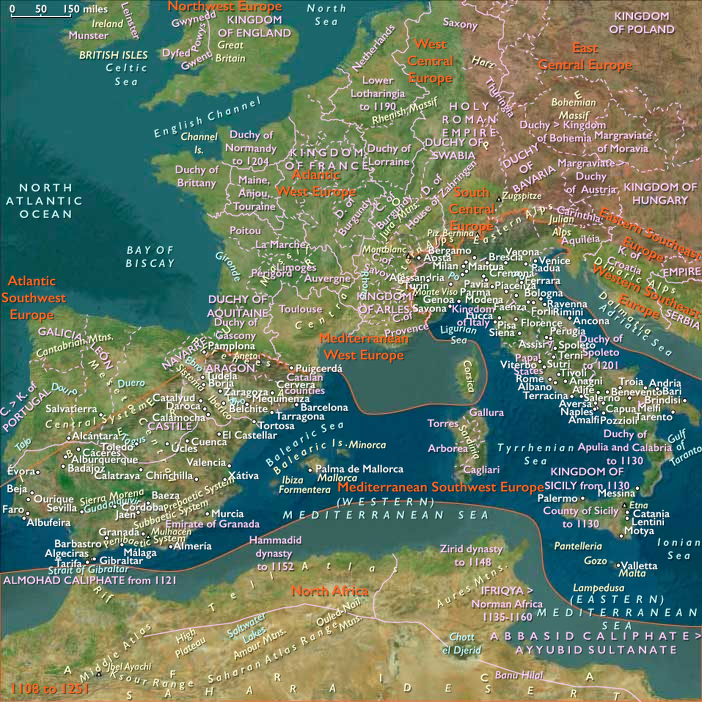
Theobald IV, Count of Champagne, succeeds his uncle Sancho VII of Navarre as King of Navarre in 1234.
In Pamplona at the time of Sancho's death, the new monarch, as Theobald I, immediately affirms the fueros of the realm.
This greatly increases his resources (not to mention his prestige), and the remaining years of his rule will be peaceful and prosperous.
Locations
Subjects
Regions
Southwest Europe
View →Subregions
Mediterranean Southwest Europe
View →Related Events
No active filters.
Showing 10 events out of 47011 total
Korean potters manufacture high-quality green Koryo ware.
In 1234, Koreans invent a new printing system with moveable type, allowing the ready dissemination of Buddhist and Confucian writings.
The Jin emperor flees in 1234, sacrifices his wives, and hangs himself.
After the victorious besiegers enter Kaifeng, Ögödei’s Chinese advisor Yeh-lü Ch'u-ts'ai directs the saving of both valuable artifacts and buildings, obtains mercy for scholars and peasants, and prevents wanton looting and slaughter.
The remaining Jurzhen withdraw to Manchuria (where they will eventually become known as Manchus).
Song general Meng Gong defeats the Jin general Wu Xian and directs his troops to besiege the city of Caizhou, to which the last emperor of the Jurchen has fled.
With the help of the Mongols, the Song armies are finally able to extinguish the Jin Dynasty that has occupied northern China for more than a century.
Dominic is canonized in 1234; this same year, Pope Gregory IX has the papal decretals on canon law collected and published as the “Decretales,” in 1234.
Louis IX Attains His Majority (1234): The End of Blanche of Castile’s Regency
In 1234, Louis IX (later Saint Louis) officially attained his majority, marking the end of his formal regency under his mother, Blanche of Castile. However, despite his coming of age, Blanche remained a highly influential figure in his reign, continuing to play a key role in political and diplomatic matters.
Blanche of Castile’s Continued Influence
- Blanche had acted as regent since 1226, following the death of Louis VIII, ensuring her son’s survival against baronial opposition and English threats.
- Even after Louis IX reached his majority in 1234, Blanche continued to advise him, particularly in matters of:
- Royal administration and governance.
- Religious and moral guidance.
- Foreign policy, particularly in dealings with England and the Holy Roman Empire.
- Her political skill had secured Capetian control during a vulnerable period, reinforcing royal authority against rebellious nobles.
Significance of Louis IX’s Majority
- Louis IX’s coming of age allowed him to rule independently, though he remained deeply influenced by Blanche’s teachings and policies.
- His reign would be characterized by:
- A strong commitment to justice and Christian morality.
- The expansion of royal authority over feudal lords.
- A devotion to the Crusades, reflecting the deep religious piety instilled by his mother.
Even after Louis IX’s official assumption of power in 1234, Blanche of Castile remained one of the most powerful and respected women in medieval France, shaping the kingdom’s future long beyond her son’s regency.
The Stedingers are Frisian peasants who refuse to pay tithes to the Archbishop of Bremen.
The archbishop had excommunicated them, and Pope Gregory IX had declared a crusade in 1232.
The peasants on May 27, 1234, lose the Battle of Altenesch and are destroyed.
A truce is reached in March 1234 between the king and Richard Marshal, the condition of which is the removal of Peter de Rivaux from court.
Meanwhile, however, conflict has broken out in Ireland between Marshal's brothers and some of the king's supporters.
Hostilities follow, and …
…Richard makes an alliance with the Welsh prince Llywelyn the Great.
He crosses from Wales to Ireland, where Peter des Roches had allegedly instigated his enemies to attack him.
Marshal is overpowered and wounded at the Battle of the Curragh by forces led by Maurice FitzGerald, Justiciar of Ireland, and on April 16, 1234, dies of his wounds while being held prisoner.
Marshal's popularity also means that his death is mourned in England, while the Poitevins—who are rumored to have instigated the Irish war—fall further into disregard.
Peter des Rivaux, in effect Henry's chief minister from 1232 onward, has held positions in the king's household and had been installed as sheriff (or granted the power to appoint sheriffs in his stead) for some twenty-one shires.
His administration includes Stephen Segrave (high sheriff of several counties), Henry of Bath (high sheriff of Gloucestershire), Robert Papelew and Brian de Lisle, and has achieved a centralization under his hand of much royal revenue.
He also holds the office of Lord High Treasurer from January 14, 1233, but falls dramatically from power in 1234, consequent on the death of Richard Marshal, Third Earl of Pembroke, which is attributed to machinations of Peter des Roches.
For a time, Peter de Rivaux and associates are proclaimed traitors.
Some partial rehabilitation follows.