
It is much less clear whether the…
1828 CE to 1839 CE
It is much less clear whether the Javanese benefited from or were impoverished by the Cultivation System.
Generalization about this question is made particularly difficult by the fact that the system as actually implemented is not very systematic and varies considerably according to time, place, and circumstance.
In some regions, for example, forty percent of the adult population labors for the system and in others, pone hundred percent; in some areas, less than four percent of agricultural land is used and in others, fifteen percent.
Abuses of the system's provisions, including official corruption, also vary sharply by locale.
The principal criticisms are, and continue to be today, moral ones.
The Cultivation System will be portrayed as having been founded on greed and as being not only coercive and exploitative but also prone to a range of abuses, all of which produce, for the average villager, only impoverishment.
This view will be put forth most memorably in the 1860 Dutch novel Max Havelaar by Eduard Douwes Dekker (1820-77), an embittered former colonial official who will write under the pseudonym Multatuli ("I have suffered much").
Douwes Dekker's account will be widely understood, probably not entirely accurately, as a thoroughgoing indictment of colonial rule in general and the Cultivation System in particular, which he will accuse of having created a uniformly desperate, destitute peasantry.
This, or something much like it, will become the received view.
Recent studies, however, based on rereadings of old evidence as well as on archival information that will become available only in the mid-twentieth century, suggest a far more complex picture.
While acknowledging that the burdens of the Cultivation System fell on the laboring Javanese populace, they also argue that the majority probably saw at least limited economic improvement and took advantage of new economic opportunities, although at the cost of a more regimented and government-controlled existence, and with the added risk of dependency on world markets.
This is a form of circumscribed change that shapes Java's village world far into the future.
Regions
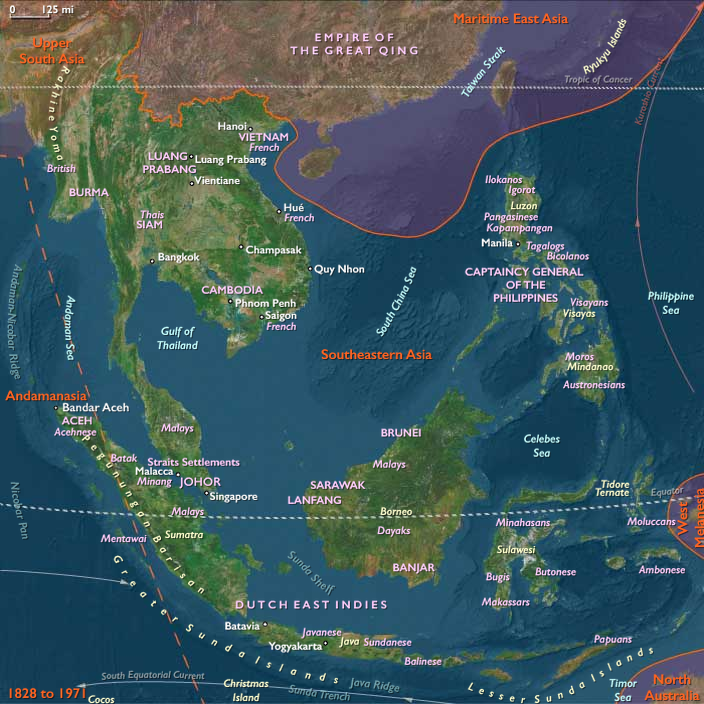
Southeast Asia
View →Subregions
