The influence of the Sienese School had…
1450 CE
The influence of the Sienese School had dominated painting in the fourteenth and early fifteenth centuries, but by 1450 Netherlandish sources are of equal if not greater importance.
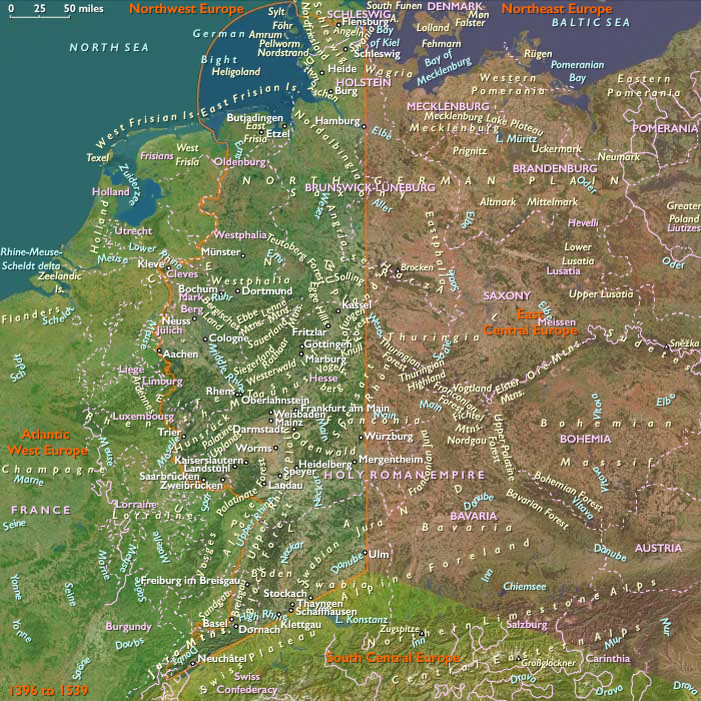
Stefan Lochner, thought to have come from Meersburg, as his parents are known to have died there, is recorded as being in Cologne by 1442, where he was paid for decorations in connection with the celebration of the visit of Emperor Frederick III.
He was elected town councilor by the painters' guild in 1447 and 1450.
There are no records of him after the end of 1451.
Lochner joins the influence of Jan van Eyck with the tradition of the International Style to produce what is often labeled a "soft" or flowing style, as opposed to southerner Konrad Witz’s blocky, "hard" forms.
There are no paintings signed by Lochner, but Albrecht Dürer recorded seeing an altarpiece by "Maister Steffan" on a visit to Cologne in 1520.
Since the publication of an article by J.F. Böhmer in 1823, this has been assumed to be a reference the triptych of the Altar of the City Patrons, and "Maister Steffan" has been identified with the documented Stefan Lochner.
On the basis of the style of the triptych, a number of other paintings have been attributed to him, including two dated versions of the Presentation in the Temple, one in the Calouste Gulbenkian Museum (1445) and another in the Hessisches Landesmuseum, Darmstadt (1447); two wings from an altarpiece, with images of saints (now in the National Gallery, London and the Wallraf-Richartz Museum, Cologne), and an altarpiece from the church of St. Lorenz, now divided between three museums.
The epitome of his style is Madonna of the Rose Bower (painted around 1450; now in the Wallraf-Richartz Museum), showing the Virgin and Child reposing in a blooming rose arbor and attended by Lochner's characteristic child Angels.
Images

Stefan Lochner: Madonna in the Rose Bower (1448).
Regions
Central Europe
View →Subregions