
The French Revolution had led to serious …
Years: 1801 - 1801
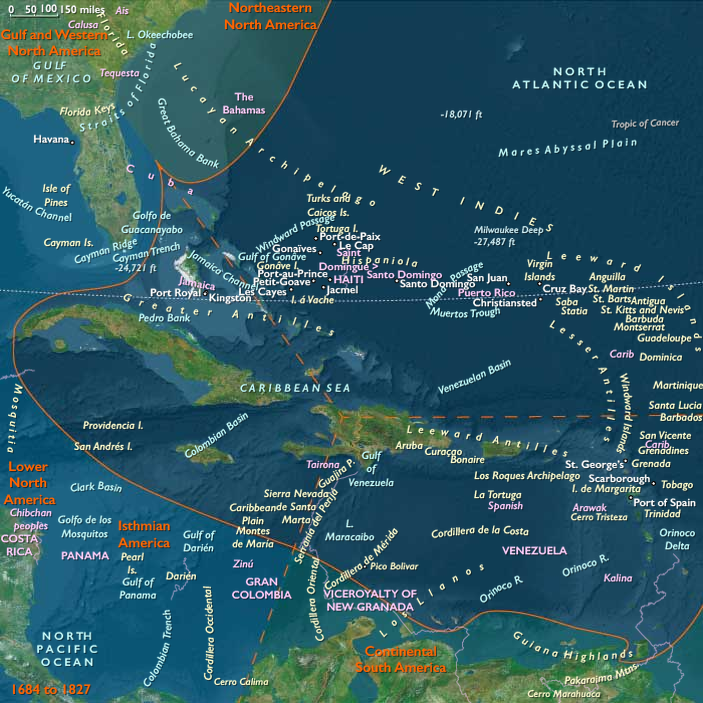
The French Revolution had led to serious social upheavals on Saint-Domingue, of which the most important was the slave revolt that led to the abolition of slavery in 1793 by the civil commissioners Sonthonax and Polverel, in a decision endorsed and spread to all the French colonies by the National Convention six months later.
Toussaint Louverture, a black former slave who had been made Governor by France, had re-established peace, fought off Spanish and British attempts to capture the island, and reestablished prosperity by daring measures.
However, he goes too far in hunting down governor Don Joaquín García y Moreno (January 27, 1801), who has remained in what had been the Spanish part of the island following the 1795 Peace of Basel.
Toussaint also challenges French imperial interests by promulgating a self-rule constitution on July 12, 1801, which declares him governor for life.
On February 9, 1801, after their defeat at Marengo, the Austrians split off from the Second Coalition and sign the Treaty of Lunéville with France.
Naples now signs a peace treaty with the French at Florence and Russia under Paul I distances itself from the coalition, with his successor Alexander I finally concludes a secret peace with Bonaparte on October 10, 1801.
Britain is thus isolated and, after the first ministry of William Pitt the Younger falls on March 13, 1801, the new government begins to consider making peace.
Napoleon Bonaparte (now First Consul) can thus concentrate on internal problems within France and its empire.
His troops are idle and his officers eager for a chance for glory.
In early 1801, Bonaparte had decided to appoint his sister Pauline's husband, general Charles Leclerc, as head of a military expedition to reassert French authority over Saint-Domingue.
Initially, Bonaparte had planned to confirm the military ranks and lands acquired by Toussaint's officers, offer Toussaint the rôle of lieutenant of France, and guarantee freedom to the former slaves, while re-establishing Paris's authority over the island in the person of its capitaine général.
Toussaint's two sons are being educated in France and, as proof to Toussaint of the French government's goodwill, Bonaparte sends them back to their father with their tutor.
By October, however, Bonaparte's opinion has shifted, as he interprets Toussaint's July constitution as an unacceptable offense to French imperial authority.
Henceforth, Bonaparte secretly directs Leclerc to disarm Toussaint's black-controlled government and deport his military officers to France.
Bonaparte foresees that Toussaint will probably put up resistance and so takes all necessary measures to defeat him should this occur—Toussaint has over sixteen thousand men available, so Leclerc is put in command of thirty thousand men drawn from nearly all the French Revolutionary Armies as well as the disciplinary corps.
People
- Alexander I of Russia
- Charles Leclerc
- Léger-Félicité Sonthonax
- Napoleon
- Paul I of Russia
- Toussaint Louverture
- William Pitt the Younger
Groups
- Austria, Archduchy of
- Habsburg Monarchy, or Empire
- Saint Domingue, French Colony of
- Russian Empire
- Naples and Sicily, Bourbon Kingdom of
- French First Republic
- Santo Domingo (French Colony)
- Britain (United Kingdom of Great Britain and Ireland)
Topics
- Haitian Revolution
- Toussaint L'Ouverture, Revolt of
- Second Coalition, War of the
- Haitian French War of 1801-03
Commodoties
Subjects
Regions
Subregions

Related Events
Showing 10 events out of 22720 total
Years: 1801 - 1801
People
- Alexander I of Russia
- Charles Leclerc
- Léger-Félicité Sonthonax
- Napoleon
- Paul I of Russia
- Toussaint Louverture
- William Pitt the Younger
Groups
- Austria, Archduchy of
- Habsburg Monarchy, or Empire
- Saint Domingue, French Colony of
- Russian Empire
- Naples and Sicily, Bourbon Kingdom of
- French First Republic
- Santo Domingo (French Colony)
- Britain (United Kingdom of Great Britain and Ireland)
Topics
- Haitian Revolution
- Toussaint L'Ouverture, Revolt of
- Second Coalition, War of the
- Haitian French War of 1801-03
Commodoties
Subjects
Regions
Subregions