
Whalers roving the Pacific by the early…
1828 CE to 1839 CE
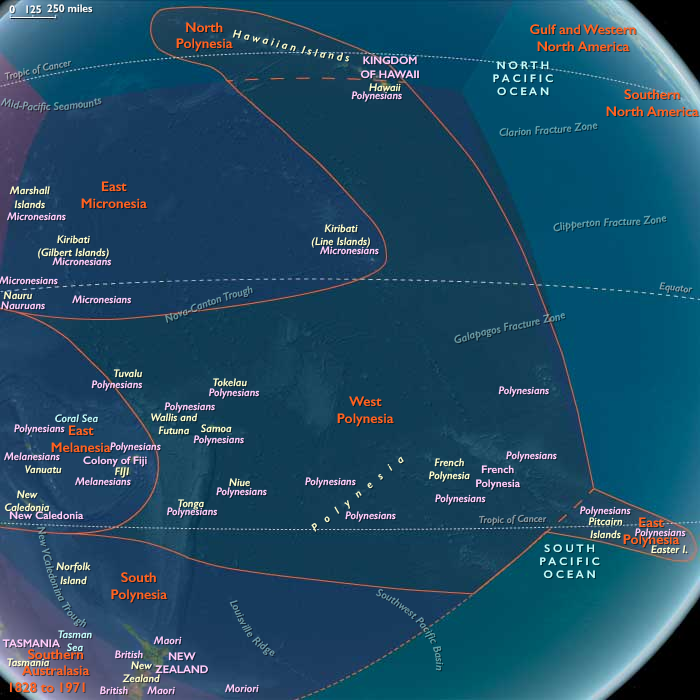
Whalers roving the Pacific by the early 1800s visit Tuvalu only infrequently, because of the difficulties of landing ships on the atolls, and no settlements are established by them.
Tuvaluans, a Polynesian people, had settled the Ellice islands around 1000 BCE, coming from Tonga and Samoa.
During pre-European-contact times there had been frequent canoe voyaging between the nearer islands.
Eight of the nine islands of Tuvalu are inhabited; thus the name, Tuvalu, means "eight standing together" in Tuvaluan.
Possible evidence of fire in the Caves of Nanumanga may indicate human occupation thousands of years before that.
Tuvalu was first sighted by Europeans in 1568 with the arrival of Álvaro de Mendaña de Neira from Spain who also encountered the island of Nui (atoll) but was unable to land.
No other Europeans had turned up again until the late 1700s when other European explorers reached the area.
Locations
Groups
Commodities
Regions
Polynesia
View →Subregions
