
Vissarion Belinsky establishes his reputation in 1834 …
Years: 1833 - 1833
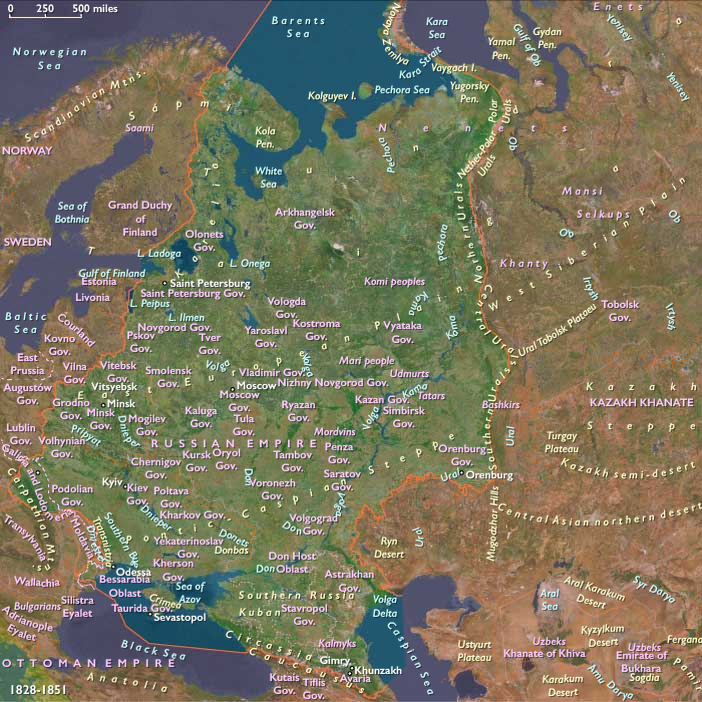
Vissarion Belinsky establishes his reputation in 1834 with his Literary Reveries, a survey of the previous two centuries of Russian literature.
The twenty-two-year-old Belinsky, expelled from Moscow University as a radical, had taken up literary criticism and journalism in 1833.
Locations
People
Groups
Topics
Subjects
Regions

Subregions
Related Events
Filter results
Showing 10 events out of 14 total
The League of the Just had participated in the Blanquist uprising of May 1839 in Paris, and will hereafter be expelled from France.
Founded by German workers in Paris in 1836, the League was initially a utopian socialist and Christian communist grouping devoted to the ideas of Gracchus Babeuf. (It will later become an international organization that Karl Marx, Friedrich Engels, and Johann Eccarius will join.)
The motto of the League of the Just (Bund der Gerechten) is "All Men are Brothers" and its goals are "the establishment of the Kingdom of God on Earth, based on the ideals of love of one's neighbor, equality and justice.”
The League of the Just is itself a splinter group from the League of Outlaws (Bund der Geaechteten) created in Paris in 1834 by Theodore Schuster, Wilhelm Weitling, and other German emigrants, mostly journeymen.
The works of Philippe Buonarroti had inspired Schuste.
The latter league has a pyramidal structure inspired by the secret society of the Republican Carbonari, and shares ideas with Saint-Simon and Charles Fourier's utopian socialism.
Their aim is to establish in the German states a "Social Republic" that will respect "freedom,” "equality," and "civic virtue.
Marx and Engels’ The Communist Manifesto, predicting the overthrow of capitalism and its replacement by socialism, proposes abolition of private property in land (through gradually increasing property tax), a heavy progressive or graduated income tax, abolition of inheritance rights (through inheritance tax), eventual confiscation of private property, a central bank, forced distribution of population, and centralization of transportation and communication under state control.
Commissioned by the Communist League and originally published in London just as the Revolutions of 1848 begin to erupt, the Manifesto presents an analytical approach to the class struggle (historical and then-present) and the conflicts of capitalism and the capitalist mode of production, rather than a prediction of communism's potential future forms.
The Communist Manifesto summarizes Marx and Engels' theories concerning the nature of society and politics, namely that in their own words "[t]he history of all hitherto existing society is the history of class struggles".
Friedrich Engels, having decided to return to Germany in 1844, stops in Paris to meet Karl Marx, with whom he had had an earlier correspondence.
Marx had been living in Paris since late October 1843, after the Rheinische Zeitung was banned in March 1843 by Prussian governmental authorities.
Prior to meeting Marx, Engels had become established as a fully developed materialist and scientific socialist, independent of Marx's philosophical development.
In Paris, Marx is publishing the Deutsch–Französische Jahrbücher.
Engels meets Marx for a second time at the Café de la Régence on the Place du Palais, August 28, 1844.
The two will quickly become close friends and will remain so their entire lives.
Marx has read and is impressed by Engels's articles on The Condition of the Working Class in England.
Marx will adopt Engels's idea that the working class will lead the revolution against the bourgeoisie as society advances toward socialism, and will incorporate this as part of his own philosophy.
The title is a suggestion by the publisher and is meant as a sarcastic reference to the Bauer Brothers and their supporters.
The book will create a controversy with much of the press and cause Bruno Bauer to attempt refuting the book in an article published in Wigand's Vierteljahrsschrift in 1845.
Bauer will claim that Marx and Engels misunderstood what he was trying to say.
Marx will later reply to his response with his own article published in the journal Gesellschaftsspiegel in January 1846.
Marx will also discuss the argument in chapter two of The German Ideology.
Written during Engels's 1842–44 stay in Manchester, the city at the heart of the Industrial Revolution, it is a compilation of Engels' own observations and detailed contemporary reports.
Engels had shown Marx his book the previous year in Paris, and had persuaded Marx that the working class can be the agent and instrument of the final revolution in history.
Karl Marx moves to Brussels in 1845.
The Prussian-born philosopher and political economist and the wealthy textile manufacturer Friedrich Engels, both once Young Hegelians, criticize their former co-believers for their emphasis on alienation in The Holy Family.
The first congress of the Communist League is held in London on June 1, 1847.
The organization has been formed through the merger of the League of the Just, headed by Karl Schapper, and the Communist Correspondence Committee of Brussels, Belgium, in which Karl Marx and Friedrich Engels are the dominant personalities.
The Communist League is regarded as the first Marxist political party and it is on behalf of this group that Marx and Engels write the Communist Manifesto late in 1847.
A London workers organization had in 1847 invited Karl Marx and Friedrich Engels to prepare a program for them, which appeared in February 21, 1848, as The Communist Manifesto, which proposes abolition of private property in land (through gradually increasing property tax), a heavy progressive or graduated income tax, abolition of inheritance rights (through inheritance tax), eventual confiscation of private property, a central bank, forced distribution of population, and centralization of transportation and communication under state control.
...the Palatinate.
The revolutionaries, supported by volunteers from the rest of Germany as well as France, Hungary, Poland, and Switzerland, including Frederick Engels, who is wounded, are finally defeated by July 12 after several battles and skirmishes.
Confederates under Lee fight the reorganized federal army under McClellan in a bloody battle at Antietam, near Sharpsburg, western Maryland, on September 17.
The 75,316 Union troops outnumber the Confederates three to two.
Union losses are 12,410, representing 16.5% of their force, including 2,108 killed, 9,549 wounded, and 753 missing.
Among the Confederates, 2,700 are killed, 9,024 wounded, and around 2,000 missing, accounting for 13,724 soldiers.
McClellan, although blocking Lee's advances, allows him to retire to Virginia. (Most military historians have strongly criticized McClellan's conduct of the battle, which proves to be one of the bloodiest single days of the war. Karl Marx, writing to Friedrich Engels on October 29, 1862, considers Antietam a decisive battle and a graveyard of the Confederacy. (Padover, Saul K., editor: Karl Marx On America & The Civil War, McGraw Hill, New York, 1976, p. 262))
