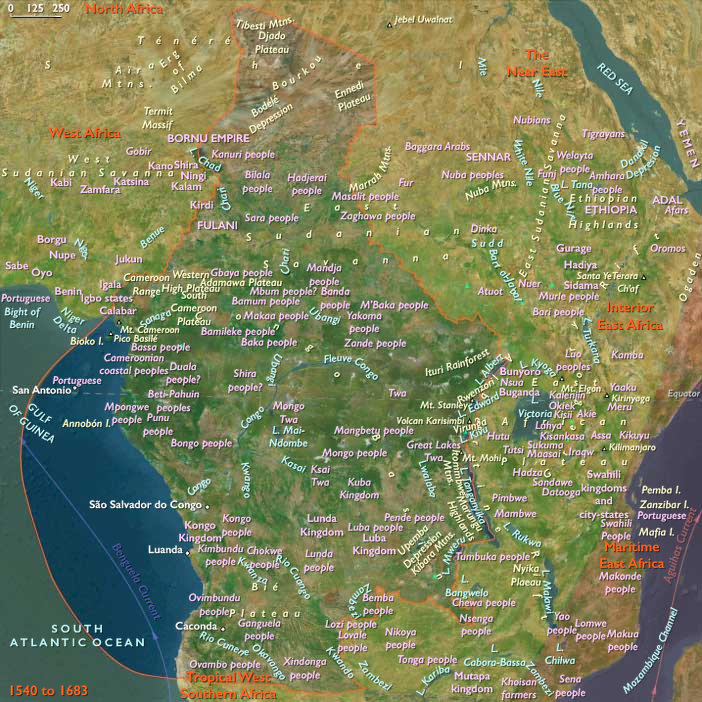
The expansionist Lunda will establish a number…
1684 CE to 1827 CE
This kingdom will successfully control the ivory trade in the area and set up a tributary organization of subordinate chiefs.
The origins of the Congo's savanna kingdoms are shrouded in myths, but their capacity to expand and conquer is directly related to their internal political structure.
Thus, the expansion of the Lunda Kingdom, which probably begins in the late sixteenth century and results in the so-called Lunda Empire that flourishes in the seventeenth and eighteenth centuries, is critically related to what historian Jan Vansina calls "the twin mechanisms of perpetual succession and positional kinship." (Jan Vansina, Kingdoms of the Savanna, Madison, 1968; and Jan Vansina, Paths in the Rainforests: Toward a History of Political Tradition in Equatorial Africa, Madison, 1990. )
That is, each succeeding officeholder, monarch or otherwise, assumes the name, title, and personal identity of the original occupant (founder) of the office (perpetual succession).
At the same time, the new officeholder adopts all kin relationships of the founder of the office as his own (positional kinship).
In this manner, the personalized identity and kin ties of each founding official are perpetuated over time.
These mechanisms are extremely useful in that they divorce the political structure from the actual descent structure.
In so doing, they free the processes of political recruitment from the constraints of kinship and facilitate the recruitment of new officials from within Lunda society and from the ranks of recently conquered peoples.
By the same token, the Lunda govern through a hierarchy of subordinate chiefs, a form of indirect rule, in newly occupied lands, a practice that facilitates the adaptation of the political kingdom beyond its original homeland.
This custom shows how the Lunda Kingdom differs in some fundamental ways from the Luba kingdoms (fifteenth to nineteenth centuries) from which it had split off, probably in the fifteenth century.
Although both evolve out of preexisting chiefdoms and share many of the same political symbols, including the notion of divine kingship, only the Lunda are able to expand substantially beyond their core area.
During the seventeenth century, the Lunda expand toward the west and northwest into present-day Angola, initially to escape Luba domination, and to the south and east, initially in search of copper and salt and control of the trade associated with these desirable commodities, and later in pursuit of ivory.
Groups
Commodities
Regions
Middle Africa
View →Subregions