Vincent van Gogh remains at Nuenen during…
November 1885 CE
Vincent van Gogh remains at Nuenen during most of 1884 and 1885, and during these years his art has grown grow bolder and more assured.
He paints three types of subjects—still life, landscape, and figure—all interrelated by their reference to the daily life of peasants, to the hardships they endure, and to the countryside they cultivate.
Zola's Germinal (1885), a novel about the coal-mining region of France, greatly impresses van Gogh, and sociological criticism is implicit in many of his pictures from this period —e.g., Weavers and The Potato Eaters (1885, the Van Gogh Museum, Amsterdam, Netherlands).
Tensions develop when Vincent accuses his brother Theo of not making a sincere enough effort to sell the paintings Vincent has begun to send him.
Theo admonishes Vincent that his darkly colored paintings are not in the current Parisian style, where Impressionist artists are now using a bright palette.
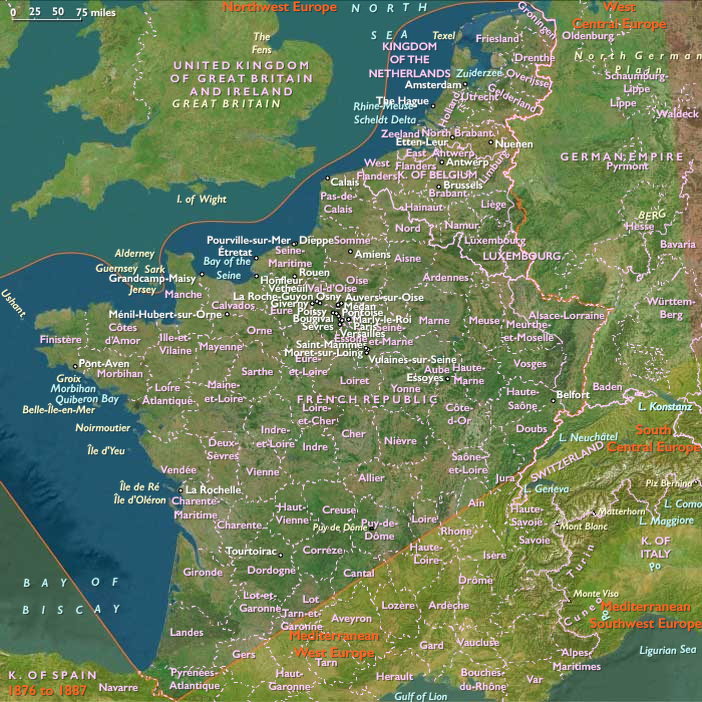
Eventually, Vincent comes to feel too isolated in Nuenen.
His understanding of the possibilities of painting is evolving rapidly; from studying Hals, he has learned to portray the freshness of a visual impression, while the works of Paolo Veronese and Eugéne Delacroix have taught him that color can express something by itself.
This leads to his enthusiasm for Peter Paul Rubens and inspires his sudden departure for Antwerp, Belgium, where the greatest number of Rubens's works can be seen.
Images

Vincent van Gogh: The Potato Eaters (1885) Oil on canvas, 82 cm × 114 cm (32.3 in × 44.9 in), Van Gogh Museum, Amsterdam
Locations
Subjects
Regions
West Europe
View →Subregions