
Large building projects between 2613 and 2494…
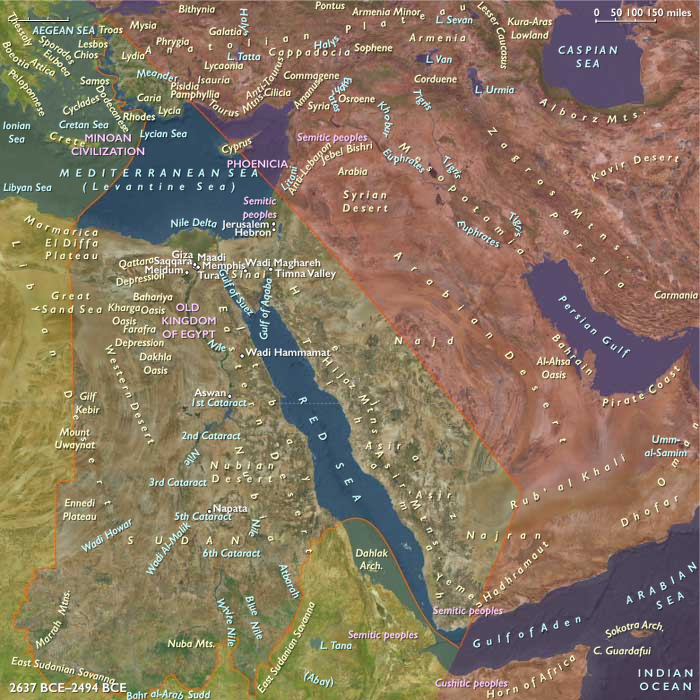
2637 BCE to 2494 BCE
Large building projects between 2613 and 2494 BCE require expeditions abroad to the area of Wadi Maghareh in order "to secure minerals and other resources not available in Egypt itself.”
Locations
Topics
Subjects
Regions
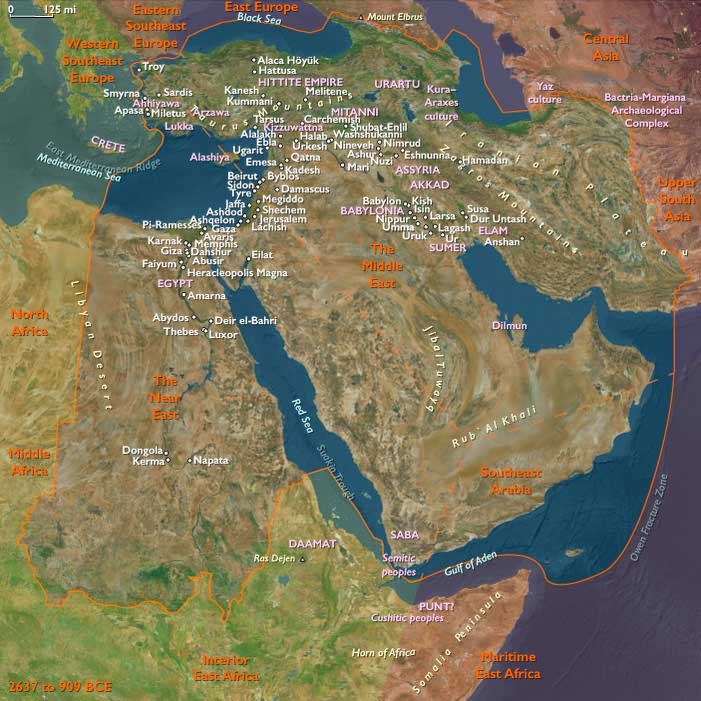
The Near and Middle East
View →Subregions
Near East
View →Related Events
Showing 10 events out of 19 total
Northwest Europe (1768–1779): Industrial Growth, Enlightenment Thought, and the American Crisis
Britain's American Crisis and Imperial Tensions
Between 1768 and 1779, Britain faced profound challenges within its empire, particularly escalating tensions with its North American colonies. Following expensive military engagements during the Seven Years’ War, Britain attempted to offset debts by enforcing unpopular taxes, including the Townshend Acts (1767–1768). American resistance culminated in the Boston Massacre (1770), deepening hostility. Parliament’s subsequent repeal of most Townshend duties did little to quell tensions, which escalated dramatically after the Boston Tea Party (1773), leading to punitive measures—the so-called Intolerable Acts (1774)—and ultimately igniting the American Revolutionary War (1775). By 1776, American colonies declared independence, fundamentally challenging Britain’s imperial dominance and reshaping global political dynamics.
Adam Smith and "The Wealth of Nations"
Amidst political and economic turmoil, Scottish Enlightenment philosopher and economist Adam Smith published his seminal work, An Inquiry into the Nature and Causes of the Wealth of Nations, in 1776. Building upon earlier lectures delivered in Edinburgh and his philosophical foundation outlined in The Theory of Moral Sentiments (1759), Smith’s masterpiece articulated principles of free trade, market-driven economics, and limited governmental intervention—what he termed the "system of natural liberty." Smith’s theories profoundly influenced economic policy, advocating that prosperity emerged through individuals pursuing rational self-interest guided by competition—the concept famously summarized as the "invisible hand." His critiques of colonialism, monopolies, and mercantilist policies resonated widely, reshaping economic thought and policy throughout Europe and North America.
Industrial Struggles and Zinc Production: The Champion Brothers
The zinc industry in Britain, initially pioneered by William Champion and advanced by his brother John Champion, experienced both innovation and financial distress during this era. Although John Champion's refined calcination process—patented earlier in 1758—advanced British metallurgy, by 1765 William faced severe economic troubles. By 1768, Champion was declared bankrupt, and the Warmley works near Bristol were acquired in 1769 by the older Bristol Brass Company, which unfortunately never fully utilized the site's production capacity. This event marked an early cautionary example of the precarious nature of industrial entrepreneurship.
Public Health and Prison Reform
Continuing public health concerns persisted, especially regarding the appalling conditions within British prisons. Following repeated outbreaks of gaol fever (typhus), notably in Newgate Prison—where poor sanitation regularly sparked epidemics reaching London’s broader population—pressure steadily grew for prison reform. Though major systemic reforms were not yet realized, heightened awareness steadily laid the groundwork for future humanitarian improvements in prison conditions.
Life Insurance and the Actuarial Revolution
The sophistication of financial services evolved significantly with the pioneering work of actuaries such as Edward Rowe Mores. The Society for Equitable Assurances on Lives and Survivorship, founded by Mores in 1762, continued to flourish, laying down foundational practices of modern insurance. Its innovative methods, calculating premiums based on accurate mortality rates and actuarial principles, increasingly influenced financial institutions throughout Britain and Europe, shaping the growth of modern insurance industries.
Cultural Innovations: The Sandwich and Bathing Machines
Cultural habits continued evolving during these years. The sandwich, named after the 4th Earl of Sandwich, John Montagu, who popularized it—reputedly while engrossed at gaming tables or working at his naval office—became widely accepted. This culinary innovation symbolized convenience, modernity, and changing social customs in British life.
Similarly, the popularity of seaside leisure expanded rapidly. Bathing machines, mobile wooden structures providing privacy for changing clothes before entering the sea, became increasingly common across coastal Britain. Initially appearing decades earlier, their adoption during this period symbolized changing attitudes toward recreation, modesty, and social customs, driving tourism to coastal resorts like Margate and Brighton.
Rococo Portraiture: A Flourishing British Art
Artistic innovation remained vibrant, particularly in the realm of Rococo portraiture. Notable artists such as Joshua Reynolds, Thomas Gainsborough, Francis Hayman, and the Swiss-born Angelica Kauffman produced portraits that captured the sophisticated elegance and cultural aspirations of British elites. These artists, influenced by the elegant compositions of Flemish master Anthony van Dyck, balanced realism and idealization, significantly shaping British visual culture.
Captain James Cook and Maritime Exploration
Between 1768 and 1779, Captain James Cook undertook his three major voyages, profoundly expanding European geographic knowledge. Sponsored by the Royal Society and the Admiralty, Cook’s first voyage (1768–1771) aboard HMS Endeavour famously included the observation of the Transit of Venus (1769) and extensive charting of New Zealand and Australia’s east coast. Subsequent expeditions (1772–1775; 1776–1779) further explored the Pacific Ocean, bringing new scientific, geographic, and ethnographic knowledge to Europe. Cook’s voyages symbolized Britain’s Enlightenment-driven exploration and maritime dominance.
Denmark-Norway Under Christian VII: Reform and Instability
In Denmark-Norway, King Christian VII (reigned 1766–1808) came to the throne. His reign was characterized by political instability, personal mental illness, and court intrigue. Nevertheless, under influential statesman and reformer Johann Friedrich Struensee (in power from 1770 to 1772), Denmark-Norway briefly experienced a flurry of Enlightenment-inspired reforms aimed at modernizing administration, promoting economic liberalism, and reducing censorship. Though Struensee’s tenure was short-lived—ending dramatically with his execution in 1772—these brief reforms left a lasting imprint on the kingdom’s future political evolution.
Ireland’s Continued Economic Struggle
In Ireland, economic hardship under restrictive Penal Laws persisted, exacerbating rural poverty and emigration. By the late 1760s and 1770s, increasingly vocal calls for reform and relief emerged, reflecting growing discontent. While urban areas like Dublin displayed signs of economic activity, Ireland’s countryside remained largely impoverished and politically disenfranchised, setting the stage for future unrest.
Scientific and Technological Progress
The late 1760s and 1770s continued to witness significant scientific and technological advancements in Northwest Europe. Building upon the navigational triumphs of John Harrison’s marine chronometer (H4), Britain’s naval and commercial fleets adopted chronometric navigation extensively, boosting maritime efficiency and safety. Concurrently, agricultural experimentation and improved manufacturing processes marked the early phases of Britain’s industrial transformation.
Between 1768 and 1779, Northwest Europe navigated complex changes characterized by imperial turmoil, revolutionary economic thought exemplified by Adam Smith, maritime exploration, scientific innovation, and the early industrial revolution. Cultural trends in art, leisure, and everyday life evolved rapidly alongside significant developments in public health, finance, and governance. Collectively, these transformations set the stage for Europe's continued global dominance, industrialization, and future revolutionary upheavals.
Captain James Cook, who had joined the British merchant navy as a teenager and joined the Royal Navy in 1755, had seen action in the Seven Years' War, and subsequently surveyed and mapped much of the entrance to the Saint Lawrence River during the siege of Quebec.
This had allowed General Wolfe to make his famous stealth attack on the Plains of Abraham, and helped to bring Cook to the attention of the Admiralty and Royal Society.
This notice had come at a crucial moment both in his personal career and in the direction of British overseas exploration, and led to his commission in 1766 as commander of HM Bark Endeavour for the first of what are to be three Pacific voyages when the Royal Society hires Cook to travel to the Pacific Ocean to observe and record the transit of Venus across the Sun.
Cook departs Plymouth in August 1768 on a three-year exploration of the Pacific.
Cook now sets sail into the largely uncharted ocean to the south, stopping at the Pacific islands of Huahine, ...
...Bora-Bora, and ...
...Raiatea, and unsuccessfully attempting to land at Rurutu.
Cook, with the help of a Tahitian named Tupaia, who has extensive knowledge of Pacific geography, manages to reach New Zealand on October 6, 1769, leading only the second group of Europeans to do so (after Abel Tasman over a century earlier, in 1642).
Captain James Cook encounters another Polynesian population, the Maori of New Zealand, when he circumnavigates the two major islands in 1769-70. (Abel Tasman, the first European contact, had arrived off the coast of New Zealand in December 1642, had battled with a group of Maori on the South Island, and had left the area largely unexplored.)
Cook, in reporting on the suitability of New Zealand for colonization, also writes about the intelligence of the Maori.
Their traditional history describes their origins in terms of waves of migration beginning about CE 1150 and culminating in the arrival of a “great fleet” in the fourteenth century from Hawaiki, a mythical land usually identified as Tahiti.
There are supposedly ancient Maori traditions of a race who were in New Zealand when the Maoris arrived.
They were fair-skinned with blonde or red hair, and constructed stone circles and other monuments.
The Maoris would have killed and eaten them, of course, as was generally their custom until well into the nineteenth century.
Still, there were early reports of red-haired Maoris, so perhaps they didn't eat all the aboriginal inhabitants, or maybe there were natural redheads among the Maori.
The most current reliable evidence strongly indicates that initial settlement of New Zealand, by Polynesians from Eastern Polynesia, occurred around 1280 CE, the date of the earliest archaeological sites and the beginning of sustained, anthropogenic deforestation.
Cook and his crew have spent six months charting the New Zealand coast.
Mapping the complete New Zealand coastline, Cook makes only some minor errors (such as calling Banks Peninsula an island, and thinking Stewart Island/Rakiura is a peninsula of the South Island).
Cook also identifies Cook Strait, which separates the North Island from the South Island, and which Tasman had not seen.
The expedition resumes their voyage westward across open sea.
New Holland, the original European name for Australia, had first been applied to the island continent in 1644 by the Dutch seafarer Abel Tasman as Nova Hollandia, naming it after the Dutch province of Holland, and will remain in use for over one hundred and fifty years.
William Dampier's account of exploring the region in 1699 had used the name in his account.
Cook writes in his Journal on March 31, 1770 that the Endeavour's voyage "must be allowed to have set aside the most, if not all, the Arguments and proofs that have been advanced by different Authors to prove that there must be a Southern Continent; I mean to the Northward of 40 degrees South, for what may lie to the Southward of that Latitude I know not". (W.J.L. Wharton, Captain Cook's Journal During the First Voyage Round the World, London, 1893. See also J. C. Beaglehole and R. A. Skelton (eds.), The Journals of Captain James Cook on His Voyages of Discovery, Vol. 1, The Voyage of the Endeavor, 1768-1771, Cambridge University Press for the Hakluyt Society, 1955, p.290.)
On the same day he records his decision to set a course to return home by way of the yet unknown east coast of New Holland (as Australia is called at this time).
A voyage to explore the east coast of New Holland, with a view to a British colonization of the country, had been recommended in John Campbell’s editions of John Harris's Navigantium atque Itinerantium Bibliotheca, or Voyages and Travels (1744-1748, and 1764), a book which Cook has with him on the Endeavour.
Cook next sets course westwards, intending to strike for Van Diemen's Land (present-day Tasmania, sighted by Tasman) to establish whether or not it forms part of the fabled southern continent.
However, the expedition is forced to maintain a more northerly course owing to prevailing gales, and sails onward until one afternoon when land is sighted, which Cook names Point Hicks.
Cook calculates that Van Diemen's Land ought to lie due south of their position, but having found the coastline trending to the southwest, records his doubt that this landmass is connected to it.
This point is on the southeastern coast of the Australian continent, and in doing so his expedition becomes the first recorded Europeans to have encountered its eastern coastline.
The landmark of this sighting is generally reckoned to be a point lying about halfway between the present-day towns of Orbost and Mallacoota on the southeastern coast of the state of Victoria.
A survey done in 1843 ignored or overlooked Cook's earlier naming of the point, giving it the name Cape Everard.
On the two hundreth anniversary of the sighting, the name was officially changed back to Point Hicks.