Wallenstein had lost much of his reputation…
June 1629 CE
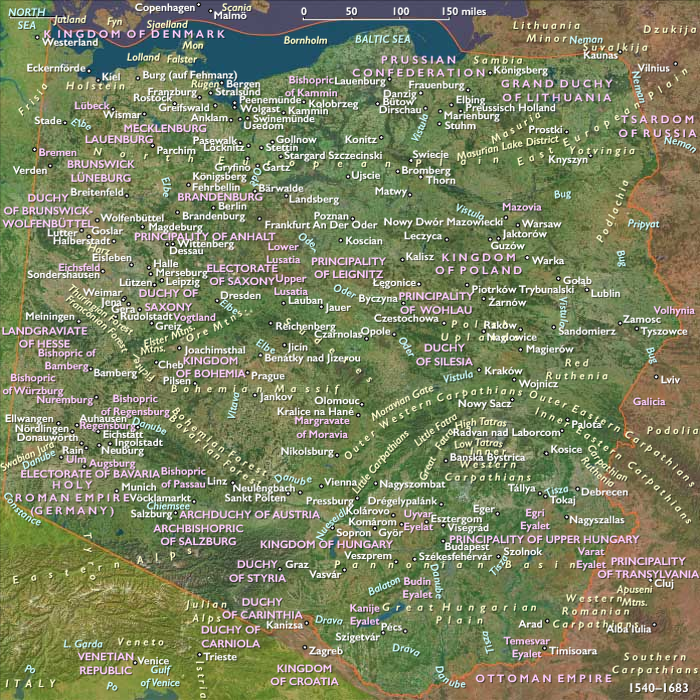
Wallenstein had lost much of his reputation in the Battle of Stralsund, but the victory at Wolgast has postponed his dismissal.
Though Ferdinand II has Ramboldo, Count of Collalto, reduce Wallenstein's army, the passage about his dismissal is stricken out.
The defeat at Wolgast, ending the most ambitious operation of the Danish 1628 amphibious assault series, is the decisive factor that leads Christian to negotiate the Peace of Lübeck with Ferdinand.
On the other hand, Wallenstein also needs a peace: The campaigns of Christian had succeeded in keeping imperial forces busy that were needed elsewhere, and with respect to Denmark, this was a major intent behind the assaults.
Furthermore, the Danish-Swedish alliance that is taking shape shape constitutes a veritable threat to Wallenstein's North German gains.
The Treaty of Lübeck, concluded in 1629, basically returns to Christian his prewar possessions, while he has to promise to abandon his support for the Protestant German states.
Thus, in the following two years more land will be subjugated by the Catholic powers.
At this point, the Catholic League persuades Ferdinand to take back the Lutheran holdings that are, according to the Peace of Augsburg, rightfully the possession of the Catholic Church.
Enumerated in the Edict of Restitution (1629), these possessions include two Archbishoprics, sixteen bishoprics, and hundreds of monasteries.
The same year, Gabriel Bethlen, the Calvinist Prince of Transylvania, dies.
Only the port of Stralsund continues to hold out against Wallenstein and the Emperor.
Images

Albrecht Eusebius Wenzel von Wallenstein, Duke of Friedland and Mecklenburg. Source: H.F. Helmolt (ed.): History of the World. New York, 1902. Copied from: University of Texas Library Portrait Gallery. Originally part of the portrait by Anthony Van Dyck, 1629; now in the Bayerische Staatsgemäldesammlungen, Munich.
Locations
People
Groups
Topics
Commodities
Subjects
Regions
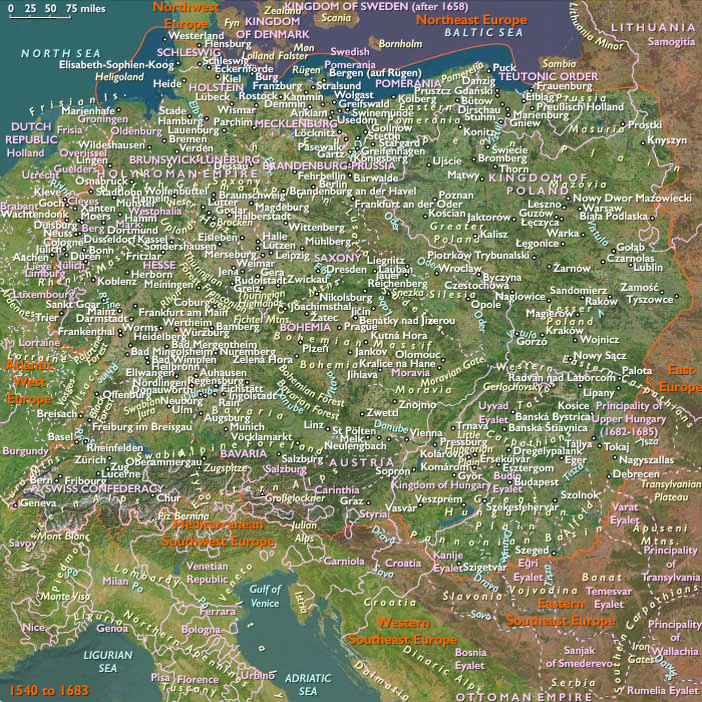
Central Europe
View →Subregions