Event
West Africa (1540–1683 CE): Songhai’s Fall, Atlantic…
West Africa (1540–1683 CE): Songhai’s Fall, Atlantic Expansion, and the Rise of New Regional Powers
Geographic and Environmental Context
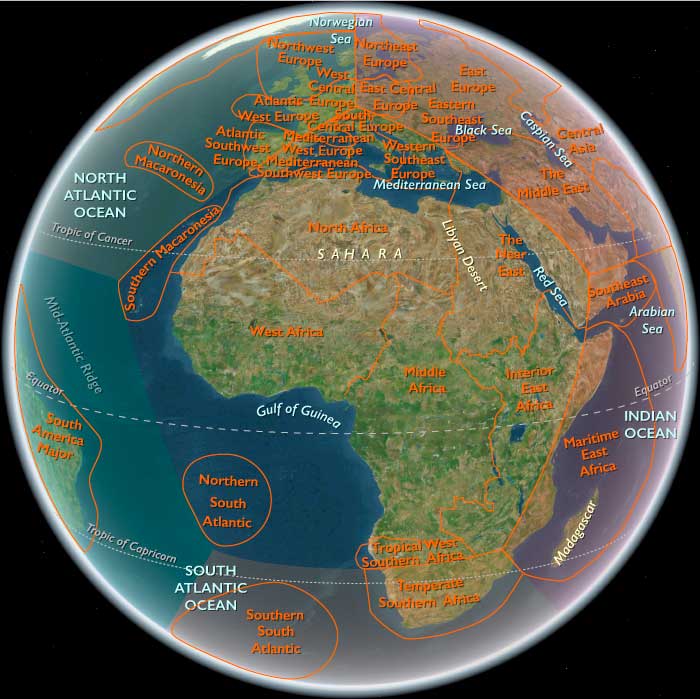
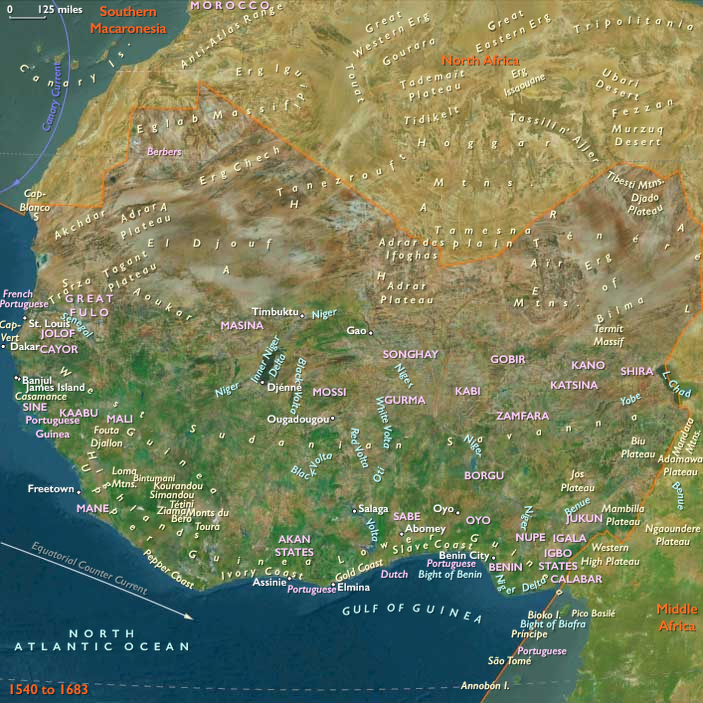
West Africa remained organized around several interacting ecological systems: the Senegal and Gambia valleys, upper Niger and Inland Delta, middle Niger and Gao region, Sahelian grasslands, Sudanian savannas, forest–savanna margins, humid forest zones, coastal lagoons, estuaries, and the Atlantic shore.
The Niger continued to support rice cultivation, fishing, grazing, flood-recession farming, settlement, and bulk transport. Djenné remained a major market center linked to both Saharan and southern trade, while Timbuktu retained important scholarly and commercial functions even after Songhai’s political collapse.
Farther south, gold-producing districts, kola zones, forest agriculture, coastal fisheries, and increasingly important Atlantic markets tied inland and coastal communities together. European coastal commerce expanded strongly during this period, but most of West Africa remained economically anchored in African-controlled agriculture, river transport, local markets, and regional trade.
Climate and Environmental Shifts
Sahelian communities continued to face variable rainfall, fluctuating pasture, and irregular flood conditions. Riverine environments buffered some of these risks by allowing communities to combine fishing, cultivation, grazing, and transport.
In the forest and coastal zones, farming expanded around growing settlements and commercial corridors. Mangroves, lagoons, estuaries, and nearshore waters supported fishing, salt production, and canoe movement.
The diversity of these environments allowed households to shift between crops, livestock, fishing, craft production, and trade when individual sectors came under pressure.
Subsistence and Settlement
Most people remained farmers, herders, fishers, artisans, and local traders.
Millet and sorghum continued to dominate the Sahel and savanna. Rice remained important in the Inland Niger Delta and western riverine zones. Yams, plantains, oil palm, kola, and other crops sustained forest and woodland communities.
Livestock remained central to both subsistence and political wealth. Cattle, sheep, and goats linked farming settlements with transhumant pastoral communities.
Ironworking, weaving, leatherworking, dyeing, pottery, woodworking, brass casting, and food processing remained major occupations. Large towns and courts depended upon these rural and household economies for food, labor, materials, and revenue.
Songhai and the Crisis of the Niger Empire
At the beginning of the period, Songhai remained the most powerful state of the middle Niger.
Its rulers controlled Gao, Timbuktu, Djenné, and important segments of trans-Saharan commerce. Timbuktu remained an intellectual and spiritual center whose fifteenth- and sixteenth-century prominence rested on mosques, madrasas, scholarship, and long-distance trade.
By the later sixteenth century, however, internal political struggles weakened the empire.
In 1591, a Moroccan expedition crossed the Sahara and defeated Songhai forces. The event broke Songhai’s imperial supremacy and was one of the major political turning points in West African history.
The collapse of the empire did not destroy the Niger economy. Agriculture, fishing, markets, scholarly communities, and river transport continued, while political authority fragmented among successor states, local rulers, and Moroccan-linked authorities along parts of the Niger.
Timbuktu, Djenné, and Scholarly Continuity
The fall of Songhai did not end intellectual life in the Niger cities.
Timbuktu retained its traditions of Islamic scholarship, manuscript culture, teaching, and jurisprudence. Its earlier golden age had created institutions strong enough to survive political upheaval, even as the city’s international political importance changed.
Djenné similarly remained a major commercial and religious center. Its location on flood-protected mounds within the Niger-Bani system continued to connect agriculture, fishing, pastoralism, and long-distance exchange.
These cities demonstrate the persistence of urban and scholarly institutions even when imperial states fragmented.
The Niger after Songhai
After 1591, the middle Niger became politically more divided.
Moroccan forces established control over some important towns, but effective authority remained uneven. Local rulers, merchant communities, scholarly families, agricultural populations, and pastoral groups retained considerable influence.
The Niger therefore continued to function as a commercial artery without being governed by a single empire.
Grain, fish, salt, textiles, livestock, and other goods moved between towns and rural communities. Riverboats remained essential to transport, while overland routes linked the Niger to Saharan, Hausa, and forest markets.
The Growth of Hausa States
Farther east, Hausa states became increasingly important.
Kano, Katsina, Zaria, Gobir, and other centers developed substantial markets, textile production, leatherworking, agriculture, and long-distance trade. Islam was well established among rulers, scholars, and merchant communities.
These states competed with one another while remaining linked by commerce and shared cultural institutions.
Hausa traders connected the Niger world, central Sahara, Lake Chad region, and forest–savanna markets, helping shift some commercial activity eastward as the old Songhai political system fragmented.
Oyo and the Yoruba Savanna
In the forest–savanna transition of southwestern Nigeria, Oyo expanded as a major political power.
Its position in open savanna country allowed cavalry to become an important military institution. Political authority rested on tribute, agriculture, trade, and control of routes connecting inland markets with coastal regions.
Oyo’s expansion did not eliminate older Yoruba towns and local political systems. Instead, it developed within a broader landscape of farming communities, craft centers, markets, shrines, and regional states.
By the seventeenth century, Oyo was becoming one of the strongest powers linking the interior savanna with the Gulf of Guinea.
Benin and the Forest Kingdoms
Benin remained one of the most powerful states of southern West Africa.
Its court supported brass casting, ivory carving, architecture, ritual institutions, and long-distance trade. Relations with Portuguese and other European merchants continued, but the kingdom retained political control over its own commercial relationships.
The wider forest zone contained many other independent states and trading networks. Ijebu, Owo, Yoruba centers, Akan polities, and numerous smaller communities participated in overlapping systems of agriculture, gold production, craft specialization, and trade.
Political authority in the forest therefore remained multipolar.
Akan Gold States
Gold-producing regions of the forest and forest–savanna frontier became increasingly important during the seventeenth century.
Akan-speaking states developed around mining districts, agricultural zones, and trading routes linking the interior to coastal markets.
Gold remained important in both inland and Atlantic commerce. As political competition intensified, several Akan states expanded their military and commercial institutions.
These developments would eventually contribute to the emergence of Asante at the end of the seventeenth century, although its great imperial expansion belongs to the following age.
Atlantic Trade and Coastal Forts
Atlantic commerce expanded dramatically during the sixteenth and seventeenth centuries.
Portuguese traders were joined increasingly by Dutch, English, French, Danish, and other European merchants. Forts and trading lodges appeared at selected coastal points, particularly along the Gold Coast.
These establishments did not control extensive territories inland. They depended heavily on African rulers, merchants, brokers, canoe operators, porters, farmers, and market communities.
Gold remained a major export, but enslaved people became increasingly important in Atlantic trade as plantation economies expanded in the Americas.
European manufactured goods—including textiles, metal goods, beads, firearms, and alcohol—entered African markets through coastal intermediaries.
The Expansion of the Atlantic Slave Trade
The transatlantic slave trade became increasingly destructive during this period.
Enslavement already existed within West African societies, and captives had long moved through Saharan and regional networks. Atlantic demand, however, greatly expanded the scale and geographic reach of slave trading.
Warfare, political competition, raiding, judicial enslavement, debt, and commercial brokerage supplied captives to coastal markets.
The effects were uneven. Some states and merchant groups gained wealth or military advantages, while other communities suffered displacement, insecurity, and demographic loss.
The Atlantic slave trade did not become the sole economic system of West Africa. Agriculture, regional commerce, gold, kola, fisheries, livestock, textiles, and local markets remained fundamental.
Firearms and Political Change
Firearms entered West African trade in greater numbers during this period, especially in coastal regions.
Their influence was gradual. Muskets did not immediately replace bows, spears, swords, cavalry, or other weapons, and access remained uneven.
Where firearms became available, they could reinforce states already able to mobilize soldiers, obtain imported powder, and control commercial routes.
Military change therefore reflected broader political and economic organization rather than the simple arrival of a new weapon.
Religion and Intellectual Life
Islam remained deeply rooted across the Sahel and northern savanna.
Timbuktu, Djenné, Gao, Hausa towns, and numerous smaller centers maintained mosques, Qur’anic schools, judges, scholars, scribes, and manuscript traditions. Timbuktu’s reputation as a major center of Islamic learning had been established during the preceding centuries and continued beyond Songhai’s collapse.
Islam also spread farther south through merchant and clerical communities. The Sudanese-style mosque tradition of northern Côte d’Ivoire reflects the extension of Islamic commercial and cultural connections into the forest–savanna frontier.
Indigenous religious traditions remained strong. Ancestor veneration, sacred groves, divination, healing systems, river and earth spirits, royal rituals, and shrine traditions continued throughout the region.
Religious change remained cumulative rather than substitutive.
Technology and Material Culture
Iron tools remained basic to agriculture and craft production.
Textile industries flourished in several regions, particularly Hausa and Mande markets. Leatherworking, pottery, woodcarving, goldworking, brass casting, and dyeing supported both household economies and elite consumption.
River canoes remained critical to Niger transport. Camels continued to dominate Saharan crossings, while donkeys, oxen, horses, and human carriers moved goods inland.
Atlantic ships represented an increasingly important external transport system, but they remained confined to the coast. African canoes and local traders still connected offshore ships to coastal settlements and inland markets.
Movement and Interaction Corridors
The Niger remained one of the region’s principal arteries, linking agricultural districts, river cities, fishing communities, and eastern markets.
Trans-Saharan routes still connected West Africa to North Africa even after Songhai’s collapse.
Hausa routes strengthened connections between central Sudanian markets and Saharan trade.
Forest tracks linked gold, kola, agricultural products, and craft goods with interior markets.
Atlantic shipping increasingly connected Senegambia, the Gold Coast, the Bight of Benin, and other coastal zones with Europe and the Americas.
West Africa thus became more strongly integrated into multiple commercial systems at once.
Adaptation and Resilience
Communities continued to manage uncertainty through diversified production.
Farmers cultivated multiple crops. Pastoralists moved livestock seasonally. Fishing communities adapted to river cycles. Merchants shifted between routes when warfare or political change disrupted established corridors.
The collapse of Songhai demonstrated this resilience particularly clearly.
A major empire disappeared, yet Niger farming, markets, manuscript culture, river transport, and long-distance trade continued. Political authority fragmented, but the deeper economic and social systems endured.
Political and Economic Development
The defining transformation of 1540–1683 CE was the shift from one dominant Niger-centered imperial system toward a more multipolar West Africa linked increasingly strongly to Atlantic commerce.
Songhai collapsed after the Moroccan invasion of 1591, but the Niger cities survived.
Hausa states expanded their commercial importance farther east.
Oyo strengthened in the Yoruba savanna.
Benin remained a major forest kingdom.
Akan states grew around gold-producing and commercial networks.
Along the Atlantic coast, European forts and merchant enclaves became more numerous while remaining dependent upon African-controlled inland systems.
The subregion therefore became politically more fragmented but commercially more interconnected.
Legacy of the Age
By 1683 CE, the great Songhai imperial system had disappeared, but West Africa had not entered an age of general decline.
The Niger remained productive and commercially important. Timbuktu and Djenné preserved scholarly, religious, and market traditions despite political disruption. The historical significance of Songhai’s 1591 collapse lay chiefly in the redistribution of political power rather than the destruction of the Niger world.
Hausa states, Oyo, Benin, and expanding Akan polities created new centers of authority. Atlantic commerce connected coastal societies ever more strongly with Europe and the Americas, while trans-Saharan and internal African trade continued.
By the end of the age, West Africa had become a multipolar political and commercial landscape. River empires had given way to overlapping inland states, forest kingdoms, coastal trading powers, and merchant networks, while the growing Atlantic slave trade introduced increasingly destructive pressures that would intensify during the following century.
-
{# Image navigates to the detail page; the magnifying-glass chip is the only Fancybox lightbox trigger (kept a separate sibling — anchors can't nest). #}
 The Middle of The Earth
World
-
{# Image navigates to the detail page; the magnifying-glass chip is the only Fancybox lightbox trigger (kept a separate sibling — anchors can't nest). #}
 West Africa
Region
-
{# Image navigates to the detail page; the magnifying-glass chip is the only Fancybox lightbox trigger (kept a separate sibling — anchors can't nest). #}
 West Africa
Subregion