West Melanesia (1396–1539 CE): Highlands, Islands, and…
1396 CE to 1539 CE
West Melanesia (1396–1539 CE): Highlands, Islands, and Expanding Worlds
Geographic & Environmental Context
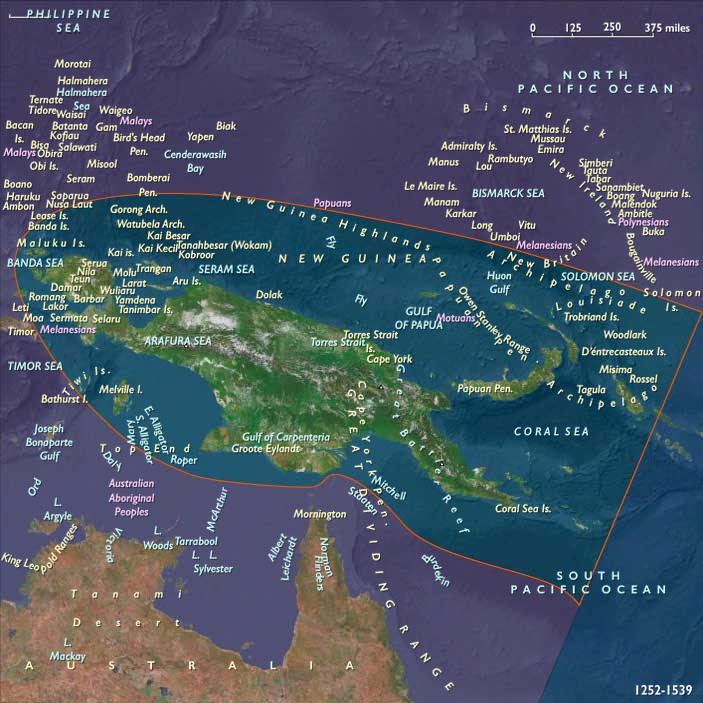
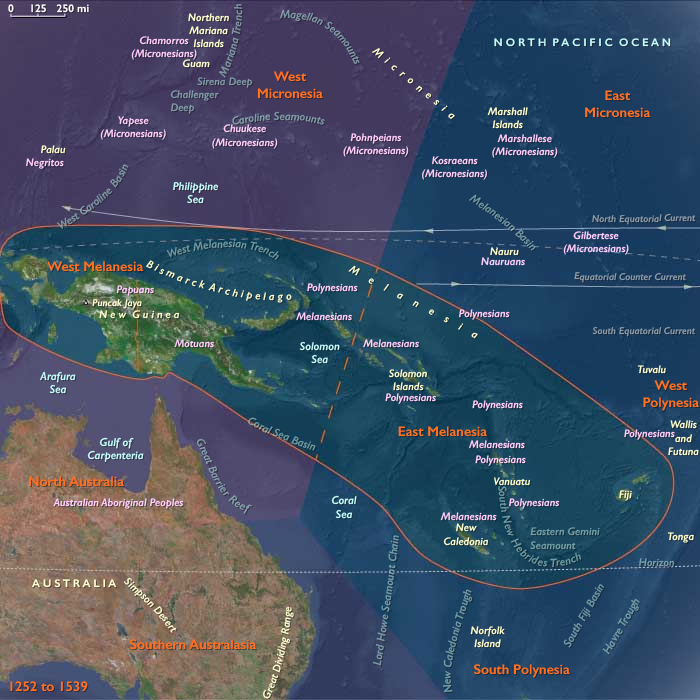
The subregion of West Melanesia includes New Guinea (both the central highlands and coastal lowlands), the Bismarck Archipelago, Bougainville, and nearby smaller islands. The vast interior of New Guinea rose in rugged mountains and valleys, with fertile highland basins supporting intensive agriculture. Coastal lowlands, mangrove estuaries, and river deltas framed settlement along the shores. Offshore, the Bismarck Archipelago and Bougainville provided volcanic soils, coral-fringed coasts, and maritime connections across the Solomon Sea.
Climate & Environmental Shifts
This age unfolded during the Little Ice Age, when global cooling brought modest temperature shifts and greater variability in rainfall. In the New Guinea highlands, cooler nights occasionally shortened growing seasons at elevation, though fertile soils buffered impacts. Coastal lowlands faced alternating cycles of drought and heavy rains tied to ENSO (El Niño–Southern Oscillation). Cyclones and volcanic eruptions in the Bismarcks punctuated the climate, reshaping coasts and agricultural zones.
Subsistence & Settlement
By this age, communities in New Guinea’s highlands had long developed intensive agriculture: irrigated taro terraces, sweet potato fields, and pig husbandry supported dense populations. In coastal lowlands and islands, subsistence blended sago, yam, banana, and breadfruit cultivation with reef and deep-sea fishing. Domesticated pigs were central to both ritual and feasting economies. Settlements ranged from fortified highland hamlets to coastal villages, linked by exchange routes. Populations were high, with the highlands of New Guinea among the most densely settled non-state societies in the world.
Technology & Material Culture
Material culture was diverse and specialized. Stone adzes, polished tools, and obsidian blades (circulating especially from the Bismarcks) remained crucial. Canoe-building was sophisticated, with large outrigger vessels enabling inter-island exchange and warfare. Elaborate wood carvings, masks, shell ornaments, and feathered regalia marked ritual and status. Highland communities developed intricate ritual paraphernalia tied to ancestor worship and initiation rites.
Movement & Interaction Corridors
West Melanesia sat at a major crossroads. Coastal and island communities maintained voyaging corridors across the Bismarck Sea, the Solomon Sea, and into Bougainville and the Solomons. The obsidian trade from New Britain continued, linking communities over hundreds of kilometers. To the east, contact extended into East Melanesia; to the west, ties with the Moluccas connected New Guinea to wider Southeast Asian maritime worlds. Highland valleys maintained exchange systems of salt, stone, pigs, and ritual valuables, binding dispersed groups into vast regional networks.
Cultural & Symbolic Expressions
Ritual life flourished. Ancestor veneration structured social and political authority, with elaborate ceremonies, feasts, and exchanges binding clans. Highland pig exchanges and ritual cycles expressed wealth, prestige, and cosmic balance. Along the coasts, ceremonial houses (men’s houses) embodied political and spiritual authority, decorated with carvings and symbolic motifs. Oral traditions, songs, and dances carried genealogies, mythic histories, and ecological knowledge across generations.
Environmental Adaptation & Resilience
Communities displayed resilience through crop diversification, pig husbandry, and exchange networks. Highland terrace systems buffered against climatic variability, while coastal societies relied on mixed horticulture and fishing. Canoe voyages ensured circulation of goods during scarcity. Ritual exchange and alliances mitigated conflict and stabilized resource distribution, embedding resilience within cultural systems.
Transition
By 1539 CE, West Melanesia was a densely populated, culturally dynamic subregion, with intensive agriculture, long-distance trade, and elaborate ritual life. Its communities sustained complex societies without states, embedded in ecological and cosmological frameworks that balanced highland intensification with coastal voyaging. European contact lay just over the horizon, but West Melanesia was already a vibrant center of Oceanic civilization.
Topics
Commodities
Subjects
Regions
Melanesia
View →Subregions