
West Micronesia (1396–1539 CE): Navigators of the…
1396 CE to 1539 CE
West Micronesia (1396–1539 CE): Navigators of the Western Pacific
Geographic & Environmental Context
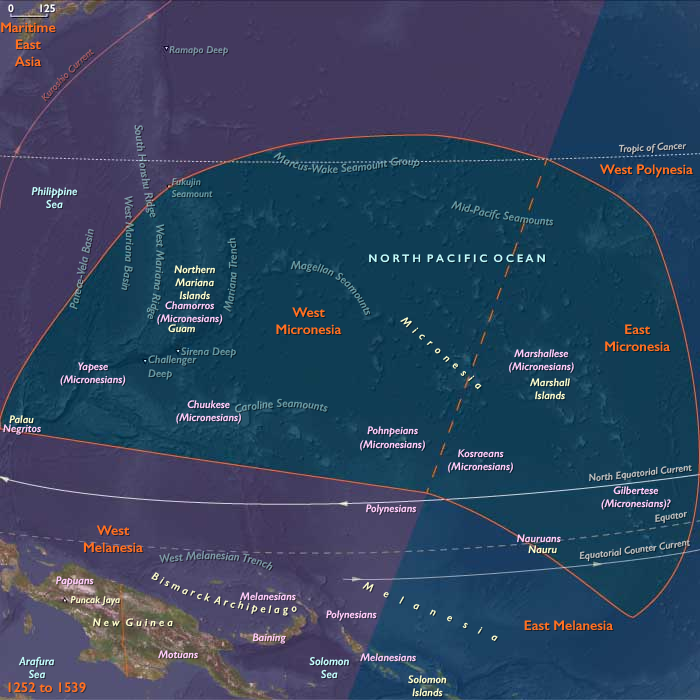
The subregion of West Micronesia includes Palau, Yap, and the Mariana Islands. These islands varied in form: Palau with its lush volcanic high islands and barrier reef; Yap with raised limestone, mangroves, and fertile soils; and the Marianas, a chain of volcanic islands with rugged coasts and sheltered lagoons. Together they formed stepping stones across the western Pacific, bridging Southeast Asia with the wider Micronesian and Polynesian worlds.
Climate & Environmental Shifts
This age coincided with the Little Ice Age, which brought modest cooling and greater variability in rainfall across the tropics. Typhoons periodically devastated islands, reshaping coastlines and gardens. ENSO cycles produced alternating droughts and floods, testing food security on limestone and atoll environments. Despite these stresses, volcanic islands like Guam, Rota, and Yap maintained fertile soils and groundwater, buffering populations.
Subsistence & Settlement
Communities flourished through a combination of horticulture, arboriculture, and fishing. On volcanic islands, taro, yam, breadfruit, bananas, and coconuts formed the agricultural base. On limestone islands, reliance on breadfruit and coconut was greater, supplemented by reef fisheries. Settlements clustered around lagoons and fertile valleys, often organized into extended clan compounds. In the Marianas, latte stone pillars supported large houses, signaling architectural sophistication and chiefly authority. Palauan villages thrived near taro patches and fish weirs; Yapese society was organized around stone paths, villages, and canoe houses.
Technology & Material Culture
Material culture reflected both practical adaptation and symbolic expression. Latte stones in the Marianas served as house foundations and elite symbols. Stone money (rai stones) of Yap were quarried on Palau and transported by canoe, embodying both wealth and navigational prowess. Palauan artisans crafted shell ornaments, carved wooden figures, and stone adzes. Canoe-building was advanced: outrigger and double-hulled canoes enabled inter-island voyaging across hundreds of kilometers, reinforced by expert star navigation.
Movement & Interaction Corridors
West Micronesia lay at the nexus of voyaging and exchange networks. Palau and Yap were connected through the transport of rai stones, linking symbolic wealth to seafaring skill. The Marianas engaged in inter-island voyaging along the chain, sustaining political unity and resource sharing. Navigational specialists maintained knowledge of stars, swells, and currents, embedding maritime corridors into cultural identity. These routes tied West Micronesia into a larger Pacific network, foreshadowing later links to Spanish Manila galleons after European arrival.
Cultural & Symbolic Expressions
Cultural systems emphasized hierarchy, ritual exchange, and cosmological order. In the Marianas, chiefly authority was expressed through latte architecture, feasting, and control of land and sea. Yap’s system of rai stones fused material wealth with spiritual potency and navigational expertise. Palau’s ceremonial houses (bai) served as community and ritual centers, adorned with symbolic carvings recounting myth, history, and law. Oral traditions, dances, and chants encoded navigational knowledge and genealogies, tying people to both land and sea.
Environmental Adaptation & Resilience
Island communities displayed resilience through crop diversification, arboriculture, and voyaging. Breadfruit and coconut groves buffered against drought; taro patches in irrigated valleys sustained core diets; and reef fisheries ensured protein security. When local resources faltered, exchange and voyaging redistributed food and valuables across islands. Ritualized systems of tribute and wealth (rai stones, feasts, and latte foundations) embedded resilience into political and social frameworks.
Transition
By 1539 CE, West Micronesia was a sophisticated maritime world of agriculturalists, navigators, and ritual leaders. Its societies blended architectural monumentality, symbolic wealth, and voyaging mastery into resilient cultural systems. Europeans had not yet reached these islands (the Marianas would be first contacted by Magellan in 1521, Palau and Yap later in the 16th–17th centuries), but West Micronesia was already deeply integrated into a Pacific-wide world of exchange, ritual, and navigation.
Groups
Topics
Subjects
Regions
Micronesia
View →Subregions
