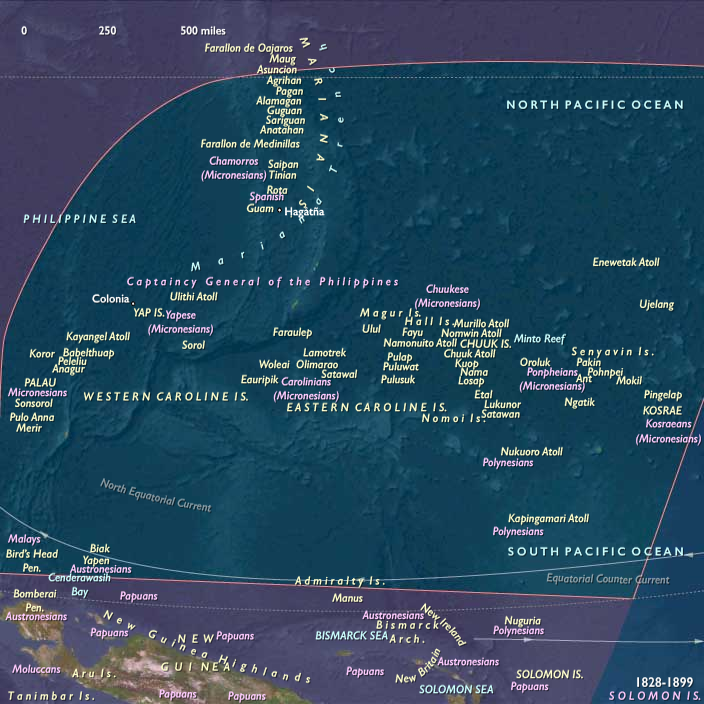
West Micronesia (1828–1971 CE): Colonial Crossroads, Warzones,…
1828 CE to 1971 CE
West Micronesia (1828–1971 CE): Colonial Crossroads, Warzones, and Strategic Trusteeships
Geography & Environmental Context
West Micronesia encompasses the Mariana Islands (including Guam and Saipan), the Caroline Islands (Palau, Yap, Chuuk, Pohnpei, Kosrae), and the Marshall Islands to the east. Anchors include the volcanic high islands of Yap, Pohnpei, and Chuuk Lagoon, the limestone plateaus of Palau, the coral atolls of the Marshalls, and the central Guam–Saipan corridor. The region straddles tropical typhoon belts and nutrient-rich reefs, making it both vulnerable and resource-abundant.
Climate & Environmental Shifts
A humid tropical regime with heavy rainfall sustained taro, breadfruit, and bananas on high islands. Typhoons regularly devastated atolls, destroying breadfruit groves and contaminating freshwater lenses. Rising demand for copra in the 19th century pushed many islands toward plantation monoculture. After 1945, nuclear testing in the Marshalls (Bikini, Enewetak) scarred environments and displaced islanders.
Subsistence & Settlement
-
Traditional lifeways: Taro pits, breadfruit orchards, fishing, and inter-island exchange persisted across the Carolines and Marshalls. Yap retained its famous stone money (rai) system.
-
Colonial economies: Copra plantations dominated under German and later Japanese rule. Guam, under U.S. control from 1898, mixed subsistence with American naval provisioning.
-
20th century: WWII devastated Saipan, Guam, and Palau. Postwar, the Trust Territory of the Pacific Islands (U.S.-administered) introduced wage labor, schools, and cash-crop dependency.
Technology & Material Culture
-
19th century: Canoes, breadfruit storage pits, and stone pathways structured traditional life.
-
Colonial period: Copra presses, mission schools, and churches altered landscapes. Japanese rule (1914–1944) introduced modern ports, airstrips, and sugar mills, especially on Saipan.
-
Postwar era: U.S. bases on Guam and Kwajalein, airstrips across Micronesia, and nuclear test infrastructure in the Marshalls. Radios, schools, and concrete housing spread after the 1950s.
Movement & Interaction Corridors
-
Colonial shifts: Spain (until 1898), Germany (Carolines, Marshalls), Japan (from 1914), the U.S. (Guam, post-1898; wider Micronesia after 1945).
-
World War II: Micronesia became the site of massive Pacific battles—Guam, Saipan, Palau, Kwajalein. Japanese fortifications and U.S. amphibious assaults transformed mobility.
-
Postwar: Air and sea links from Guam connected the islands to Hawaii and the Philippines; trust territory shipping and military flights replaced traditional canoe exchange.
Cultural & Symbolic Expressions
-
Missionary legacies: Catholicism (Spain, France) and Protestantism (Germany, U.S.) reshaped religious life.
-
Hybrid cultures: Chamorro in Guam blended Spanish, Filipino, and U.S. influences; Carolinian and Marshallese traditions persisted alongside Western schooling.
-
Postwar identities: Islanders debated autonomy, independence, and U.S. affiliation; cultural revivals in navigation, dance, and stone-money reaffirmed heritage.
Environmental Adaptation & Resilience
-
Cyclone resilience: Taro pits, breadfruit fermentation, and inter-island exchange buffered shortages.
-
Colonial adaptation: Islanders mixed copra production with subsistence; U.S. aid after WWII substituted for lost autonomy.
-
Nuclear displacement: Bikini and Enewetak islanders relocated multiple times, relying on U.S. rations and compensation, reshaping traditional resilience.
Political & Military Shocks
-
Spanish–German transition (1899): Spain sold Carolines and Marshalls to Germany; Guam ceded to U.S. after Spanish-American War.
-
Japanese mandate (1914–44): Industrialization, settlement, and fortification reshaped society.
-
World War II: Battles destroyed much of Micronesia; populations suffered forced labor and displacement.
-
U.S. Trust Territory (1947): United Nations mandate placed Micronesia under American administration, embedding it in Cold War geopolitics.
-
Nuclear era: Marshall Islands became testing grounds (1946–58), leaving health and displacement crises.
Transition
Between 1828 and 1971, West Micronesia passed through Spanish, German, Japanese, and American empires, each leaving deep marks. From subsistence and stone money to copra plantations, airstrips, and nuclear fallout, the islands became both victims and strategic prizes. By 1971, Micronesians faced a new era: the choice between autonomy and continued U.S. association, as their cultures and ecologies carried both resilience and scars of global empires.
Groups
Topics
Subjects
Regions
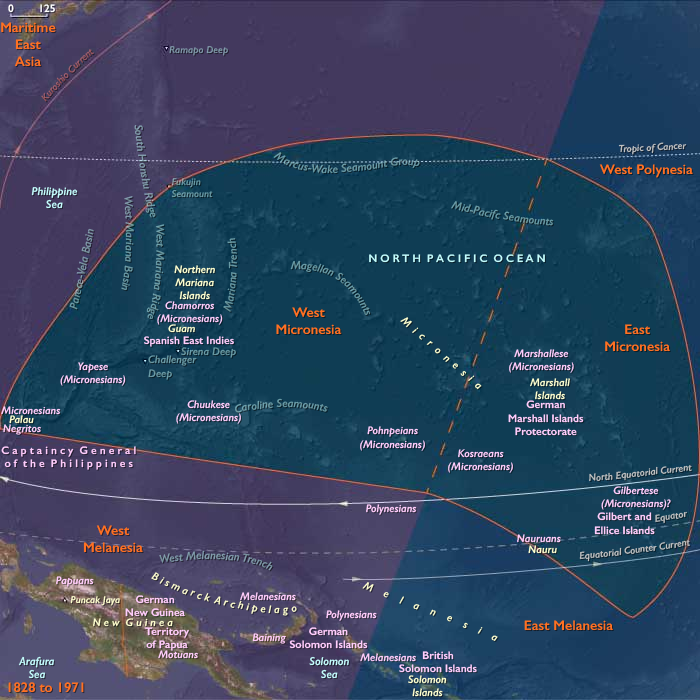
Micronesia
View →Subregions