
Event
Fashion and Hairdressing in Late Medieval Western…
Fashion and Hairdressing in Late Medieval Western Europe
By the mid-14th century, Western European women’s hairstyles became increasingly elaborate, reflecting both social status and evolving aesthetic trends. A particularly striking style emerged in which women coiled their hair on either side of the face and secured it within metal-wire frames or baskets, often covered with fine veils or decorative nets (crespines or cauls).
Characteristics of the Hairstyle
- The hair was parted at the center, with long sections braided and wrapped into coils or horn-like shapes at the temples.
- These coils were often enclosed within decorative metal-wire cages or mesh caps, lending structure and elegance to the style.
- A silk or embroidered veil frequently covered the structure, emphasizing modesty and refinement.
Social and Cultural Significance
- The style was particularly popular among noblewomen, as it required considerable effort and accessories, making it a marker of wealth and status.
- It complemented the high, structured headdresses that were becoming fashionable, including the hennin (cone-shaped headdress) that would emerge later in the century.
- The hairstyle also reflected the broader Gothic aesthetic, which emphasized elongated, graceful silhouettes, including in fashion, art, and architecture.
Legacy and Evolution
This trend laid the groundwork for even more extravagant headwear in the late 14th and 15th centuries, including the heart-shaped escoffion, the steeple hennin, and the butterfly veils of Burgundian court fashion. The emphasis on framing the face with structured hair and fabric remained a defining feature of medieval elite women's fashion.
-
{# Image navigates to the detail page; the magnifying-glass chip is the only Fancybox lightbox trigger (kept a separate sibling — anchors can't nest). #}
 The North Atlantic Lands
World
-
{# Image navigates to the detail page; the magnifying-glass chip is the only Fancybox lightbox trigger (kept a separate sibling — anchors can't nest). #}
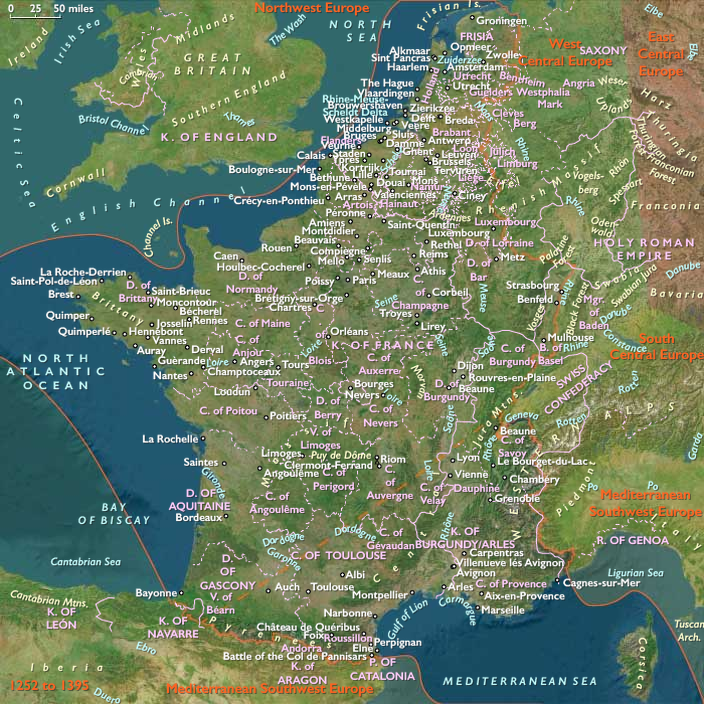 West Europe
Region
-
{# Image navigates to the detail page; the magnifying-glass chip is the only Fancybox lightbox trigger (kept a separate sibling — anchors can't nest). #}
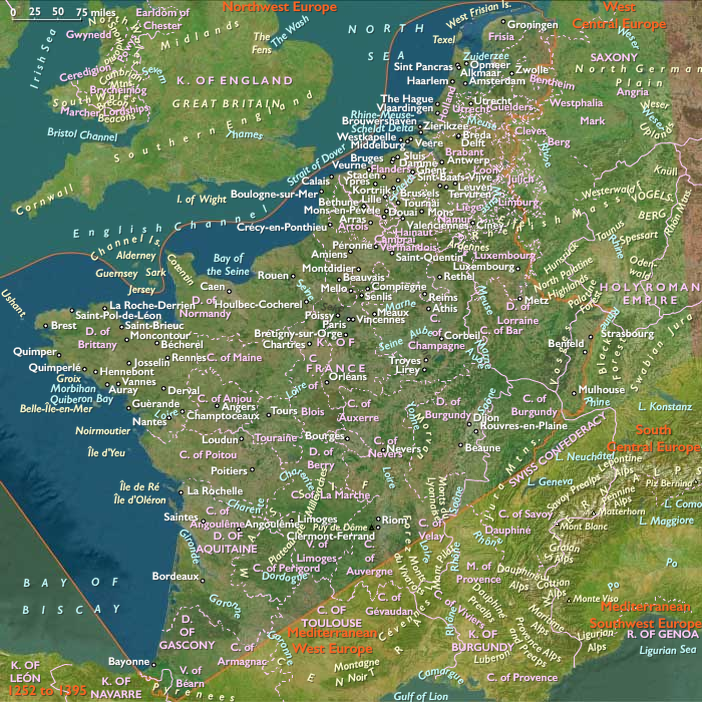 Atlantic West Europe
Subregion
