Western West Indies (1540–1683 CE): Sugar, Slavery,…
1540 CE to 1683 CE
Western West Indies (1540–1683 CE): Sugar, Slavery, and Maritime Conflict
Geographic & Environmental Context
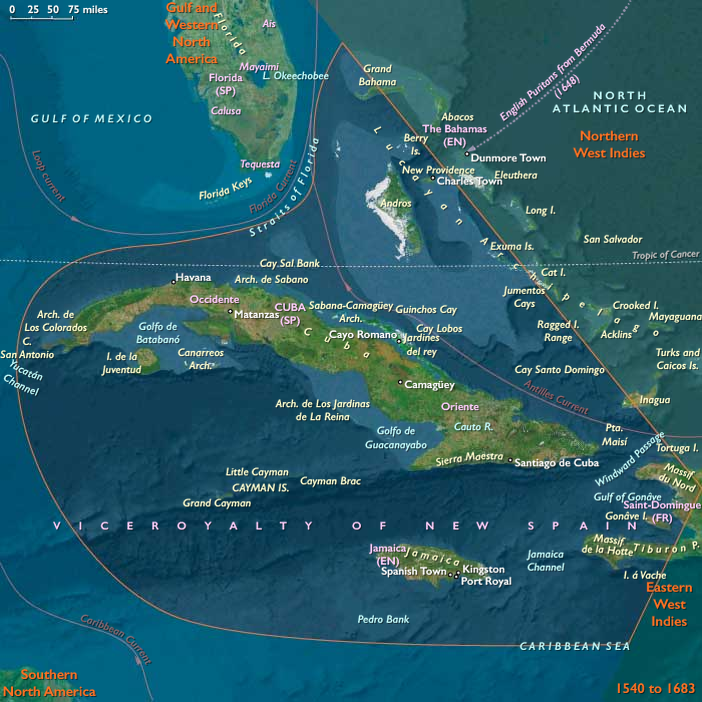
The subregion of Western West Indies includes Cuba, Jamaica, the Cayman Islands, and the Inner Bahamas (Andros, New Providence, Great Exuma, and neighboring islands). Anchors included the Sierra Maestra mountains of Cuba, the Blue Mountains of Jamaica, the Andros Barrier Reef, and the deep waters of the Cayman Trench. Fertile valleys, limestone plains, and sheltered bays made Cuba and Jamaica vital to Spain’s empire, while the Bahamas and Caymans became waypoints and pirate refuges.
Climate & Environmental Shifts
The Little Ice Age persisted with cooler decades and more frequent hurricanes. Drought struck Cuba’s interior at intervals, stressing ranching and farming, while Jamaica’s highlands and Cuba’s river valleys sustained plantation agriculture. The low-lying Bahamas were vulnerable to hurricanes and saltwater intrusion.
Subsistence & Settlement
-
Cuba: Became Spain’s Caribbean stronghold. Havana grew as a fortified port and fleet rendezvous. Cattle ranching expanded in the interior, alongside sugar and tobacco plantations worked by enslaved Africans.
-
Jamaica: Claimed by Spain but sparsely settled. Spanish ranches and villages dotted the north coast. Indigenous Taíno survivors were largely absorbed into Afro-Indigenous communities.
-
Cayman Islands: Remained uncolonized but were used by Spanish ships and later pirates for turtle hunting and fresh water.
-
Inner Bahamas: Populated intermittently by small Spanish and later English settlements; depopulation from earlier slave raids left many islands thinly inhabited until the 17th century.
Technology & Material Culture
Spanish introduced stone fortifications, galleons, firearms, and iron tools. Sugar mills, tobacco presses, and African agricultural practices transformed landscapes. Havana’s fortifications, including Castillo de la Real Fuerza (begun 1558), symbolized imperial defense. Enslaved Africans carried cultural traditions in crafts, music, and foodways, blending with European and Taíno survivals.
Movement & Interaction Corridors
-
The Spanish treasure fleets converged at Havana before sailing for Seville, making Cuba a strategic hub.
-
The Bahamas became a corridor for privateers and buccaneers, harassing Spanish shipping.
-
The Caymans served as provisioning stops for seafarers.
-
Smuggling routes carried contraband between Cuba, Jamaica, and northern colonies.
Cultural & Symbolic Expressions
-
Catholic cathedrals, missions, and festivals anchored Spanish identity in Cuba and Jamaica.
-
African traditions—drumming, dances, cabildos (mutual-aid societies)—flourished despite restrictions.
-
In Cuba, the cult of the Virgin of Charity (later Virgen de la Caridad del Cobre) gained prominence, blending African and Spanish devotion.
-
The Bahamas became associated with piracy in European imagination, symbolic of rebellion and opportunity.
Environmental Adaptation & Resilience
Cattle ranchers adapted to drought by moving herds inland. Planters diversified sugar, tobacco, and cattle to buffer losses. Africans sustained resilience through foodways (cassava, okra, plantains) and hidden ritual practices. Islanders rebuilt after hurricanes with sturdier stone houses and fortifications.
Transition
By 1683 CE, the Western West Indies had become a strategic frontier of Spain’s empire. Cuba stood fortified as the linchpin of treasure fleets. Jamaica, underpopulated and vulnerable, would soon fall to English conquest (1655). The Bahamas and Caymans lingered as pirate strongholds and marginal settlements. The subregion was defined by sugar, slavery, contraband, and the clash of empires.
Images

Western West Indies (with civilization) ©2024-25 Electric Prism, Inc. All rights reserved.
Commodities
Subjects
Regions
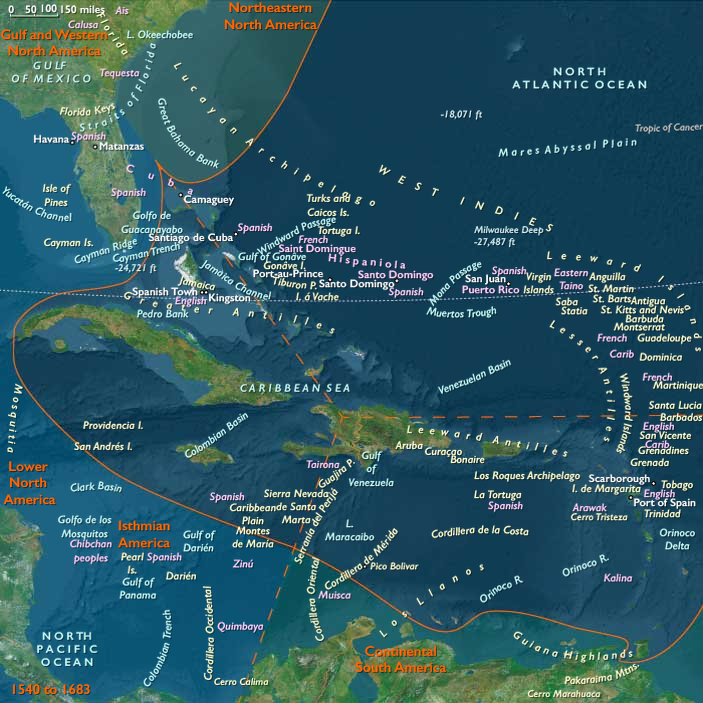
West Indies
View →Subregions