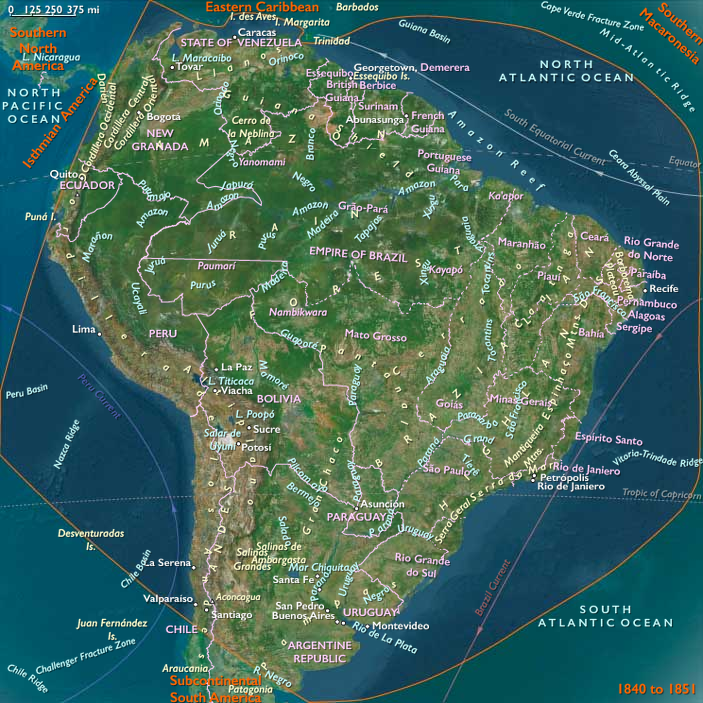
New Granada's early conservative leaders, or Ministerials…
1840 CE to 1851 CE
New Granada's early conservative leaders, or Ministerials as they are called initially, are slightly more distinguished socially than their adversaries, and each faction is stronger in some regions than others, but there are no significant differences in economic interest or social policy.
Neither faction is necessarily averse to economic liberalism.
Differences revolved instead around constitutional and ecclesiastical issues.
Having won the civil war, the Ministerials in 1843 adopt still another constitution, which strengthens central control over provincial authorities, whereas their opponents increasingly flirt with federalism.
The Ministerials also invite the Jesuits, expelled from the Spanish Empire by Charles III, to return to New Granada, with a view to their playing a key role in secondary education and defending the country's youth against dangerous new doctrines.
In this, they demonstrate their intention to forge a close relationship with the Roman Catholic Church, both from religious conviction and from a belief in its importance as a force for social and political stability.
By contrast, their opponents hope to resume the course of religious reform begun at the Congress of Cucuta in 1821 and interrupted by Bolivar's dictatorship.
Unfortunately for the Ministerials, however, in 1849 divisions in their camp allow the opposition candidate, General Jose Hilario Lopez Valdez (president, 1849-53), to triumph.
It was during this presidential campaign that the contending factions adopt definitively the terms Liberal and Conservative and that the parties bearing those names can be said to have taken shape.
Locations
People
Groups
Regions
South America
View →Subregions