
Breda’s governor, Justinus of Nassau, surrenders in …
Years: 1625 - 1625
June
Breda’s governor, Justinus of Nassau, surrenders in June 1625 after a costly eleven-month siege, which only thirty-five hundred Dutchmen and less than six hundred Englishmen have survived.
The sixty-six-year-old governor, the only extramarital child of William of Orange, is allowed to leave for Leiden.
The Siege of Breda, Spinola's greatest success and one of Spain's last major victories in the Eighty Years' War, is part of a plan to isolate the Republic from its hinterland.
La rendición de Breda (English: The Surrender of Breda), also known as El cuadro de las lanzas or Las lanzas, is a painting by Velázquez, painted during the years 1634–35, and inspired while Velázquez was visiting Italy with Spinola.
It is considered one of the Velázquez' best artworks.
Jan Morris has called it "one of the most Spanish of all pictures" (Jan Morris 1964: "Spain", p.29).
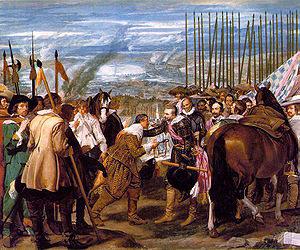
Diego Velázquez: The Surrender of Breda(1634–5), Oil on canvas, 307 cm × 367 cm (121 in × 144 in), Museo del Prado, Madrid, Spain
Locations
People
Groups
- Christians, Roman Catholic
- Protestantism
- Spain, Habsburg Kingdom of
- Netherlands, United Provinces of the (Dutch Republic)
- Netherlands, Southern (Spanish)
- France, (Bourbon) Kingdom of
- Habsburg Monarchy, or Empire
Topics
- Protestant Reformation
- Counter-Reformation (also Catholic Reformation or Catholic Revival)
- Eighty Years War (Netherlands, or Dutch, War of Independence)
Commodoties
Subjects
Regions
Subregions
Related Events
Showing 10 events out of 32824 total
Years: 1625 - 1625
June
Diego Velázquez: The Surrender of Breda(1634–5), Oil on canvas, 307 cm × 367 cm (121 in × 144 in), Museo del Prado, Madrid, Spain
Locations
People
Groups
- Christians, Roman Catholic
- Protestantism
- Spain, Habsburg Kingdom of
- Netherlands, United Provinces of the (Dutch Republic)
- Netherlands, Southern (Spanish)
- France, (Bourbon) Kingdom of
- Habsburg Monarchy, or Empire
Topics
- Protestant Reformation
- Counter-Reformation (also Catholic Reformation or Catholic Revival)
- Eighty Years War (Netherlands, or Dutch, War of Independence)
Commodoties
Subjects
Regions
Subregions