Solon, on his return to Athens, finds…
561 BCE to 550 BCE
Solon, on his return to Athens, finds the citizens divided into regional factions headed by prominent nobles.
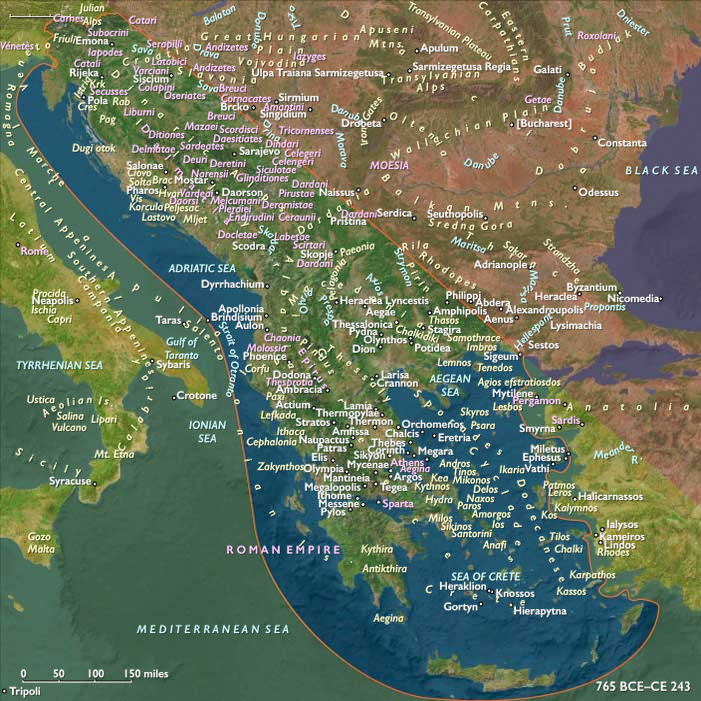
The two major vying factions are called the Plain, led by Lycurgus, and the Coast, led by Megacles, whose Alcmaeonid family, although permitted a return to Athens in the early sixth century, is still considered stained by blood guilt.
Solon's friend and relative Peisistratus, general in the final war (570 to 565) for Salamis and leader of northeastern Attica, has organized his own faction, named the Hillsmen, a group that includes noble families from his own district, the eastern part of Attica, and a very considerable part of the growing population of the city of Athens.
Peisistratus seems to Solon to be planning to become tyrant.
The old statesman's urgent warnings are disregarded, even dismissed as the ravings of a madman.
His reply is that “A little time will show the citizens my madness, / Yes, will show, when truth comes in our midst.” At one point, Peisistratus slashes himself and the mules of his chariot and makes a dramatic entrance into the agora (marketplace) to show how his enemies have wounded him.
The people have voted him use of a bodyguard of citizens armed with clubs, with the aid of which he seizes the Acropolis and holds power briefly in 560/559, but Lycurgus and Megacles combine to expel him to northern Greece.
Within five years, Peisistratus achieves a reconciliation with Megacles, who not only helps to restore his power in Athens but also gives to Peisistratus his daughter Coesyra.
Peisistratus reduces taxes, aids the poor and encourages literature and the arts.
The tyrant mistreats his wife, however, and in 552 the Alcmaeonids and Lycurgus once again throw him out, driving him to exile in Euboea.
The “Rampin Rider” or “Rampin Horseman,” an equestrian statue executed about 560, is an early example of a man-animal composition.
The statue was made of marble and has traces of red and black paint.
The rider has many of the features typical of an Archaic kouros, but has several asymmetrical features that break with the period's conventions.
The statue was originally thought to be a part of a set statues, perhaps paired with another as a mounted presentation of Castor and Pollux common on vases from this period.
According to another theory, the statue represents the winner of a race.
This theory is supported by the crown of lovage, given to winners of the Nemean Games and the Isthmian Games, on the statue.
Monster motifs dominate Greek gable sculptures of the era, as exemplified by a gaily colored limestone statue of a three-headed monster executed between 560 and 550.
Around this time, the Athenians begin to take over the lucrative vase-painting market dominated, until now, by the Etruscans.
Locations
Topics
Commodities
Subjects
Regions
Southeast Europe
View →Subregions