
Lopo Soares receives reports while in Cochin …
Years: 1504 - 1504
October
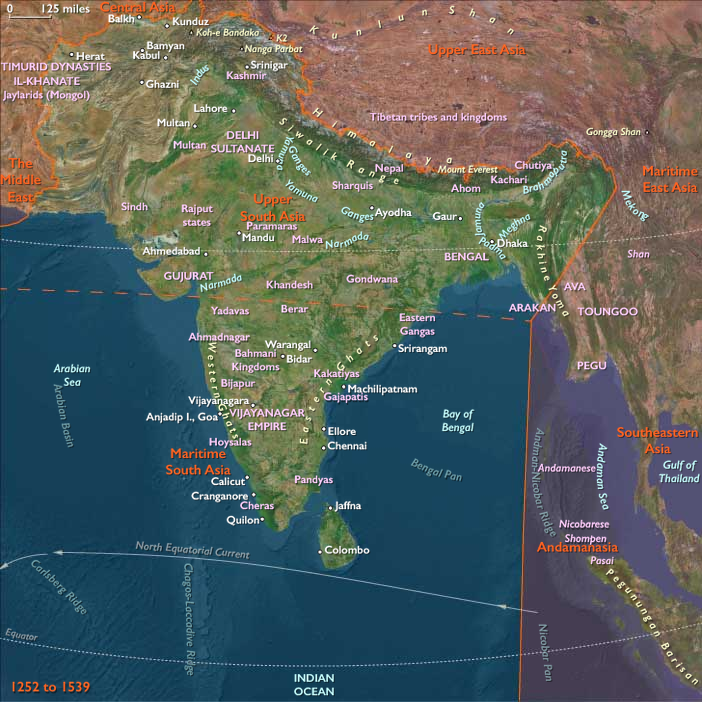
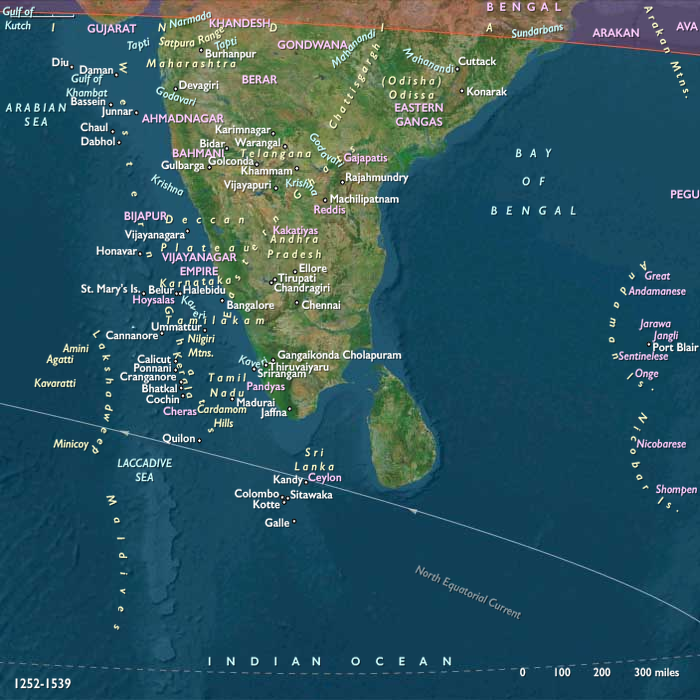
Lopo Soares receives reports while in Cochin that the Zamorin of Calicut has dispatched a force to fortify Cranganore, the port city at the northern end of the Vembanad lagoon, and the usual entry point for the Zamorin's army and fleet into the Malabari backwaters.
Reading this as a preparation for a renewed attack on Cochin after his armada leaves, Lopo Soares decides on a preemptive strike.
He orders a squadron of around ten fighting ships and numerous Cochinese bateis and paraus, to head up there.
The heavier ships, unable to make their way into the shallow channels, anchor at Palliport (Pallipuram, on the outer edge of Vypin island, guarding the channel between Cranganore and the sea).
Converging on Cranganore, the Portuguese-Cochinese Vembanad fleet quickly disperses the Zamorin's forces on the beach with cannon fire, and then lands an amphibian assault force of some thousand Portuguese and another thousand Cochinese Nairs, who take on the rest of the Zamorin's forces in close combat.
The Zamorin's forces are defeated and driven away from the city.
The assault troops capture Cranganore, and subject the ancient city, the once-great capital of the Chera Dynasty of Kerala, to a thorough and violent sacking and razing.
Even while the main fighting is still going on, deliberate fires are set around the city by squads led by Duarte Pacheco Pereira and factor Diogo Fernandes Correa.
The fires quickly consume most of the city, save for the Syrian Christian quarters, which are carefully spared (Hindu and Jewish homes are not given the same consideration).
Hearing of the attack, the Zamorin dispatches a hastily-formed Calicut fleet, some five ships and eighty paraus, to save the city, but the idling Portuguese ships near Palliport intercept and defeat them in a brief naval encounter.
Two days later, the Portuguese receive an urgent message from the ruler of Tanur (Tanore), whose kingdom lies to the north, on the road between Calicut and Cranganore.
The raja of Tanur had come to loggerheads with his overlord, the Zamorin, and offered to place himself under Portuguese suzerainty instead, in return for military assistance.
He reports that a Calicut column, led by the Zamorin himself, had been assembled in a hurry to try to save Cranganore, but that he managed to block their passage at Tanur.
Lopo Soares immediately dispatches Pêro Rafael with a caravel and a sizeble Portuguese armed force to assist the Tanurese.
The Zamorin's column is defeated and dispersed soon after its arrival.
The raid on Cranganore and the defection of Tanur are serious setbacks to the Zamorin, effectively placing the Vembanad lagoon out of the Zamorin's reach.
Any hopes the Zamorin had of quickly resuming his attempts to capture Cochin via the backwaters are effectively dashed.
The Battle of Cochin has broken his authority.
Locations
People
- Afonso de Albuquerque
- António de Saldanha
- Diogo Fernandes Pereira
- Duarte Pacheco Pereira
- Francisco de Almeida
- João da Nova
- Lopo Soares de Albergaria
- Lourenço de Almeida
- Manuel I of Portugal
- Pêro de Ataíde
- Tristão da Cunha
Groups
- Hinduism
- Jews
- Christians, Eastern (Diophysite, or “Nestorian”) (Church of the East)
- Nair
- Islam
- Kolattunādu (Kingdom of Cannanore)
- Christians, Roman Catholic
- Cochin, Kingdom of
- Ormus, Kingdom of
- Ethiopia, Solomonid Dynasty of
- Kozhikode, or Calicut, Kingdom of
- Egypt and Syria, Mamluk Burji Sultanate of
- Portugal, Avizan (Joannine) Kingdom of
- Portuguese Empire
- Portuguese Mozambique
Topics
- India, Medieval
- Yemen, Medieval
- Age of Discovery
- Portuguese Conquests in India and the East Indies
- Colonization of Asia, Portuguese
- Cochin, Battle of
- Portuguese–Mamluk naval war
- Portuguese Ceylon
Commodoties
Subjects
- Commerce
- Watercraft
- Engineering
- Labor and Service
- Conflict
- Exploration
- Faith
- Government
- Custom and Law
- Technology
- Finance
Regions
Subregions
Years: 1504 - 1504
October
Locations
People
- Afonso de Albuquerque
- António de Saldanha
- Diogo Fernandes Pereira
- Duarte Pacheco Pereira
- Francisco de Almeida
- João da Nova
- Lopo Soares de Albergaria
- Lourenço de Almeida
- Manuel I of Portugal
- Pêro de Ataíde
- Tristão da Cunha
Groups
- Hinduism
- Jews
- Christians, Eastern (Diophysite, or “Nestorian”) (Church of the East)
- Nair
- Islam
- Kolattunādu (Kingdom of Cannanore)
- Christians, Roman Catholic
- Cochin, Kingdom of
- Ormus, Kingdom of
- Ethiopia, Solomonid Dynasty of
- Kozhikode, or Calicut, Kingdom of
- Egypt and Syria, Mamluk Burji Sultanate of
- Portugal, Avizan (Joannine) Kingdom of
- Portuguese Empire
- Portuguese Mozambique
Topics
- India, Medieval
- Yemen, Medieval
- Age of Discovery
- Portuguese Conquests in India and the East Indies
- Colonization of Asia, Portuguese
- Cochin, Battle of
- Portuguese–Mamluk naval war
- Portuguese Ceylon
Commodoties
Subjects
- Commerce
- Watercraft
- Engineering
- Labor and Service
- Conflict
- Exploration
- Faith
- Government
- Custom and Law
- Technology
- Finance
Regions
Subregions