
The Archduke Charles is proclaimed as the…
December 1711 CE
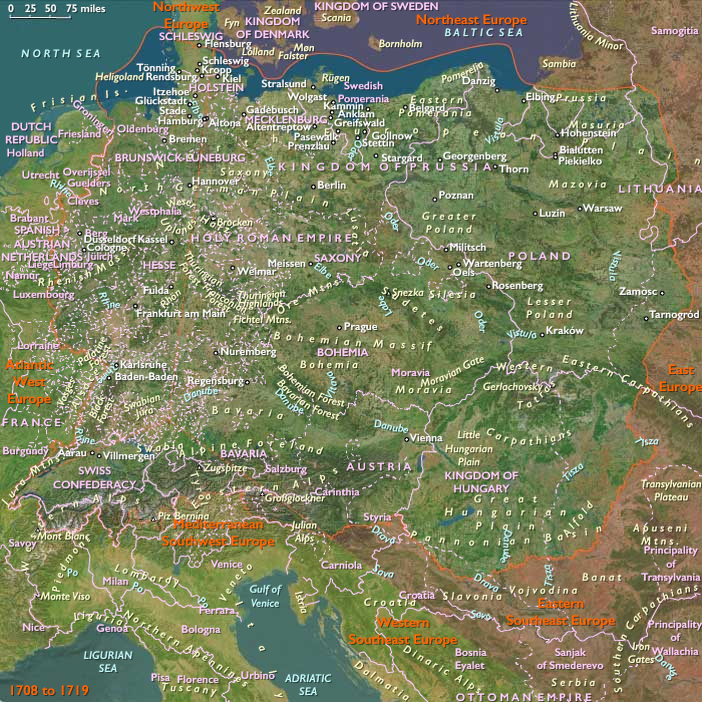
The Archduke Charles is proclaimed as the new Holy Roman Emperor, Charles VI, upon his return from Spain, where he had been the Austrian nominee for the Spanish throne during the War of the Spanish Succession.
His sister-in-law Wilhelmine Amalia of Brunswick-Lüneburg had become Empress of the Holy Roman Empire upon her husband Joseph's election as Emperor in 1705.
Wilhelmine had been widowed in 1711, and her mother-in-law had become the interim regent until her brother-in-law could return from Spain.
Wilhelmine is the youngest daughter of John Frederick, Duke of Brunswick-Lüneburg, and Benedicta Henrietta of the Palatinate.
Her two surviving sisters are Charlotte Felicitas, who had married the Duke of Modena, and Henriette Marie, who has never married.
Wilhelmine had been given a Catholic education by her great-aunt Louise Holladine at the convent of Maubuisson, and did not return to Hanover until she was twenty years old, in 1693.
The Holy Roman Empress Eleonor Magdalene of the Palatinate-Neuburg had decided early on that Wilhelmine Amalia would be her daughter-in-law.
As a result, she had married Eleonor's son, Archduke Joseph, the heir of Emperor Leopold I, on February 24, 1699.
The opera Hercule and Hebe by Reinhard Keiser (1674–1739) was performed at their wedding.
She Wilhelmina has borne her husband three children: Maria Josepha of Austria (December 8, 1699 – November 17, 1757); she will marry Augustus III ("the Saxon") Archduke Leopold Joseph of Austria (October 29, 1700 – August 4, 1701); Maria Amalia of Austria (October 22, 1701 – December 11, 1756); she will marry Charles VII, Holy Roman Emperor.
Wilhelmine Amalia is described as beautiful but also as religious and serious.
Her relationship with her husband was initially described as happy, but it had soon deteriorated.
Joseph had had a long line of mistresses, both servants and nobles, such as Dorothea Daun, and had sired several illegitimate children, but no surviving male heir with his spouse.
Joseph had contracted syphilis in 1704, and had given the disease to his wife.
It has been suggested that this condition was the reason for the failure of the Empress to produce more children after the birth of her second daughter.
Without male heirs, a crisis had developed with regard to the imperial succession.
Locations
People
Groups
Regions
Central Europe
View →Subregions
