
William I creates a royal forest in…
1079 CE
William I creates a royal forest in about 1079 for the royal hunt, mainly of deer.
Known as the New Forest, it is created at the expense of more than twenty small hamlets and isolated farmsteads; hence it is 'new' in William’s time as a single compact area.
Commodities
Subjects
Regions
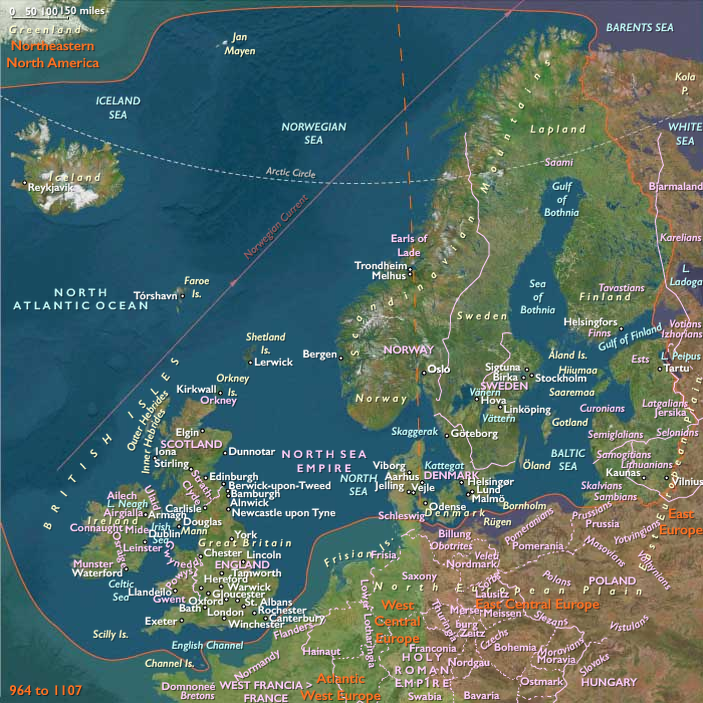
North Europe
View →Subregions
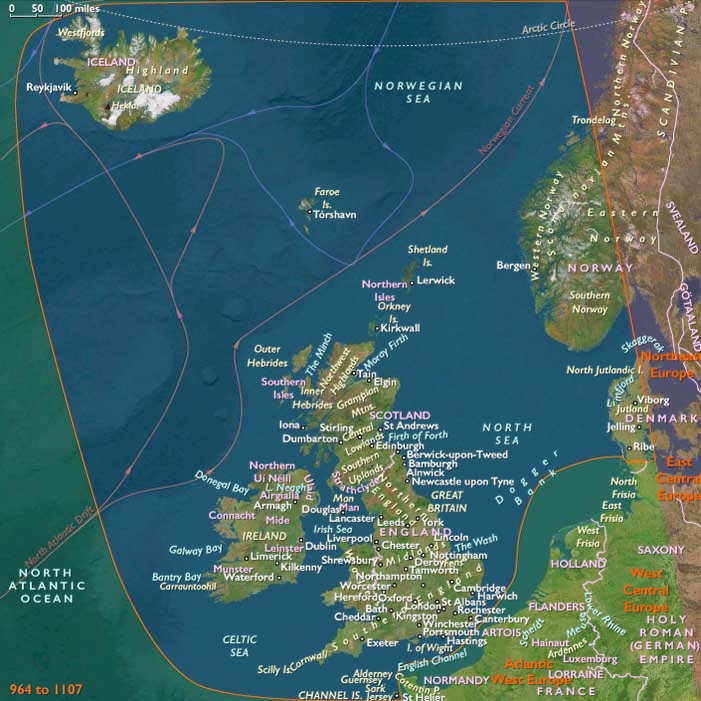
Northwest Europe
View →Related Events
No active filters.
Showing 10 events out of 50585 total
Thurong Kiet makes peace overtures to the Song; the Song commander Guo Kui agrees to withdraw his troops, but keeps five disputed regions of Quang Nguyen (renamed Shun'anzhou or Thuan Chau), Tu Lang Chau, Mon Chau, To Mau Chau, and Quang Lang.
These areas now comprise most of modern Vietnam's Cao Bang Province and Lạng Sơn Province.
Su Shi and his teacher Wen Tong, who dies in 1079, gain renown as masters of the special category of painting known as bamboo art.
Su Shi, a major poet and essayist, surpasses in importance his well-regarded younger brother, Su Zheh, and his equally celebrated father, Su Xun, both prose writers.
The innovative Su Shi rejects the prosodic conventions and limitations of the Tang poets, forming an influential literary circle that invents a new style of verse.
His own robust poetry is notable for its romantic expressionism.
An opponent to the political reforms of Wang Anshi, he is banished in 1079.
Not much is known about Sviatoslav's son Roman, nicknamed the Red.
Roman had replaced Gleb after the latter had been being sent to Novgorod, and had united with his brother Oleg and cousin Boris (a son of one of younger sons of Yaroslav the Wise) in the fight against their uncles Grand Princes Vsevolod and Iziaslav after the death of his father in 1076.
He had taken part at the battle of Nezhatina Niva, soon after which he is killed somewhere in the Kipchak steppes (Desht-i Qipchaq, or Cumania) on August 2, 1079.
The widowed Nikephoros now weds Mary, the wife of the deposed but still living Michael VII.
He names Michael's son Constantine as his successor but will later decide on one of his own nephews instead.
He relegates Constantine's fiancée (or wife), Guiscard's daughter, Helen, to a convent.
Zvonimir had come into a minor conflict with the one of the dukes from Istria (a vassal of emperor Henry II) who had been preparing for an attack on Croatia, in which the pope interferes in 1079 and settles the fray on behalf of Zvonimir.
Tangier falls to the Amoravids in 1079.
The Siege of Gerberoi and William the Conqueror’s Humiliation (January 1079)
By January 1079, William the Conqueror had grown increasingly frustrated with his rebellious eldest son, Robert Curthose, who, with the support of King Philip I of France, had fortified himself in Gerberoi Castle. Determined to crush the revolt, William launched a three-week siege of Gerberoi. However, in an unexpected counterattack, Robert’s forces routed the besiegers, and in the ensuing battle, Robert personally unhorsed his father, delivering William one of the most humiliating defeats of his reign.
The Siege of Gerberoi (January 1079)
- William’s besieging army set up camp around Gerberoi, aiming to starve the defenders into submission.
- The castle’s defenders, led by Robert Curthose and his knights, with French reinforcements, held firm against William’s forces.
- For three weeks, the Normans maintained the siege, but failed to breach the defenses.
The Counterattack and William’s Humiliation
- In a daring sally, Robert and his men launched a surprise attack on the Norman besiegers, catching them off guard.
- In the ensuing chaos, Robert encountered his father in battle and personally unhorsed him, knocking the King of England and Duke of Normandy to the ground.
- William was only saved from death by a loyal English knight, who intervened just in time.
Aftermath: William’s Rage and the End of the Siege
- Humiliated by his son’s victory, William cursed Robert, publicly disowning him in the heat of battle.
- He then abandoned the siege and retreated to Rouen, marking one of the few battlefield defeats in his career.
- This clash at Gerberoi proved Robert’s military capability, earning him respect among his allies in France and Flanders.
Consequences and Significance
- Robert’s victory at Gerberoi strengthened his position, proving that he could hold his own against his formidable father.
- The defeat weakened William’s authority, particularly among his continental vassals, showing that his rule over Normandy was not absolute.
- This father-son conflict would continue to divide the Norman dynasty, ultimately contributing to the eventual loss of Normandy to England’s enemies.
The Siege of Gerberoi (1079) marked one of the lowest points of William the Conqueror’s reign, demonstrating the growing rift between him and his eldest son, a conflict that would shape the fate of Normandy and England in the years to come.
Bishop Walkelin begins work on a completely new cathedral at Winchester in 1079.
Much of the limestone used to build the structure is brought across from the Isle of Wight from quarries around Binstead.
Nearby Quarr Abbey draws its name from these workings, as do many local places such as Stonelands and Stonepitts.
Godfred Corvan, an Icelandic-born Viking, has twice attempted the conquest of the Isle of Man, long under the control of the Dublin Norsemen.
The Isle of Man is part of a larger political entity called the Kingdom of the Sudreys, or Kingdom of the Isles, which consists of Mann and the Hebrides.
According to the Chronicles of Mann, Godred Crovan's father was "Harald the Black of Ysland" about whom nothing more is known.
Other sources suggest he may have been a brother or son of Ivar Haraldsson, who died in 1054.
King Godred Sitricson had died in 1070 and his throne had passed to his son Fingal, but he does not seem to have remained there long.
Godred Crovan had assembled a fleet and an army, probably of Norsemen from the Hebrides, and in 1079 attacks the island.
Repulsed, he soon returns for a second attempt.
and is again repulsed, but later in the same year Godred Crovan comes back a third time, and the chronicles are reasonably clear as to what happened next: Corvan and his Vikings defeated the Manxmen at the Battle of Skyhill, one and a half miles west of Ramsey.
It has been suggested that Fingal died at this battle, as he disappears from the record from this time, but the otherwise detailed account neglects to mention this.
The result of the battle is that the Manx submit to Godred’s rule and a sanctioned plundering of the island is carried out by his men.
The island is then divided between the north, for rule by the Manx, and the South, for rule by those from the Hebrides whom Godred had brought with him to the battle.
Despite Godred then moving on to a conquest of Dublin before returning to the Hebrides, he will retain rule of the island until his death in 1095.
His descendants will continue to rule the island for the next seventy-four years, until 1153.
Word of William's defeat at Gerberoi stirs up difficulties in northern England.
William, in failing to effect a royal peace north of the River Tees in Yorkshire, has inadvertently provided Scotland’s King Malcolm III Canmore with an excuse to invade England and control disputed areas; his troops in 1079 overrun Northumberland as far south as the Tyne.
King Malcolm III in August and September 1079 raids south of the River Tweed, devastating the land between the River Tees and the Tweed in a raid that lasts almost a month.