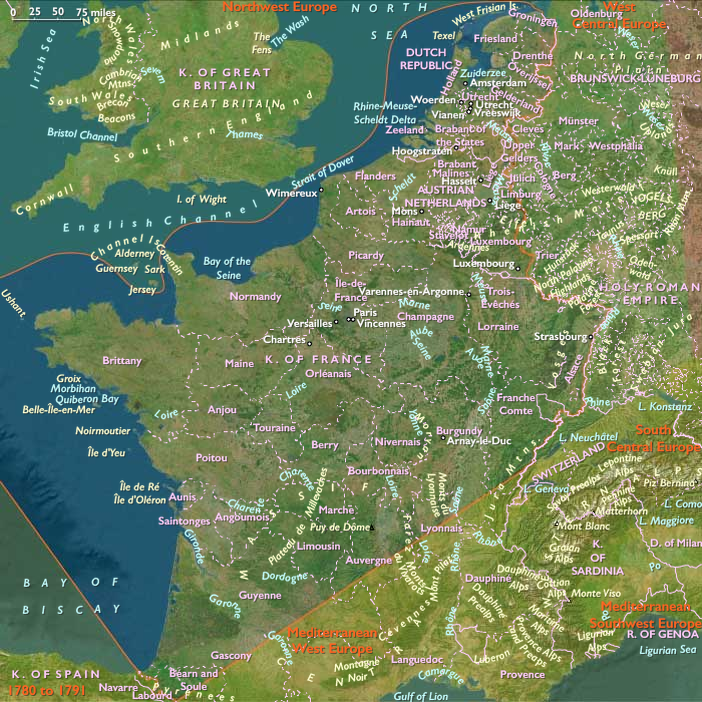
The Brabantine rebels recall the States-General, a…
January 1790 CE
Its fifty-three members, representing the states and social classes, meet in Brussels in January 1790 to begin negotiations.
The constitution eventually devised by the States-General is inspired by both the Dutch Verlatinge of 1581 and American Declaration of Independence of 1776.
Shortly afterward, the Articles of Confederation serve as a model for the Treaty of the United Belgian States of January 11, 1790.
The revolutionaries of Liège had established a republic, which joins the United Belgian States in a semblance of an alliance.
The United Belgian States is a confederal republic of eight provinces that have their own governments, are sovereign and independent, and are governed directly by the Sovereign Congress, the confederal government.
The Sovereign Congress is seated in Brussels and consists of representatives of each of the eight provinces.
The provinces of the republic are divided into 11 smaller separate territories, each with their own regional identities: Flanders, West Flanders, Brabant, Hainaut, The Tournaisis, Namur, Luxembourg, Liège, Limburg, Antwerp, and Mechelen.
The liberals are disgusted that members of society from beyond the guilds, clergy and nobility are not consulted.
They also see the closed sessions of the States-General as ridiculing the idea of popular sovereignty.
The declaration of the independence is not supported by Britain and the Dutch, who believe that the new independent state will not be able to act as an effective buffer against possible French territorial expansion in the region.
Groups
Papal States (Republic of St. Peter)
View →
Christians, Roman Catholic
View →
Austria, Archduchy of
View →
Holy Roman Empire
View →
Netherlands, United Provinces of the (Dutch Republic)
View →
Habsburg Monarchy, or Empire
View →
Britain, Kingdom of Great
View →
Netherlands, Southern (Austrian)
View →
United Belgian States
View →
Regions
West Europe
View →Subregions