
The Truce of Malestroit and the Fragmentation …
Years: 1343 - 1343
September
The Truce of Malestroit and the Fragmentation of the Montfortist Cause (1343–1346)
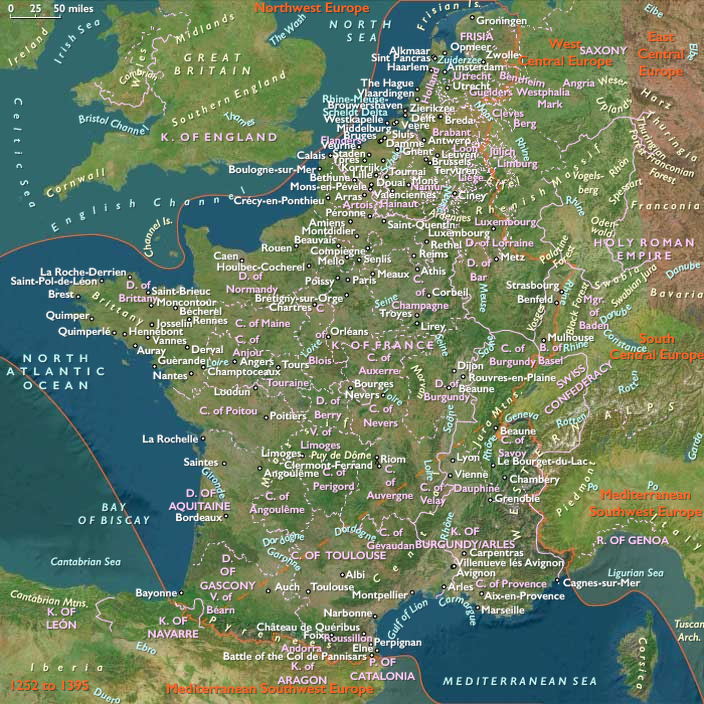
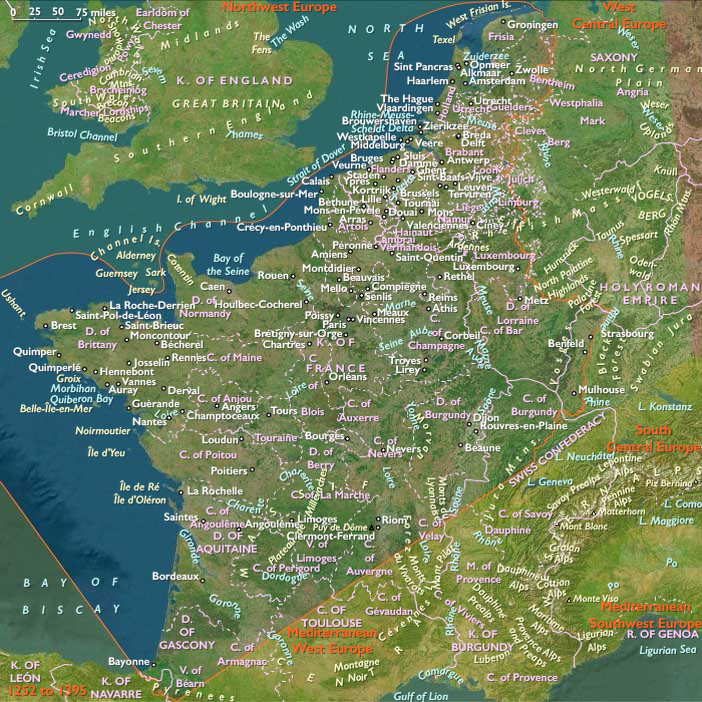
Although the Truce of Malestroit (January 1343) was intended to pause hostilities between England and France until September 29, 1346, it made little difference in Brittany, where Charles of Blois refused to recognize the agreement, claiming that he was fighting his own war rather than one directed by Philip VI of France. This allowed the French-backed forces to continue their attacks, ensuring that brutal small-scale warfare persisted despite the truce.
The Montfortist Cause in Crisis
With John of Montfort still imprisoned in Paris, his faction was in disarray:
- Montfortist-controlled areas were effectively administered from London, as neither Montfort nor his family could provide leadership.
- His wife, Joanna of Flanders, who had successfully resisted French forces in 1342, had recently gone mad, further destabilizing the movement.
- His son, John IV of Brittany, was still an infant, leaving the faction without a strong native leader.
- The Montfortist stronghold at Brest remained secure, backed by a large permanent English garrison, but outside the English-controlled coastal cities, Montfortist power was fading.
John of Montfort’s Release from Prison (September 1, 1343)
- On September 1, 1343, Montfort was released from prison in Paris after posting a massive bond and swearing to remain confined to his estates in eastern France.
- Though technically free, he was politically neutralized, unable to take direct action in Brittany without violating the terms of his release.
The Continuing Struggle in Brittany
- The English garrisons along the coast held firm, particularly at Brest, but elsewhere, the Montfortist movement was disintegrating.
- The Montfortists had some isolated successes, such as expelling the papal custodians from Vannes, but without a unifying leader, they were mostly reduced to begging for troops and money from London.
- Meanwhile, Charles of Blois, unrestrained by the truce, continued his offensives, further weakening the Montfortist position.
Conclusion: A Movement in Decline
Although the Truce of Malestroit was meant to stabilize the conflict, it had little impact in Brittany, where Charles of Blois refused to stop fighting. The Montfortist cause, deprived of leadership, crumbled, leaving only English-controlled garrisons as a bulwark against total defeat.
With John of Montfort neutralized in France, his faction was entirely dependent on English support, making Brittany a key proxy battleground in the ongoing Hundred Years’ War.
Locations
People
- Charles of Blois Châtillon
- Edward III of England
- Joan, Duchess of Brittany
- John of Montfort
- Philip VI of France
Groups
Topics
Commodoties
Subjects
Regions
Subregions
Related Events
Showing 10 events out of 44425 total
Years: 1343 - 1343
September
Locations
People
- Charles of Blois Châtillon
- Edward III of England
- Joan, Duchess of Brittany
- John of Montfort
- Philip VI of France
Groups
Topics
Commodoties
Subjects
Regions
Subregions