
Event
Forests had further expanded further and temperatures…
Forests had further expanded further and temperatures had risen, probably to levels similar to those today, with the ending of the most recent ice age around ten thousand years ago and the beginning of the Holocene era.
The rising sea levels caused by the melting glaciers by nine thousand five hundred years ago had cut Britain off from Ireland, and continental Europe is cut off for the last time by around 6500 to 6000 BCE.
The warmer climate has changed the Arctic environment to one of pine, birch, and alder forest; this more closed landscape is less conducive to the large herds of reindeer and wild horse that had previously sustained humans.
Those animals are replaced in people's diets by pig and less social animals such as elk, red deer, roe deer, wild boar and aurochs (wild cattle) which would have required different hunting techniques.
Tools change to incorporate barbs that can snag the flesh of an animal, making it harder for it to escape alive.
Tiny microliths are developed for hafting onto harpoons and spears.
Woodworking tools such as adzes appear in the archaeological record, although some flint blade types remain similar to their Paleolithic predecessors.
The dog is domesticated because of its benefits during hunting and the wetland environments created by the warmer weather would have been a rich source of fish and game.
It is likely that these environmental changes are accompanied by social changes.
Humans spread during this period and reach the far north of Scotland.
-
{# Image navigates to the detail page; the magnifying-glass chip is the only Fancybox lightbox trigger (kept a separate sibling — anchors can't nest). #}
 The North Atlantic Lands
World
-
{# Image navigates to the detail page; the magnifying-glass chip is the only Fancybox lightbox trigger (kept a separate sibling — anchors can't nest). #}
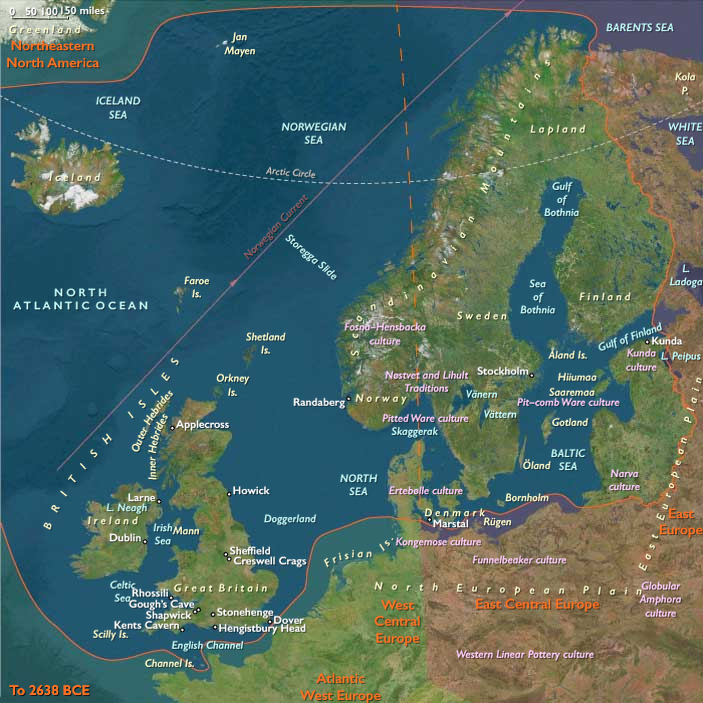 North Europe
Region
-
{# Image navigates to the detail page; the magnifying-glass chip is the only Fancybox lightbox trigger (kept a separate sibling — anchors can't nest). #}
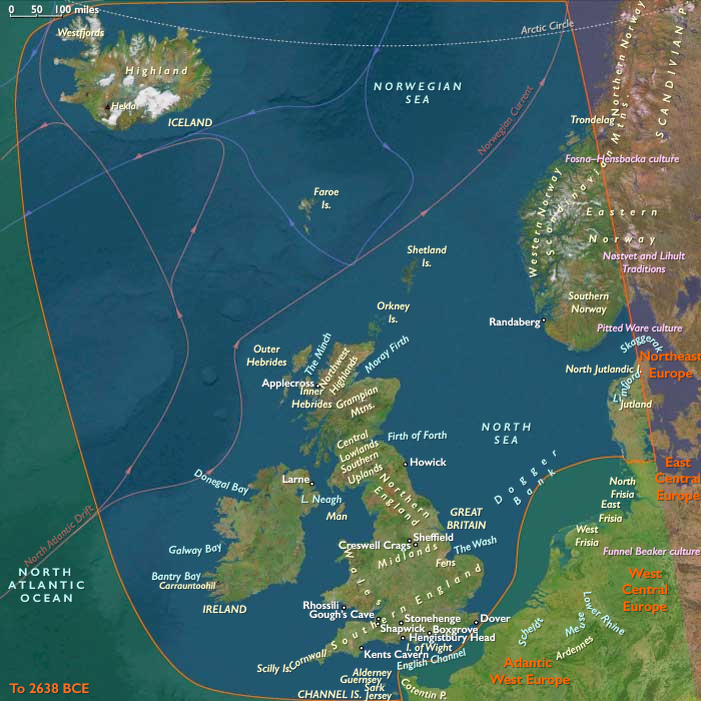 Northwest Europe
Subregion
