
Zeta (later to become known as Montenegro),…
1390 CE
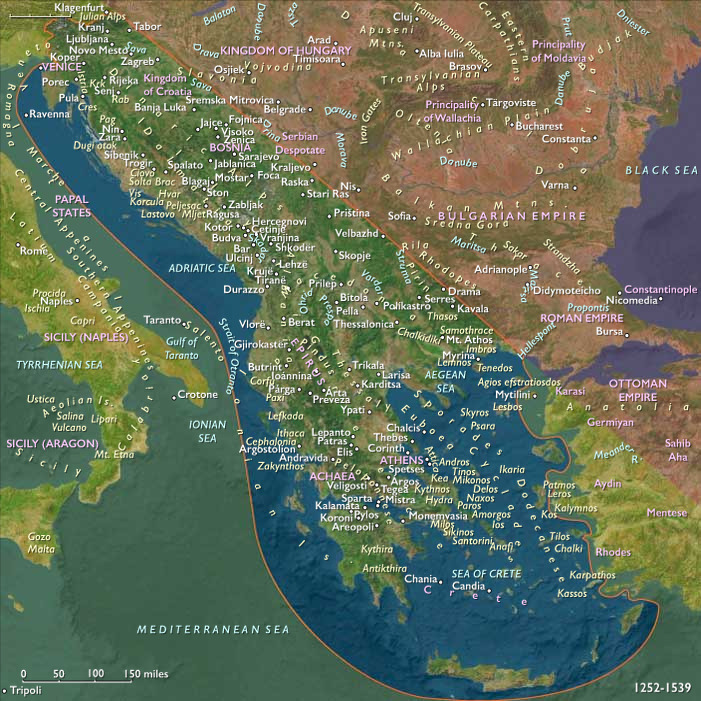
Zeta (later to become known as Montenegro), settled by Slavs in the seventh century CE and a part of Serbia since the twelfth century, achieves independence in 1389 after the conquest of Serbia by the Ottoman Turks.
Locations
Groups
Commodities
Subjects
Regions

Southeast Europe
View →Subregions
Western Southeast Europe
View →Related Events
No active filters.
Showing 10 events out of 43503 total
Chiang Mai’s ruler Saenmuengma leads troops south against Ayutthaya in 1390 with the ostensible mission of restoring Sukhothai’s independence.
Sukhothai’s King Sai Luethai (Thammaraja) II, anticipating a possible annexation of his kingdom by Chiang Mai, confronts and defeats Saenmuengma, who avoids capture by fleeing on the backs of two servants.
European paper milling has undergone a rapid improvement of many work processes from the mid-fourteenth century onward.
The first permanent paper mill north of the Alps is established in Nuremberg by Ulman Stromer in 1390; it will be depicted a century later in the lavishly illustrated Nuremberg Chronicle.
Bayezid, immediately after obtaining the Ottoman throne, had had his younger brother strangled to avoid a plot.
He has recognized Stefan Lazarević, the son of Lazar, as the new Serbian leader (later despot), with considerable autonomy.
Bayezid arranges additional marriage alliances, having in 1389 taken as his sixth wife a daughter of John V Palaiologos by his wife, Helena Kantakouzenos.
In 1390, he takes as his seventh wife Hafisa Khanum, daughter of Amir Fakhr ud-din 'Isa Bey, Amir of Aydin; as his eighth wife Karamanoglu Khanum; as his ninth wife Sultan Khanum, daughter of Amir Sulaiman Shah Suli Bey, Amir of Dulkadir; and as his tenth wife (at Krushevatch Jami) Princess Despina Maria Olivera Khanum (b.
1372), daughter of the slain Prince Lazar Hrebeljanovic of Serbia, by his wife, Queen Militza, née Bulco.
Each of these marriages to Balkan princesses brings Christian followers and advisers into the Ottoman court, and it is under their influence that Bayezid will abandon the simple nomadic courts and practices of his predecessors and isolate himself behind elaborate court hierarchies and ceremonies borrowed primarily from the Greeks, setting a pattern that will be continued by his successors.
However, Bayezid is unable to take advantage of his father's victory to achieve further European conquest; in fact, he is compelled to restore the defeated vassals and return to Anatolia.
This return is precipitated by the rising threat of the Turkmen principality of Karaman, created on the ruins of the Seljuq empire of Anatolia which had its capital at Konya.
Bayezid's predecessors had avoided forceful annexation of Turkmen territory in order to concentrate on Europe.
They had, however, expanded peacefully through marriage alliances and the purchase of territories.
The acquisition of territory in central Anatolia from the emirates of Hamid and Germiyan had brought the Ottomans into direct contact with Karaman for the first time.
Murad had been compelled to take some military action to prevent it from occupying his newly acquired Anatolian territories but then had turned back to Europe, leaving the unsolved problem to his successor son.
Karaman had willingly cooperated with Serbia in inciting opposition to Ottoman rule among Murad's vassals in both Europe and Anatolia.
This opposition strengthens the Balkan Union that had been routed by the Ottomans at Kosovo and stimulates a general revolt in Anatolia that Bayezid is forced to meet by an open attack as soon as he is able.
The city of Shiraz had been spared destruction by the invading Mongols, when its local ruler had offered tributes and submission to Genghis Khan.
Shiraz was again spared by Tamerlane, when in 1382 the local monarch, Shah Shuja, had agreed to submit to the invader.
In the thirteenth century, Shiraz became a leading center of the arts and letters, thanks to the encouragement of its ruler and the presence of many Persian scholars and artists.
For this reason the city was named by classical geographers Dar al-‘Elm, the House of Knowledge.
Among the Iranian poets, mystics and philosophers born in Shiraz are the poets Sa'di and Hafez and the mystic Roozbehan.
Thus Shiraz has been nicknamed "The Athens of Iran".
Mohammed Shams-ud-Din Hafez, Iran's great lyric poet, although orphaned early, had obtained a thorough education in the Islamic sciences—Hafez means one who has memorized the entire Koran.
Widely acclaimed in his own day, his lyrics, “ghazals,” are notable for their beauty and bring to fruition the erotic, mystical, and bacchic themes that have long pervaded Persian poetry.
He spends virtually his entire life in the city of Shiraz, dying there in about 1390.
Circassians from the North Caucasus region had become the majority in the Mamluk ranks by the late fourteenth century.
A revolt had broken out in 1377 in Syria and spread to Egypt, and the government had been taken over by the Circassians Barakah and Barquq; the last Bahri Sultan Al-Salih Hajji had been dethroned in 1382, thus ending the Bahri dynasty, and Barquq had been proclaimed sultan.
Barquq had been expelled in 1389 but in 1390 recaptures Cairo.
Permanently in power, he founds what came to be called the Burji dynasty.
Europe is meanwhile terrorized and Ottoman rule south of the Danube is assured; Bayezid's prestige in the Islamic world is so enhanced that he is given the title of sultan by the shadow 'Abbasid caliph of Cairo, despite the opposition of the caliph's Mamluk masters, who want to retain the title only for themselves.
The sultan has meanwhile begun unifying Anatolia under his rule.
Forcible expansion into Muslim territories could endanger the Ottoman relationship with the gazis, who are an important source of warriors for this ruling house on the European frontier, so Bayezid has begun the practice to first secure fatwas, or legal rulings from Islamic scholars, justifying their wars against these Muslim states.
However, he suspects the loyalty of his Muslim Turkmen followers, for Bayezid relies heavily on his Serbian and Greek vassal troops to perform these conquests.
In a single campaign over the summer and fall of 1390, Bayezid conquers the beyliks of Aydin, …
…Saruhan and …
…Menteşe.
His major rival Sulayman, the emir of Karaman, responds by allying himself with the ruler of Sivas, Kadi Burhan al-Din and the remaining Turkish beyliks.
Nevertheless, …
…Bayezid pushes on and in the fall and winter of 1390 overwhelms the remaining beyliks—Hamid, …
…Teke, and …